Band 5.5 IELTS Writing Task 1 Model Answer
Overall Band Score: 5.5 · Cambridge IELTS 14 · 2026-11-28
IELTS Writing Task 1 question
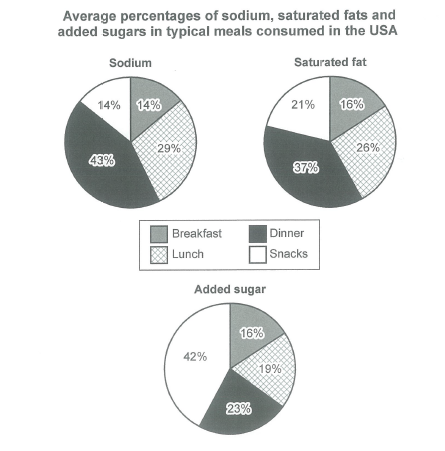
The charts below show the average percentages in typical meals of three types of nutrients, all of which may be unhealthy if eaten too much.
Summarize the information by selecting and reporting the main features, and make comparisons where relevant.
Student answer (Band 5.5)
The pie charts proportion the average percentages of threee types of nutrients, Sodium, Saturated fat and Added sugar in typical meals in Breakfast, Dinner , Lunch and Snacks consumed in the Usa, which may be unhealthy if eaten too much.
Overall, individual more adapt added suagr while having Snaks. While taking Dinner and lunch they consumed high sodium than the other two nutrients. During the brekfast consumed Saturated fat and Sugar has equal proportion.
While having a breakfast people consumed 14% of Sodium, similer percentage of saturated fat and added sugar consumed at 16 %. People taking 29% and 43% of Sodium was consumed in lunch and dinner which was highest proportion of sodium compare to other two nutrients. After that 26% and 37 % shared saturated fat during lunch and dinner respectively. Similerly number has decreased while taking added sugar was at 19% and 23% respectively.
Conversly, added suagar was highly taken during the snacks which was maximum at 42% compare to other nurients and least amout of saturated fat was taken during snaks and breakfast.
AI examiner evaluation
| Criterion | Band |
|---|---|
| Task Achievement / Task Response | 6.5 |
| Coherence and Cohesion | 6.0 |
| Lexical Resource | 5.0 |
| Grammatical Range and Accuracy | 5.0 |
| Overall | 5.5 |
Task Achievement / Task Response: Band 6.5
You identify the main contrasts: dinner has the highest sodium and saturated-fat shares, while snacks have the highest added-sugar share. Most figures you include match the chart, and the overview also notes the equal breakfast shares for saturated fat and sugar. This covers the key features and shows some comparison, supporting a strong response. However, the overview’s claim that people “more adapt added sugar” with snacks is unclear, and the final comparison does not give the snack figures for sodium or saturated fat. The statement that saturated fat is lowest in snacks and breakfast is also imprecise: breakfast is the lowest, but snacks are not. More precise overview wording and a fuller comparison of all meal categories would strengthen the report.
Coherence and Cohesion: Band 6.0
The response has a recognisable structure: an introduction, an overview, and two paragraphs of detail. The sequence from breakfast to lunch and dinner, followed by snacks, gives the reader a basic route through the data. However, progression is sometimes difficult to follow because several comparisons are compressed into awkward sentences, such as “People taking 29% and 43% of Sodium was consumed in lunch and dinner.” Linking words including “After that,” “Similarly,” and “Conversely” help signal relationships, but some are used mechanically or do not make the comparison fully clear. Organise the details more consistently by nutrient or meal, and use clear references to the figures being compared to make the progression smoother.
Lexical Resource: Band 5.0
You use relevant chart vocabulary, including “proportion,” “highest proportion,” “respectively,” and “consumed,” so the topic is generally understandable. However, the range and control are limited by repeated wording and noticeable spelling and word-choice errors. Examples include “threee,” “suagr,” “Snaks,” “similer,” and “nurients”; these make the writing look less controlled. Some phrases are also unnatural or unclear, particularly “individual more adapt added sugar” and “least amout of saturated fat was taken.” Choose standard reporting language such as “accounted for,” “share,” and “was highest,” and check spelling carefully. More precise vocabulary would help you describe the chart without relying repeatedly on “consumed” and “taken.”
Grammatical Range and Accuracy: Band 5.0
You attempt both simple and more extended sentence forms, and the overall meaning can usually be recovered. However, control is inconsistent, especially in sentences that combine figures and comparisons. For example, “People taking 29% and 43% of Sodium was consumed in lunch and dinner” has an unclear subject and faulty verb construction; “During the brekfast consumed Saturated fat and Sugar has equal proportion” also lacks a clear grammatical subject and uses an unsuitable verb form. Articles, sentence boundaries, and punctuation are not consistently controlled, as seen in the opening sentence and the comma before “which.” Build comparisons with a clear subject and verb—for example, “Sodium accounted for 29% at lunch and 43% at dinner”—and proofread each sentence for agreement and completeness.
See this exact question answered at other band scores. The same prompt compared across bands.
Browse more IELTS Writing model answers or get your own writing scored by the same AI examiner.