Band 5.5 IELTS Writing Task 1 Model Answer
Overall Band Score: 5.5 · Cambridge IELTS 14 · 2026-11-28
IELTS Writing Task 1 question
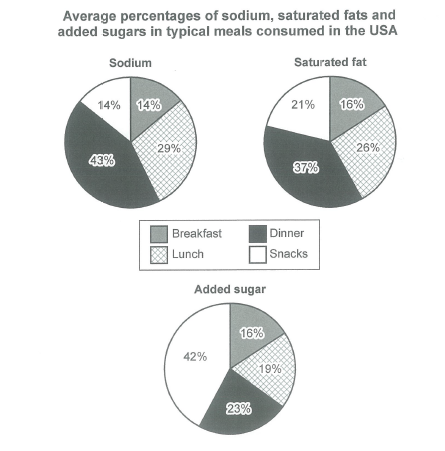
The charts below show the average percentages in typical meals of three types of nutrients, all of which may be unhealthy if eaten too much.
Summarize the information by selecting and reporting the main features, and make comparisons where relevant.
Student answer (Band 5.5)
The pie charts represent the average percentages in typical meals of three types of nutrients, in which all these unwell if we consumed excessive.
Overall, the percentage of sodium and saturated fat are consumed higher in dinner and relatively in percentage. In contrast, breakfast are considerd unhealthy nutrients.
At sodium and saturated fat dinner is the main contribute in sodium the dinner percentage is 43% and in saturated fat is 37%. Lunch is second source making up 29% of sodium and 26% of saturated fat. Meanwhile, snacks contribute 21% to saturated fat and 14% to the sodium.
When it comes to added sugar snacks are the largest source of 42%. The sugar consumed in dinner is 23% and 19% in lunch.
Finally, the breakfast shows the lowest figure cross all categories 14% of sodium, 16% of saturated fat and 16% of added sugar.
AI examiner evaluation
| Criterion | Band |
|---|---|
| Task Achievement / Task Response | 6.0 |
| Coherence and Cohesion | 6.0 |
| Lexical Resource | 5.0 |
| Grammatical Range and Accuracy | 5.0 |
| Overall | 5.5 |
Task Achievement / Task Response: Band 6.0
You identify the main contrasts accurately: dinner has the highest shares of sodium (43%) and saturated fat (37%), while snacks lead for added sugar (42%). You also include several relevant figures and an overview. However, the overview’s claim that breakfast is “unhealthy” is unclear and does not describe the chart’s main pattern; breakfast is generally the lowest or joint-lowest category. The added-sugar comparison is less fully developed than the other two nutrients, and the response is 18 words below the 150-word minimum (the 11 words copied from the task prompt are excluded). To strengthen the report, state the key overall contrasts clearly and add a little more comparison across all four meal types.
Coherence and Cohesion: Band 6.0
The response has a recognisable structure: an introduction, an overview, and paragraphs describing the nutrient figures. This makes the information reasonably easy to follow, and transitions such as “Meanwhile,” “When it comes to,” and “Finally” help signal changes in focus. However, some links are awkward or unclear, particularly “At sodium and saturated fat dinner is the main contribute,” which makes the relationship between the meal and the figures difficult to process. The overview also does not lead cleanly into the detailed comparisons. Group the information consistently—for example, compare dinner and lunch for sodium and saturated fat, then contrast these with snacks for sugar—and use clearer sentence links rather than relying mainly on transition phrases.
Lexical Resource: Band 5.0
You use relevant chart vocabulary, including “percentage,” “source,” “largest,” and “lowest figure,” and the reader can generally identify the meals and nutrients being compared. However, several word choices and collocations are inaccurate or unclear, such as “all these unwell,” “main contribute,” and “the breakfast shows.” “Relatively in percentage” also does not express a clear comparison. These errors make parts of the report less natural and occasionally obscure the intended meaning. Aim for precise reporting language such as “accounted for,” “contributed,” and “the lowest proportion,” and check word forms and spelling, including “considered.” A broader set of accurate comparison phrases would help you describe the data more flexibly.
Grammatical Range and Accuracy: Band 5.0
You attempt both simple statements and longer sentences, and most figures can be understood despite some grammatical errors. However, errors in agreement and sentence construction are evident in “breakfast are considerd” and “dinner is the main contribute in sodium.” The opening phrase “in which all these unwell if we consumed excessive” is also incomplete and does not form a clear grammatical clause. Articles and prepositions need attention in phrases such as “At sodium and saturated fat.” To improve, build complete sentences around a clear subject and verb, check singular/plural agreement, and use a reliable pattern such as “Dinner accounts for 43% of sodium intake.” More accurate complex sentences would make the comparisons easier to follow.
See this exact question answered at other band scores. The same prompt compared across bands.
Browse more IELTS Writing model answers or get your own writing scored by the same AI examiner.