Band 5.0 IELTS Writing Task 1 Model Answer
Overall Band Score: 5.0 · Cambridge IELTS 14 · 2026-11-28
IELTS Writing Task 1 question
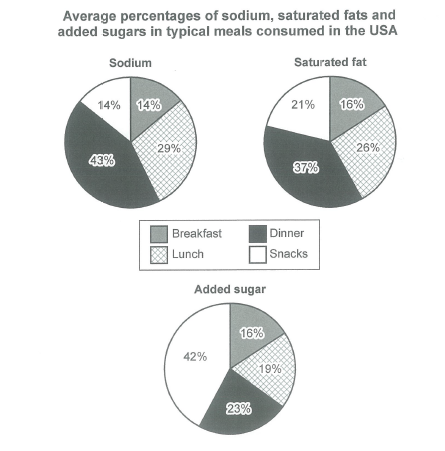
The charts below show the average percentages in typical meals of three types of nutrients, all of which may be unhealthy if eaten too much.
Summarize the information by selecting and reporting the main features, and make comparisons where relevant.
Student answer (Band 5.0)
The pie charts illustrate the average percentages the three types of meals and nutrients, it may unlhealthy to eat too much. Average of percantages of sodium, saturated fats and added sugars in typical meals consumed in the USA.
Overall, the Dinner which acounted for the far most in the all pie charts. While, the lowest category ever found in these pie chart it is the Breakfast, snacks and lauch were show stable and slightly fluctivational.
In these pie charts which is the highest catagory is Dinner accounted for 43% in sodium and at the end in Added sugar their the ratio sharply decrease at 23%. Similarly, the snacks which has aviable in high amount in the added sugar 42% but in the sodium and saturated fat campare to each other so Saturated fat higher than the sodium 7percentage.
Breakfast which is stable and remain calm in the all the pie chart accounted in the sodium at 14% less than the saturated fat atleast 2percantage. Although in the added sugar were samilar. Consequently in the snacks ever found the value of the sodium at 14% but as campare to the saturated fat its aviable in the snacks 16% the last which accounted 42%.
AI examiner evaluation
| Criterion | Band |
|---|---|
| Task Achievement / Task Response | 5.5 |
| Coherence and Cohesion | 4.5 |
| Lexical Resource | 5.0 |
| Grammatical Range and Accuracy | 4.5 |
| Overall | 5.0 |
Task Achievement / Task Response: Band 5.5
You identify several important features, especially dinner’s 43% share of sodium and snacks’ 42% share of added sugar, and you attempt an overall comparison. However, the overview is not fully accurate: dinner is not the largest category in every chart, because snacks lead for added sugar, and breakfast is not consistently the lowest, since snacks are lower for sodium. Some comparisons are also unclear or incorrect; for example, saturated fat in snacks is 21%, not 16%, and the claim that dinner’s added-sugar figure “sharply decrease[s]” is not clearly framed against another meal. To strengthen the response, state the main contrasts accurately and compare all three nutrients more systematically.
Coherence and Cohesion: Band 4.5
The response has an attempted introduction, overview and detail paragraphs, so there is some basic organisation. However, the progression is difficult to follow because comparisons shift between meals and nutrients without a clear pattern. Phrases such as “Similarly” and “Consequently” do not always show the relationship between the information that follows, while “at the end” and “the last” leave the reference unclear. The final paragraph also repeats the snack figures rather than developing a distinct comparison. Grouping the details by nutrient or by meal, and using clear links such as “By contrast” and “Meanwhile,” would make the report easier to follow.
Lexical Resource: Band 5.0
You use some task-relevant vocabulary, including “accounted for,” “percentage,” “saturated fat” and “added sugar,” and you attempt to describe comparisons with words such as “higher” and “decrease.” However, the range is limited and several word choices or collocations make the meaning difficult to understand. For example, “stable and slightly fluctivational” is unclear, and “the far most” is not a natural way to describe the largest share. Spelling errors such as “percantages,” “catagory” and “aviable” are also noticeable. Aim for precise chart language and check spelling; this will help readers understand your comparisons without having to infer your meaning.
Grammatical Range and Accuracy: Band 4.5
You attempt both simple and longer sentences, including clauses beginning with “While” and “Although,” but many are incomplete or inaccurately formed. For instance, “While, the lowest category ever found…” is a fragment, and “the Dinner which acounted for the far most” lacks a complete, well-formed clause. Errors in articles, agreement and sentence construction recur, as in “the three types of meals and nutrients” and “the snacks which has.” Punctuation also creates run-on or disconnected ideas. Practise writing complete subject–verb sentences first, then add one comparison clause at a time, checking that each sentence has a clear main clause and that verbs agree with their subjects.
See this exact question answered at other band scores. The same prompt compared across bands.
Browse more IELTS Writing model answers or get your own writing scored by the same AI examiner.