Band 6.0 IELTS Writing Task 1 Model Answer
Overall Band Score: 6.0 · Cambridge IELTS 14 · 2026-11-10
IELTS Writing Task 1 question
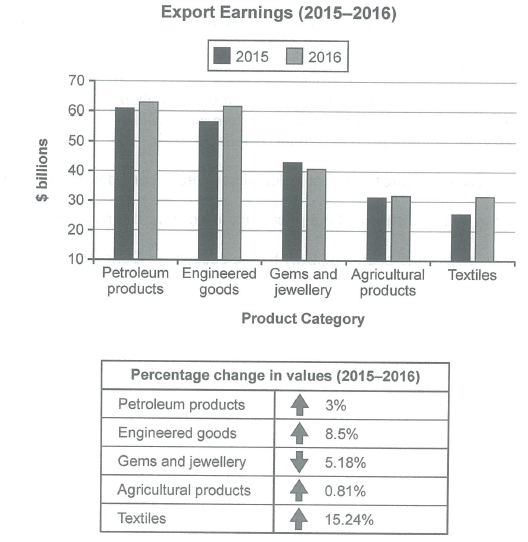
The chart below shows the value of one country’s exports in various categories during 2015 and 2016. The table shows the percentage change in each category of exports in 2016 compared with 2015.
Summarise the information by selecting and reporting the main features, and make comparisons where relevant.
Student answer (Band 6.0)
The given chart illustrates the value of one country's export in various category from 2015 to 2016 and the percentage change in each category of exports in 2016 compared with 2015.
Overall, an export earings from petroleum products was the highest in both the years and its value also increased by 3% in 2016, whereas earings from export of textiles was the least in 2015 which increase by 15.24% in 2016.
In the years 2015 and 2016, petroleum products and engineered goods were most favoured by people and had the maximum export earnings which was $ 61 billion and $ 56 billion which rose to $ 63 billion and $ 62 billion in 2016, while the percentage change in petroleum products was 3 whereas it was 8.5% in engineered goods. The ratio of germs and jewellery products decreased by 5.18 which was $ 41 billion in 2016 and $ 43 billion in 2015.
Export earnings from the textile products was $ 25 billion and $ 31 billion in the years 2015 and 2016 and its percentage is increased by 15.24. The percentage change in the agricultural products was minimum ( 0.81) and the remained almost same in both years approximately $ 32 billion.
AI examiner evaluation
| Criterion | Band |
|---|---|
| Task Achievement / Task Response | 6.5 |
| Coherence and Cohesion | 5.5 |
| Lexical Resource | 6.0 |
| Grammatical Range and Accuracy | 5.5 |
| Overall | 6.0 |
Task Achievement / Task Response: Band 6.5
You address the main features and provide a clear overview: petroleum products earned the most in both years, while textiles had the strongest percentage increase. Most reported trends match the chart, including the fall in gems and jewellery and the near-stability of agriculture. The response also includes useful comparisons and figures. However, the overview says textiles were the least-earning category without specifying that this was true only in 2015; in 2016, textiles and agriculture were approximately equal. The engineered-goods figure for 2015 is given as $56 billion rather than about $57 billion, and the claim that these products were “most favoured by people” is not supported by export data. More precise, fully chart-based reporting would strengthen the response.
Coherence and Cohesion: Band 5.5
The response has a recognisable structure, with an introduction, an overview and two detail paragraphs. Grouping the higher-earning categories together and then discussing the remaining categories gives the reader a useful starting point. However, progression within the detail paragraphs is not always smooth: the first body paragraph moves from petroleum and engineered goods to gems, while the final paragraph returns to textiles and agriculture without a clear comparison linking them. Some connections are also awkward or unclear, such as “whereas the earnings from export of textiles was the least” and “and the remained almost same.” Use clearer topic sentences and comparison signals, and make each paragraph’s grouping explicit to improve the overall flow.
Lexical Resource: Band 6.0
You use a reasonable range of task-related vocabulary, including “export earnings,” “percentage change,” “decreased,” and “approximately,” and the meaning is generally clear. There are, however, several inaccurate or unnatural choices that limit precision. “Most favoured by people” suggests consumer preference, which the chart does not show; “germs and jewellery” is an incorrect form of “gems and jewellery”; and “the ratio of … products” is not suitable for describing earnings. Spelling errors such as “earings” also recur. Aim for accurate collocations and consistent terms such as “category,” “earnings,” and “rose/fell,” rather than using expressions that imply information beyond the chart.
Grammatical Range and Accuracy: Band 5.5
You attempt both simple and more complex sentences, including comparisons joined with “whereas” and “while,” and the main trends can usually be understood. Some grammatical errors remain, particularly with agreement, articles and sentence construction. For example, “an export earings … was” has mismatched number and agreement, while “the textile products was” should use a plural verb. The clause “which increase by 15.24%” also needs a past-tense form, and “the remained almost same” is not a complete grammatical construction. Several long sentences combine multiple comparisons, making these errors more noticeable. Check subject–verb agreement and tense, and divide complex comparisons into shorter, controlled sentences.
See this exact question answered at other band scores. The same prompt compared across bands.
Browse more IELTS Writing model answers or get your own writing scored by the same AI examiner.