Band 5.5 IELTS Writing Task 1 Model Answer
Overall Band Score: 5.5 · Cambridge IELTS 14 · 2026-11-10
IELTS Writing Task 1 question
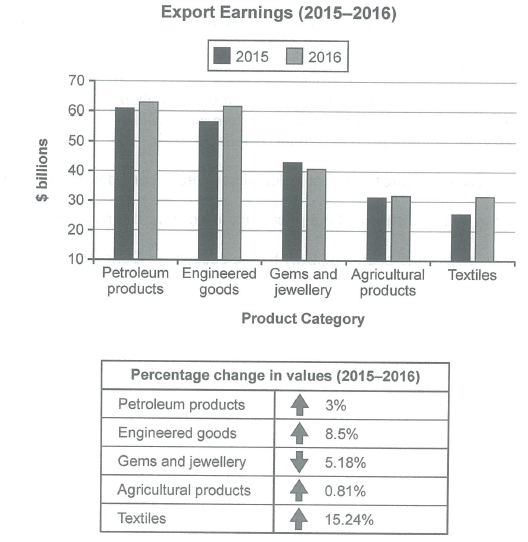
The chart below shows the value of one country’s exports in various categories during 2015 and 2016. The table shows the percentage change in each category of exports in 2016 compared with 2015.
Summarise the information by selecting and reporting the main features, and make comparisons where relevant.
Student answer (Band 5.5)
the given chart represents the resource of single country supply in significant categories in the period of time between 2015 to 2016 . the graph shows the percentage change in each product of exports in 2016 in the comparison of 2015.
overall, what stand out from the given representation is that, the textiles and engineered goods is the most exporting product and the agricultural products and petroleum products are the least numerous products
looking at the details, the value of textiles is the most demanding product which is increace with 15.24% in 2016 beside that engineered goods is the second most exporting resource by the rise of 8.5% from 2015 .
however, many resources had face problem of less exporting numbers , firstly gems and jewellery with the decreasing value of 5.18% . moreover there is agricultural products with the slight changes of 0.81% in 2016 . finally in the end there is petroleum products with gental growth of 3% in the 2016 with the comparison of 2015.
AI examiner evaluation
| Criterion | Band |
|---|---|
| Task Achievement / Task Response | 5.0 |
| Coherence and Cohesion | 5.5 |
| Lexical Resource | 5.5 |
| Grammatical Range and Accuracy | 5.0 |
| Overall | 5.5 |
Task Achievement / Task Response: Band 5.0
You identify several relevant changes, including the rise in textiles and engineered goods and the fall in gems and jewellery, and you include the table’s percentage figures accurately. However, the overview misidentifies the leading and lowest export categories: petroleum products, not textiles or engineered goods, had the highest values, while textiles were not among the lowest in 2016. The response also focuses mainly on percentage changes and does not clearly summarise the chart’s export values or compare the categories across both years. Some descriptions, such as agricultural products having “slight changes,” are vague. To improve, give an accurate overview of the main value rankings and trends, then support it with a few key figures from the chart as well as the table.
Coherence and Cohesion: Band 5.5
The response has a basic paragraph structure: an introduction, an overview, and two paragraphs of details. This gives the reader some organisation, and transitions such as “however,” “moreover,” and “finally” signal movement between points. However, the progression is not consistently logical. The overview’s claim about the highest and lowest categories conflicts with the later details, and the final paragraph groups categories without a clear comparison of their values. Some linking phrases are mechanical or awkward, particularly “finally in the end.” Organise the body around clear comparisons—for example, categories that rose versus the one that fell—and use references that make each comparison easy to follow.
Lexical Resource: Band 5.5
You use some task-related vocabulary, including “percentage change,” “decreasing value,” and “growth,” so the reader can generally understand the topic. However, the range is limited and several word choices or collocations are inaccurate, making parts of the report unclear. For example, “the most demanding product” does not describe export value, and “resource of single country supply” is not a natural way to introduce the chart. There are also noticeable spelling errors, such as “increace” and “gental.” Aim for precise chart language and check spelling: terms such as “export earnings,” “recorded,” “rose,” and “declined” would communicate the data more naturally.
Grammatical Range and Accuracy: Band 5.0
You attempt both simple and more extended sentences, and the main topic is usually understandable. However, grammatical errors occur frequently and sometimes make relationships between ideas difficult to follow. Examples include “the textiles and engineered goods is,” where the plural subject needs a plural verb, and “many resources had face problem,” which has an incorrect verb form and article use. The opening sentence also has unclear sentence construction, while punctuation and spacing around commas and full stops are inconsistent. Practise accurate subject–verb agreement, past-tense reporting forms, and complete sentence patterns. Shorter, controlled sentences would help you present comparisons clearly before you attempt more complex structures.
See this exact question answered at other band scores. The same prompt compared across bands.
Browse more IELTS Writing model answers or get your own writing scored by the same AI examiner.