Band 6.5 IELTS Writing Task 1 Model Answer
Overall Band Score: 6.5 · Cambridge IELTS 14 · 2026-11-16
IELTS Writing Task 1 question
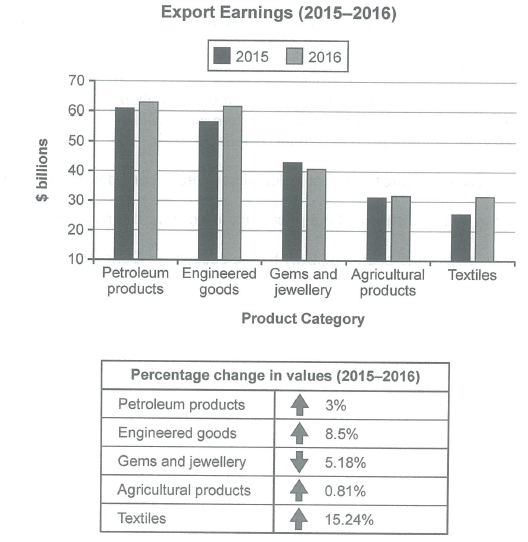
The chart below shows the value of one country’s exports in various categories during 2015 and 2016. The table shows the percentage change in each category of exports in 2016 compared with 2015.
Summarise the information by selecting and reporting the main features, and make comparisons where relevant.
Student answer (Band 6.5)
The bar chart illustrates a nation's export earnings in petroleum products, engineered goods, gems and jwellery, agricultural products and textiles in 2015 and 2016. Unit of earnings is billion dollars. The table gives information about modification in earnings for all these aspects during this period.
Overall, petroleum products made the most profit for both years . Textiles made the least earning in 2015. In addition, profits made by agricultural products remained the same for both years. Textiles showed a significant increase in values while gems and jwellery faced a notable drop.
Financial outcome from petroleum products was almost 60 in 2015 and then rose to nearly 63 in 2016, showing a percentage increase of 3%. Engineered goods made the same earning as petroleum products in 2016. Export earnings from textiles increased from over 20 in 2015 to over 30 in 2016, showed that they made a remarkable progress( about 15.24%).
There is a minor percentage change for agricultural products(about 0.81%) which showed that earning from agricultural products remained persistent with above 30 for both periods. Furthermore, gems and jwellery was the only category that faced a loss in earnings(about 5.18%) from almost 43 in 2015 to above 40 in 2016.
AI examiner evaluation
| Criterion | Band |
|---|---|
| Task Achievement / Task Response | 7.0 |
| Coherence and Cohesion | 7.0 |
| Lexical Resource | 6.0 |
| Grammatical Range and Accuracy | 6.0 |
| Overall | 6.5 |
Task Achievement / Task Response: Band 7.0
You cover the main features and make relevant comparisons: petroleum products are identified as the leading category, textiles as the lowest in 2015 and the strongest growth, and gems and jewellery as the only category to decline. Most figures and trends are consistent with the chart, including the approximate petroleum and gems values and the reported percentage changes. The overview is clear, although saying agricultural earnings “remained the same” is slightly over-generalised: they rose marginally from about $31 billion to $31.5 billion, in line with the small positive change shown. The comparison that engineered goods matched petroleum in 2016 is useful, but the response would be stronger with more precise figures for engineered goods and a clearer account of the relative values across categories.
Coherence and Cohesion: Band 7.0
The response is organised into an introduction, an overview and two detail paragraphs, giving it a clear progression from the broad picture to category-specific information. Linking expressions such as “Overall,” “In addition,” “Furthermore” and “while” help signal relationships between points. The final paragraphs also group related trends sensibly, contrasting growth in textiles with the decline in gems and jewellery. Some connections are less smooth because several figures and interpretations are packed into long sentences, and “showed that” is used where a more direct link would be clearer. The overview could also distinguish the slight agricultural increase from genuinely unchanged earnings. More consistent grouping by highest values, growth and decline would make the comparisons easier to follow.
Lexical Resource: Band 6.0
You use an adequate range of task-related vocabulary, including “export earnings,” “percentage increase,” “significant increase” and “notable drop.” These choices communicate the main trends, and the response attempts more formal alternatives such as “financial outcome” and “remarkable progress.” However, some wording is imprecise or unnatural for describing chart data: “made the most profit” refers to profit rather than export earnings, while “modification in earnings” and “remained persistent” are awkward collocations. There are also spelling errors in “jwellery,” repeated several times. Aim for precise, natural terms such as “generated the highest export revenue,” “change in earnings” and “remained broadly stable.” This would improve accuracy and flexibility without requiring more elaborate vocabulary.
Grammatical Range and Accuracy: Band 6.0
You use a mix of simple and complex sentence forms, including contrast clauses such as “while gems and jwellery faced a notable drop” and a relative clause in “the only category that faced a loss.” Most sentences remain understandable, but some grammatical errors and punctuation issues persist. For example, “Export earnings from textiles increased …, showed that” incorrectly joins the clauses; use “showing that” or make this a separate sentence. “Gems and jwellery was” has a subject–verb agreement error, and “Unit of earnings is billion dollars” needs an article and a more complete grammatical form. Spacing before full stops and brackets is also inconsistent. Greater control of clause linking, agreement and articles would make the varied structures more accurate.
See this exact question answered at other band scores. The same prompt compared across bands.
Browse more IELTS Writing model answers or get your own writing scored by the same AI examiner.