Band 6.0 IELTS Writing Task 1 Model Answer
Overall Band Score: 6.0 · Cambridge IELTS 14 · 2026-11-17
IELTS Writing Task 1 question
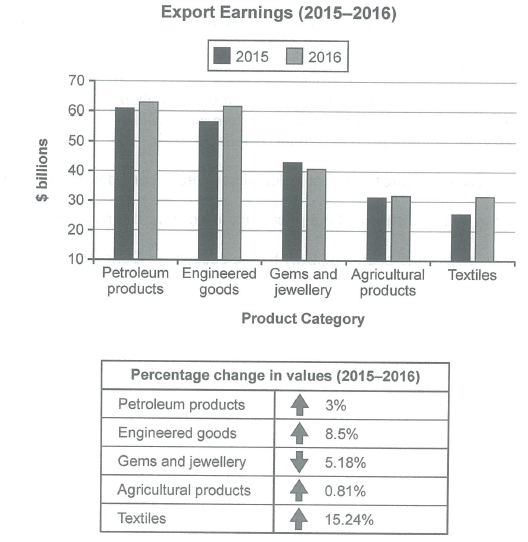
The chart below shows the value of one country’s exports in various categories during 2015 and 2016. The table shows the percentage change in each category of exports in 2016 compared with 2015.
Summarise the information by selecting and reporting the main features, and make comparisons where relevant.
Student answer (Band 6.0)
The bar chart display what one country's earning from exports products in 5 catagories, while the table illustrates how the exports catagories figure changed between 2015 and 2016.
Overall, the most of the earning came from petroleum products. In addition, while a significant number of percentage was growth from Textiles export, only germs and juwellery percentage was decreased over the period.
The accompanying bar chart illustrates that, a significant amount of earnings were came from exporting petroleum products with approximately 61 billions in 2015 and roughly 63 billions in 2016. In contrast, textlies export showed the lowest earning around 26 billions in 2015 and approximately 31 billions in 2016, which were very similar agricultural products in the same year.
Moving on to the changed parcentage, 15.24% of the textiles export showed a considerable increased over the years , while only 3% values came from petroleum products. However, a relatively declined partcentage experienced in germs and juwellery at 5.18%.
AI examiner evaluation
| Criterion | Band |
|---|---|
| Task Achievement / Task Response | 5.5 |
| Coherence and Cohesion | 6.5 |
| Lexical Resource | 5.5 |
| Grammatical Range and Accuracy | 5.5 |
| Overall | 6.0 |
Task Achievement / Task Response: Band 5.5
You identify the main overall pattern: petroleum products earned the most, textiles had the strongest percentage growth, and gems and jewellery was the only category to decline. The figures you give for petroleum and textiles are broadly consistent with the chart. However, coverage is incomplete: engineered goods are omitted, and agricultural products are mentioned only as similar to textiles in 2016, without reporting their near-stability or the table’s 0.81% rise. The overview also says “a significant number of percentage was growth,” which is unclear, and the comparison of textiles with agriculture does not explain their different starting values. Include the key figures and trends for all categories, and make the overview more precise.
Coherence and Cohesion: Band 6.5
The response has a clear four-part structure: introduction, overview, chart details and percentage changes. This gives the reader a generally logical route through the information, and transitions such as “Overall,” “In contrast” and “Moving on” help signal shifts. The progression is not fully developed, however: the final paragraph reports only three percentage changes, leaving the comparison incomplete, and the link between textiles and agricultural products is awkwardly expressed in “which were very similar agricultural products.” Some linking phrases also feel formulaic rather than helping clarify relationships. Grouping the categories by trend—for example, increases, stability and decline—and using clearer comparisons would make the organisation more complete and cohesive.
Lexical Resource: Band 5.5
You use some task-relevant vocabulary, including “exports,” “earnings,” “approximately,” “in contrast” and “declined,” and the intended meaning is usually recoverable. However, spelling and word-choice errors are noticeable, including “catagories,” “textlies,” “germs,” “juwellery” and “parcentage.” Several combinations are also unnatural: “a significant number of percentage was growth,” “earnings were came from,” and “a considerable increased.” These errors reduce precision, particularly when describing the table. Aim for accurate forms such as “export categories,” “percentage increase,” and “earnings came from,” and use a consistent range of reporting verbs such as “rose,” “fell” and “remained stable.”
Grammatical Range and Accuracy: Band 5.5
You attempt both simple and more complex sentences, including a contrast clause beginning “while” and a sentence comparing the two years. However, errors in verb forms, agreement and sentence construction are frequent enough to make some statements difficult to follow. For example, “the bar chart display” needs subject–verb agreement, while “earnings were came from” combines incompatible verb forms. The phrase “which were very similar agricultural products” lacks a clear grammatical relationship, and “a considerable increased” uses an incorrect form after the article. Work on building accurate basic clauses first, then add subordinate clauses. Check agreement, verb forms and punctuation, especially in longer sentences.
See this exact question answered at other band scores. The same prompt compared across bands.
Browse more IELTS Writing model answers or get your own writing scored by the same AI examiner.