Band 6.0 IELTS Writing Task 1 Model Answer
Overall Band Score: 6.0 · Cambridge IELTS 14 · 2026-11-25
IELTS Writing Task 1 question
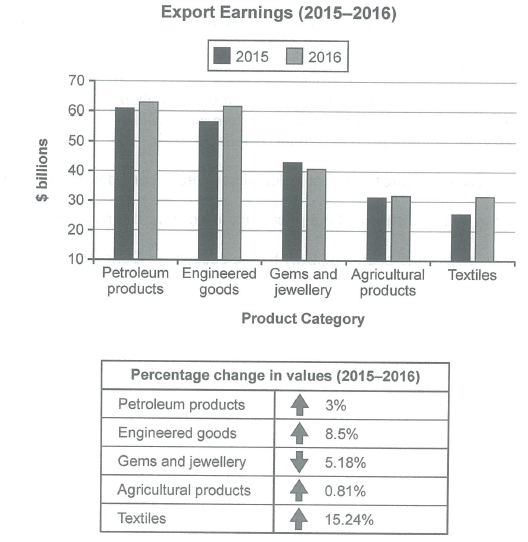
The chart below shows the value of one country’s exports in various categories during 2015 and 2016. The table shows the percentage change in each category of exports in 2016 compared with 2015.
Summarise the information by selecting and reporting the main features, and make comparisons where relevant.
Student answer (Band 6.0)
THE CHART ILLUSTRATES THE EXPORT INCOME OF A COUNTRY IN 5 INDUSTRIES, PETROLEUM PRODUCTS,ENGINEERED GOODS,GEMS AND JEWELLERY, AGRICULTURE AND TEXTILES IN 2015 AND 2016. WHILE THE TABLE SHOWS THE PERCENTAGE CHANGE IN EACH EXPORT CATEGORY IN 2016 COMPARED WITH 2015.
OVERALL, EXPORT OF PETROLEUM PRODUCTS AND ENGINEERING GOODS WAS HIGH IN BOTH YEARS WITH SLIGHT RISE IN 2016. BY CONTRAST EARNING FROM REMANING 3 INDUSTRIES WAS ON LOWER SIDE. COMPARED TO 2015 IN 2016 EXPORT PERCENTAGE EARNING OF 4 NDUSTRIES INCREASED EXCEPT GEMS AND JEWELLERY.
IN 2016 COUNTRY EARNED ABOVE 60 BILLION $ FROM PETROLEUM AND ENGINEERED GOODS AND PERCENTAGE CHANGE FOR BOTH PRODUCTS WAS 3% AND 8.5% RESPECTIVELY IN YEAR 2016 COMPARED WITH 2015. WHILE IN 2015 THE FIGURE WAS 60 BILLIONS $ FOR PETROLEUM AND 56 BILLION $ FOR ENGINEERED GOODS.
REGARDING EXPORT OF GEMS AND JEWELLERY IN THE YEAR 2015 ABOVE 40 BILLION $ WAS EARNED WHILE 40 BILLION $ IN 2016 RESULTING IN THE DECREASE IN PERCENTAGE OF EARNING BY 5.18%. FURTHERMORE IN CONTEXT OF AGRICULTURAL PRODUCTS COUNTRY EARNED 31 BILLION $ IN 2015 AND 31.5 BILLION $ IN 2016 WITH PERCENTAGE CHANGE OF ONLY 0.18%. ON THE OTHER HAND IN TEXTILE INDUSTRY INCOME WAS ALMOST 25 BILLION $ IN 2015 THAT ROSE TO 32 BILLION $ IN 2016 WITH HIGHEST OF ALL THE PERCENTAGE CHANGE OF 15.24% AMONG RESTS.
AI examiner evaluation
| Criterion | Band |
|---|---|
| Task Achievement / Task Response | 6.5 |
| Coherence and Cohesion | 6.5 |
| Lexical Resource | 6.0 |
| Grammatical Range and Accuracy | 5.5 |
| Overall | 6.0 |
Task Achievement / Task Response: Band 6.5
You cover the main categories and provide a clear overview: petroleum and engineered goods earned the most, while gems and jewellery declined and the other categories rose. Several comparisons are supported with figures, including the high 2016 values for petroleum and engineered goods and the strong growth in textiles. This gives the response a solid account of the chart and table. However, one table figure is misreported: agricultural products rose by 0.81%, not 0.18%. The overview also says the remaining three industries were “on lower side,” which is vague, and the comparison of category values could be more precise. To strengthen the response, check each percentage against the table and make the overview identify the largest and smallest changes more clearly.
Coherence and Cohesion: Band 6.5
The response has a recognisable structure: an introduction, an overview, and two paragraphs grouping the higher-earning categories and the remaining categories. This makes the information generally easy to follow, and transitions such as “By contrast,” “Furthermore,” and “On the other hand” help signal comparisons. The progression is not always smooth, however. The overview’s reference to “remaining 3 industries” is unclear, and the final paragraph moves from gems to agriculture and then textiles without a particularly clear grouping principle. Some linking phrases also make relationships feel mechanical rather than precise. For stronger progression, organise the details consistently—for example, discuss the two leading categories together, then the three lower-value categories—and use references that clearly identify each category.
Lexical Resource: Band 6.0
You use a reasonable range of task-related vocabulary, including “export income,” “percentage change,” “resulting in the decrease,” and “rose to,” so the main trends are usually understandable. There are also attempts at more formal reporting language. However, several choices are inaccurate or unnatural, such as “earning … was on lower side,” “percentage earning,” and “highest of all the percentage change … among rests.” Spelling and word-form problems, including “remanिंग” (intended as “remaining”) and “NDUSTRIES,” also reduce precision. These issues do not prevent the reader from understanding the comparisons, but more accurate collocations and consistent spelling would make the report more fluent and appropriately formal.
Grammatical Range and Accuracy: Band 5.5
You attempt both simple and more complex sentence forms, including a contrast clause beginning “While the table shows…” and a result construction with “resulting in.” Most of the intended comparisons can be understood, but some grammatical errors remain. For example, “export … was high” does not agree naturally with the plural categories, and “the figure was 60 billions $” has problems with number and noun form. The opening is also written as a fragment after “While,” rather than as a complete sentence. Punctuation and sentence boundaries are inconsistent, particularly where long sentences join several comparisons. Aim to produce complete sentences, check subject–verb agreement and singular/plural forms, and use full stops to separate distinct data points.
See this exact question answered at other band scores. The same prompt compared across bands.
Browse more IELTS Writing model answers or get your own writing scored by the same AI examiner.