Band 6.0 IELTS Writing Task 1 Model Answer
Overall Band Score: 6.0 · Cambridge IELTS 14 · 2026-11-26
IELTS Writing Task 1 question
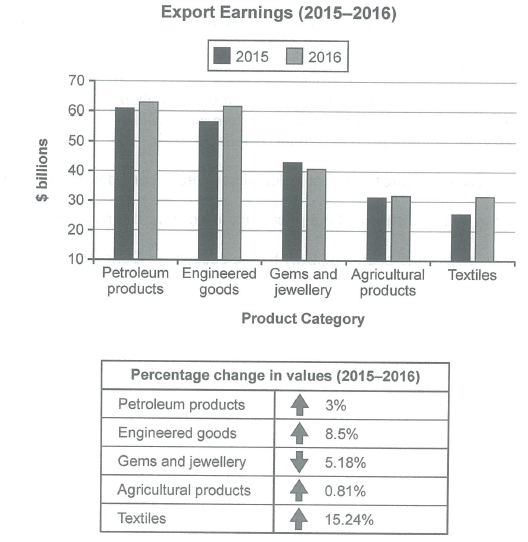
The chart below shows the value of one country’s exports in various categories during 2015 and 2016. The table shows the percentage change in each category of exports in 2016 compared with 2015.
Summarise the information by selecting and reporting the main features, and make comparisons where relevant.
Student answer (Band 6.0)
The chart shows the value of one country's exports earnings between 2015 and 2016. The figures are given in billion dollars and percentage.
Overall, it is evident that petrolium products brought more money, while engineered goods and gems and jewellery showed noticable growth as well. Agricultural products and textile illustrate some movement too.
Looking at the details, petroleum products made around 60 billions in 2015, engineered goods above 50 billions, gems and jewellery 40 above billions, agricultural products around 30 billions whereas, textile kept below 30 billions in 2015.
As for 2016, petroleum products showed 3% increase and engineered goods rose above 8%, while gems and jewellery declined 5.18%, agricultural products demonstrate a marginal rise of 0.81%. However, textiles made a significant progress and we can see an enormouse rise of 15.24% compared to earnings made through exports in 2015 in textile industry and easily crossed over 30 billions in just one year.
AI examiner evaluation
| Criterion | Band |
|---|---|
| Task Achievement / Task Response | 6.0 |
| Coherence and Cohesion | 6.5 |
| Lexical Resource | 5.5 |
| Grammatical Range and Accuracy | 5.5 |
| Overall | 6.0 |
Task Achievement / Task Response: Band 6.0
You identify the main categories and report several relevant figures and percentage changes, including the decline in gems and jewellery and the strong rise in textiles. The overview, however, is not fully accurate: it says engineered goods and gems and jewellery showed growth, although gems fell from about $43 billion to $41 billion. It also describes agricultural products and textiles as showing “some movement,” which is vague, and does not clearly summarise the overall pattern that most categories rose while gems declined. Some comparisons are present, but the account of the 2015 values is not consistently precise. To strengthen the response, give a concise, accurate overview first, then compare the largest and smallest earnings and the most notable changes using the chart values as well as the percentages.
Coherence and Cohesion: Band 6.5
The response has a clear overall arrangement: an introduction, an overview, and paragraphs covering the figures and changes. This gives the reader a generally logical route through the information, and linking phrases such as “Overall,” “Looking at the details,” and “As for 2016” help signal shifts. The progression is not fully smooth, however. The final sentence is very long and combines the textile percentage, comparison with 2015, and its earnings level, making the key information harder to follow. The overview also groups categories imprecisely, which weakens the organisation of the main trends. Use shorter sentences and organise the details by clear comparisons—for example, increases together and the one decline separately—to make the progression more controlled.
Lexical Resource: Band 5.5
You use a reasonable range of task-related vocabulary, including “declined,” “marginal rise,” “significant progress,” and “earnings,” so the main meaning is generally clear. However, several word-choice, collocation, and spelling problems reduce precision. “Petrolium” and “noticable” are misspelled, while “made a significant progress” is an unnatural collocation. “Some movement” is too vague for describing the data, and “enormouse rise” is both misspelled and overly emphatic for an objective report. “Textile” is also used where the category is “textiles.” Aim for accurate, neutral reporting language and check spelling carefully; precise verbs such as “rose,” “fell,” and “remained stable” would describe the trends more naturally.
Grammatical Range and Accuracy: Band 5.5
You attempt a mix of simple and more complex sentences, including a contrast with “while” and a time comparison in the final sentence. Most of the message remains understandable, but some grammatical errors affect accuracy. For example, “60 billions” uses an incorrect plural after a number, and “gems and jewellery 40 above billions” has an unclear word order. In “agricultural products demonstrate a marginal rise,” the present tense does not fit the past-period data, and “whereas, textile” has awkward punctuation and sentence structure. The final sentence also joins several ideas into an unwieldy construction. Practise forming clear comparisons with consistent past-tense verbs, correct number expressions, and shorter clauses; this will preserve your range while improving control.
See this exact question answered at other band scores. The same prompt compared across bands.
Browse more IELTS Writing model answers or get your own writing scored by the same AI examiner.