Band 5.5 IELTS Writing Task 1 Model Answer
Overall Band Score: 5.5 · Cambridge IELTS 14 · 2026-11-27
IELTS Writing Task 1 question
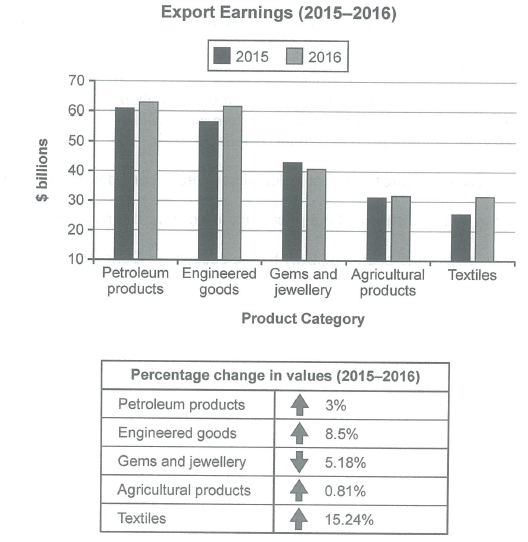
The chart below shows the value of one country’s exports in various categories during 2015 and 2016. The table shows the percentage change in each category of exports in 2016 compared with 2015.
Summarise the information by selecting and reporting the main features, and make comparisons where relevant.
Student answer (Band 5.5)
The diagrams illustrate the different products of export earning and proportion change in the values of different categories of the one countries in the years 2015 and 2016.
Overall, petroleum products accounted form the highest export, while textiles had the least among all categories initially, but textiles was the highest change of proportion than others.
In 2015, petroleum product showed the highest export at around 60 billions, whereas textiles was the lowest. Engineered goods following petroleum product in 2015 at round 58 billions, but in 2016 it stood at approximately 62 billions close to peteoleum product.
The textiles accounted for the highest proportion change in values with 15.24
AI examiner evaluation
| Criterion | Band |
|---|---|
| Task Achievement / Task Response | 5.0 |
| Coherence and Cohesion | 5.5 |
| Lexical Resource | 5.5 |
| Grammatical Range and Accuracy | 5.5 |
| Overall | 5.5 |
Task Achievement / Task Response: Band 5.0
You identify two relevant overall features: petroleum products were the largest export category, and textiles recorded the strongest percentage increase. You also give approximate figures for petroleum and engineered goods, which broadly match the chart. However, the report is incomplete: it stops after mentioning textiles’ 15.24% rise and does not describe the remaining categories or the decline in gems and jewellery. The overview’s claim that textiles were initially the smallest is accurate, but the comparison of changes is not developed with the other figures. The response also falls short of the required 150 words, limiting how fully you can select and report the main features. Include a complete overview and compare the key rises, fall and broadly stable categories.
Coherence and Cohesion: Band 5.5
The response has a recognisable sequence: an introduction, an overview, and a paragraph with details from 2015 and 2016. Linking words such as “Overall,” “whereas” and “but” help signal relationships between points. However, the progression is limited because the final paragraph ends abruptly after the textiles figure, with no concluding comparison or coverage of the other categories. Some references are also unclear, as in “the highest change of proportion than others,” where the comparison is difficult to follow. To make the organisation more effective, group the categories by trend—for example, increases, the decline in gems and jewellery, and near-stability in agriculture—and ensure each paragraph develops a complete point.
Lexical Resource: Band 5.5
You use some task-relevant vocabulary, including “export,” “categories,” “accounted for,” “highest” and “approximately,” so the main subject is generally understandable. There is also an attempt to describe change through “proportion change in values.” However, several word choices and collocations are inaccurate or awkward, such as “export earning,” “highest change of proportion,” and “the one countries.” “Following petroleum product” is also an imprecise way to rank engineered goods. Spelling errors such as “peteoleum” reduce accuracy. Use standard chart language consistently, such as “export earnings,” “percentage change,” “rose,” “fell” and “remained almost unchanged.” This would make comparisons clearer and give the vocabulary more control and precision.
Grammatical Range and Accuracy: Band 5.5
You attempt both simple and more developed sentence forms, including a contrast with “whereas” and a clause beginning “but in 2016.” The main comparisons can usually be understood, but grammatical control is uneven. For example, “textiles was the highest change” has subject–verb agreement and sentence-structure problems, while “Engineered goods following petroleum product” is not a complete clause. There are also errors in number and articles in “60 billions” and “the one countries.” The final sentence is incomplete, ending with “15.24” without stating the percentage or completing the thought. Practise complete sentences with accurate agreement and plural forms, and check that each sentence has a clear subject and verb and is fully punctuated.
See this exact question answered at other band scores. The same prompt compared across bands.
Browse more IELTS Writing model answers or get your own writing scored by the same AI examiner.