Band 6.0 IELTS Writing Task 1 Model Answer
Overall Band Score: 6.0 · Cambridge IELTS 14 · 2026-11-14
IELTS Writing Task 1 question
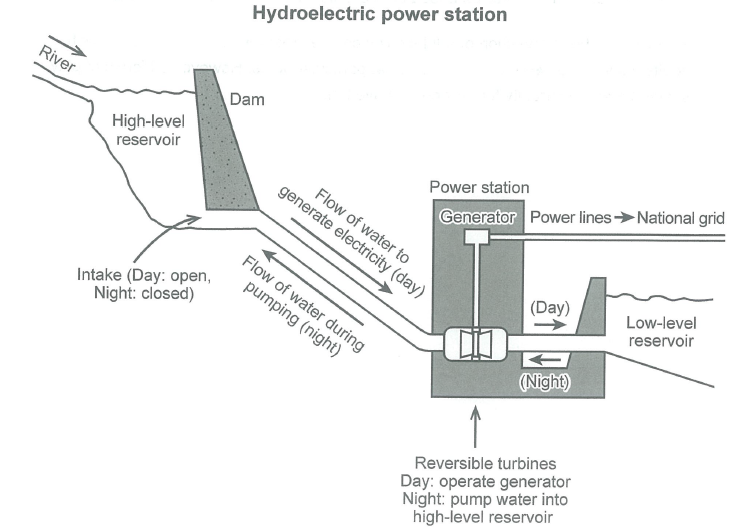
The diagram below shows how electricity is generated in a hydroelectric power station.
Summarise the information by selecting and reporting the main features, and make comparisons where relevant.
Student answer (Band 6.0)
The diagram illustrates the process by which electricity is produced in a hydroelectric power station.
Overall, the process begins with using the water from the river and end with the production of electricity.
The river water flows to a high-level reservoir. The dam controls the flow by opening the intake during the day and close it at night. Water travels downward and enters the power station during the day and at night the flow is way from power station.
Here some of the water is allowed by the reversible generator to move into a low-level reservoir at day time while at night this water is pumped back into the high-level reservoir. The reversible turbines operate the generator. Water travels through this genertor which generates electricity. Once electricity is generated, it travels through the power lines and enters the national grid.
AI examiner evaluation
| Criterion | Band |
|---|---|
| Task Achievement / Task Response | 5.5 |
| Coherence and Cohesion | 6.0 |
| Lexical Resource | 6.0 |
| Grammatical Range and Accuracy | 5.5 |
| Overall | 6.0 |
Task Achievement / Task Response: Band 5.5
You identify the main stages and include the important day–night contrast: water moves from the high-level reservoir through the station to the low-level reservoir by day, then is pumped back at night. However, the overview is incomplete and partly inaccurate: the process does not simply end with electricity production, since the water is recycled, and electricity is sent to the national grid. The description also says water travels through the generator, whereas it passes through the reversible turbines; the generator is driven by them. The response is 140 words, below the required 150, so some stages and relationships remain under-explained. To strengthen the account, clarify the full cycle and distinguish the turbines, generator and water route.
Coherence and Cohesion: Band 6.0
The response has a clear basic structure: an introduction, an overview and a description of the process. Its sequence is generally understandable, and time markers such as “during the day” and “at night” help distinguish the two operating modes. However, the progression becomes less clear in the final paragraph, where the water route, turbine operation and electricity transmission are combined without a precise sequence. “Here” is also an unclear transition, and “this water” could refer more explicitly to water in the low-level reservoir. Organise the body in chronological order, first describing daytime generation and then nighttime pumping, and use clearer links such as “Meanwhile” or “After passing through the turbines” to make relationships easier to follow.
Lexical Resource: Band 6.0
You use an adequate range of process vocabulary, including “high-level reservoir,” “intake,” “reversible turbines,” “power lines” and “national grid.” These terms make the general subject clear, and the day/night wording is relevant. Some choices are imprecise or awkward, however: “the flow is way from power station” does not clearly express that water flows away from the station at night, and “allowed by the reversible generator” confuses the component and its function. There is also a spelling error in “genertor.” Use the diagram’s technical labels consistently and choose precise process verbs, for example “flows,” “passes through” and “is pumped back.” This would improve clarity without requiring more elaborate vocabulary.
Grammatical Range and Accuracy: Band 5.5
You attempt both simple and more complex sentences, including a contrast between daytime and nighttime operation. The main meaning is usually recoverable, but some grammatical errors reduce accuracy. In the overview, “begins with using … and end” has faulty parallel structure and verb form; write “begins with water entering … and ends with …”. In “opening the intake during the day and close it at night,” the verb forms should be parallel (“opening … and closing …”). The sentence beginning “Here” also has an unclear construction, while “at day time” needs a more natural time expression. Aim for consistent tense and parallel forms, and separate the day and night stages into complete, clearly controlled sentences.
See this exact question answered at other band scores. The same prompt compared across bands.
Browse more IELTS Writing model answers or get your own writing scored by the same AI examiner.