Band 5.0 IELTS Writing Task 1 Model Answer
Overall Band Score: 5.0 · Cambridge IELTS 14 · 2026-11-17
IELTS Writing Task 1 question
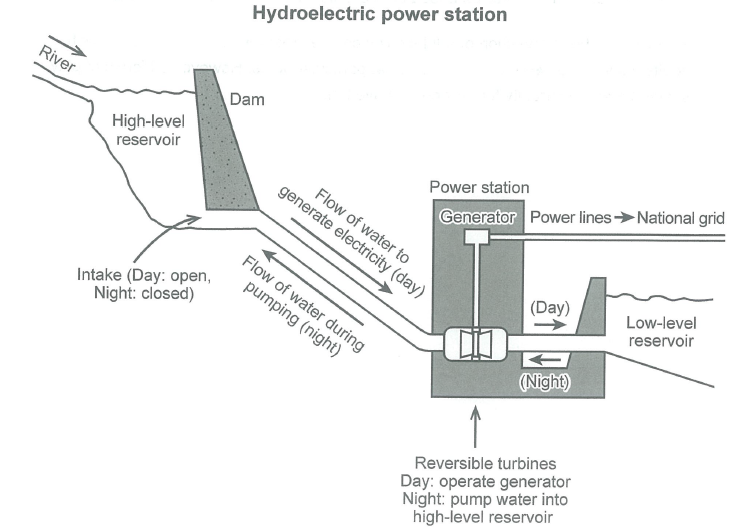
The diagram below shows how electricity is generated in a hydroelectric power station.
Summarise the information by selecting and reporting the main features, and make comparisons where relevant.
Student answer (Band 5.0)
this flow chart illustrates how electricity is generated in a hyporoelectric power station. First, in the river there is a dam and the water flows down to generate electricity during the day so below the part of power station or generator it has a tube called reversible turbines the water flow down in the low-level reservoir . during day it generates electricity and during night it pump the water into the high level reservoir, so basically in the day it is open and in the night it is close. Overall the chart describes how generator works during daytime and night time and what is use of it. every parts of the generator is a huge important on how it will work. it has a specific task from morning to evening so every bit of it has a big impact. The reverse turbines has 2 purpose and it is the most relevant part of the generator.
AI examiner evaluation
| Criterion | Band |
|---|---|
| Task Achievement / Task Response | 5.0 |
| Coherence and Cohesion | 4.5 |
| Lexical Resource | 5.0 |
| Grammatical Range and Accuracy | 5.0 |
| Overall | 5.0 |
Task Achievement / Task Response: Band 5.0
You identify the central contrast between daytime generation and nighttime pumping, and mention the low-level and high-level reservoirs and reversible turbines. However, the process is only partially described: the river’s role in filling the high-level reservoir, the intake’s day/night settings, and the generator’s connection to power lines and the national grid are missing or unclear. The statement that “in the river there is a dam” misrepresents the layout, and “below the part of power station or generator” does not clearly explain the equipment sequence. The overview also shifts into unsupported general comments such as “every bit of it has a big impact” rather than summarising the cycle. To improve, report the main stages accurately and give a concise overview of how water moves in both directions.
Coherence and Cohesion: Band 4.5
There is a basic attempt to organise the response, beginning with “First” and ending with “Overall,” and the day/night contrast gives the reader a broad sense of the process. However, most information is packed into one long, loosely connected sequence, so the order of stages is difficult to follow. The transition from the process description to general claims about the generator is abrupt, and “so basically” does not clarify the relationship between the intake and the operating cycle. Repeated references to “during the day” and “during night” do not create a clear progression. Use separate paragraphs for the overview and the process, then describe the daytime route followed by the nighttime return route with clear sequencing links.
Lexical Resource: Band 5.0
The response uses some relevant process vocabulary, including “low-level reservoir,” “generator,” and “reversible turbines,” and it attempts to distinguish the two operating modes. However, the range is limited and several choices are inaccurate or imprecise, which makes parts of the description hard to interpret. “Hyporoelectric” is a misspelling of “hydroelectric,” while “tube” is too general for the conduit carrying water. Phrases such as “every parts” and “huge important” are also unnatural, and “reverse turbines” later differs from the correct term used earlier. Aim for precise technical nouns and avoid vague evaluative language; for example, describe the water’s route and the turbines’ function rather than saying each part has a “big impact.”
Grammatical Range and Accuracy: Band 5.0
You attempt to combine ideas using clauses and time references, as in “during day it generates electricity and during night it pump the water,” but control is inconsistent. Errors in verb forms and agreement occur frequently: “it pump” should be “it pumps,” and “every parts … is” has mismatched number. Articles and sentence boundaries are also problematic, particularly in the opening description, where several stages run together without clear punctuation. The response relies mainly on simple clauses joined by “and” or “so,” with limited accurate variety. Practise writing short, complete sentences in the present simple, checking subject–verb agreement and articles, then connect the stages with a few controlled clauses such as “When the intake is open, water flows…”
See this exact question answered at other band scores. The same prompt compared across bands.
Browse more IELTS Writing model answers or get your own writing scored by the same AI examiner.