Band 5.5 IELTS Writing Task 1 Model Answer
Overall Band Score: 5.5 · Cambridge IELTS 14 · 2026-11-17
IELTS Writing Task 1 question
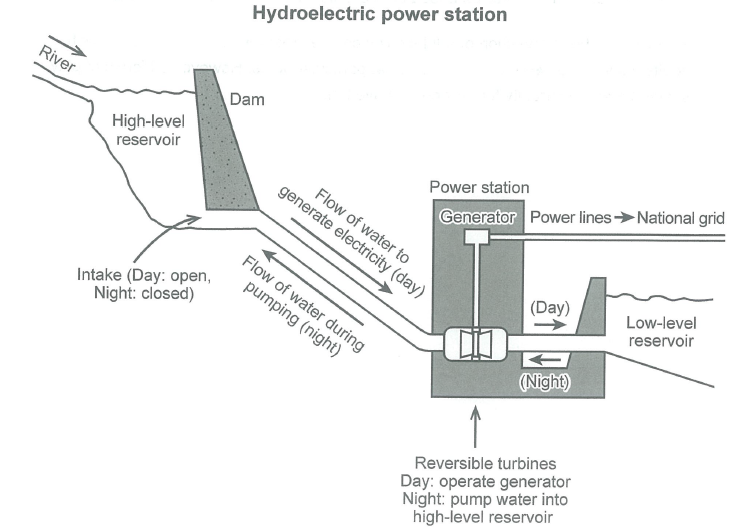
The diagram below shows how electricity is generated in a hydroelectric power station.
Summarise the information by selecting and reporting the main features, and make comparisons where relevant.
Student answer (Band 5.5)
Hydroelectric power station is basically a power station which uses water for the purpose of generating electricity. The generation of electricity works in a step by step process. In this process water from the river is set to store in a dam. The water is used for the high level reservoir and also for the low level reservoir. The water do its working in day and also at night. At night the water flows so it can go through its process of pumping. Whereas at day the water has a main purpose. At day the water flows for the purpose of generating electricity. After the intake of water the dam is set to open whereas at night the dam is closed. Reversible Turbines are set for the generation of electricity. At night these turbines pump water into the high level reservoir while at day they operate generator. These generators operate to generate electricity. They are linked to power station from where the electricity is flown into the power lines and than from there it is set towards the national grid from where it is set to used for different purposes.
AI examiner evaluation
| Criterion | Band |
|---|---|
| Task Achievement / Task Response | 6.0 |
| Coherence and Cohesion | 5.0 |
| Lexical Resource | 5.5 |
| Grammatical Range and Accuracy | 5.0 |
| Overall | 5.5 |
Task Achievement / Task Response: Band 6.0
You cover the main stages and correctly describe the key day–night contrast: water flows down to generate electricity during the day, while the turbines pump it back to the high-level reservoir at night. You also mention the generator, power lines and national grid. However, some details are unclear or inaccurate. The river feeds the high-level reservoir; the water is not “set to store in a dam,” and it is the intake—not the dam—that is open by day and closed at night. The overview is also implicit rather than clearly stated. To strengthen the report, introduce the two operating modes in a concise overview, then describe the route of water and electricity in sequence, distinguishing the high- and low-level reservoirs precisely.
Coherence and Cohesion: Band 5.0
The response contains relevant information and broadly moves from the water source to electricity distribution, with the day and night operations included. However, the progression is not consistently clear because the stages are repeated and sometimes presented out of sequence. For example, the discussion moves from night pumping to daytime generation, then back to the intake and dam before returning to the turbines. Repeated phrases such as “At day” and “from where” also make the connections mechanical, while the single paragraph gives the reader little visual guidance. Organise the report into an introduction and overview, followed by a paragraph tracing daytime flow and another explaining the night-time reversal. Use clear references such as “this water” and “the turbines” to link stages.
Lexical Resource: Band 5.5
You use relevant process vocabulary, including “high level reservoir,” “intake,” “reversible turbines,” “generator,” and “national grid,” so the subject is generally identifiable. However, the range is limited by repeated, imprecise phrases such as “for the purpose of,” “set to,” and “from where.” Some choices are unnatural or inaccurate for this process: electricity is “transmitted” or “supplied,” rather than “flown,” and water is “stored” in a reservoir rather than “set to store.” Use precise verbs to describe each stage, such as “flows,” “drives,” “generates,” and “is pumped back.” Also maintain standard forms such as “high-level” and “low-level” when these modify “reservoir.”
Grammatical Range and Accuracy: Band 5.0
You attempt both simple and longer sentences, and the reader can usually follow the main process. However, control is uneven, particularly in verb forms, agreement and sentence construction. For example, “The water do its working” should be “The water does its work,” while “water from the river is set to store” needs a passive form such as “is stored.” The sentence beginning “After the intake of water” also creates an unclear relationship between the intake and the dam. Several long sentences join multiple stages with limited punctuation, making the structure harder to follow. Practise accurate passive constructions for process descriptions and vary sentence length: use concise sentences for individual stages, then a controlled complex sentence to compare daytime and night-time operation.
See this exact question answered at other band scores. The same prompt compared across bands.
Browse more IELTS Writing model answers or get your own writing scored by the same AI examiner.