Band 5.0 IELTS Writing Task 1 Model Answer
Overall Band Score: 5.0 · Cambridge IELTS 14 · 2026-11-17
IELTS Writing Task 1 question
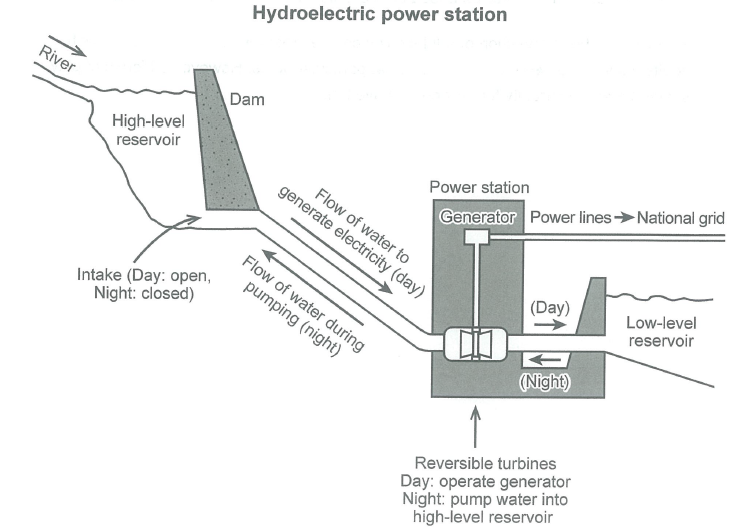
The diagram below shows how electricity is generated in a hydroelectric power station.
Summarise the information by selecting and reporting the main features, and make comparisons where relevant.
Student answer (Band 5.0)
The given digram illustrates how electricity is produced in a hydroelectric power station.
In the first stage , the water that coming from rivers is collecting in the dam with the high- level reservior that is open during the day and close on night.
Then, from the bottom on dam the water is flowing to generate electricity during the day, after that , when the water delivered to the power station the generater is working to produce power that sending through power lines to the national grid.
part of power going to low -level resevoir during the day , and the residue go back to the reversible turbines which operate generator on day, or pump water into high-level reservior on night.
finally the water return bach to the high- level reservoir durin pumping on night.
AI examiner evaluation
| Criterion | Band |
|---|---|
| Task Achievement / Task Response | 5.0 |
| Coherence and Cohesion | 5.0 |
| Lexical Resource | 5.0 |
| Grammatical Range and Accuracy | 5.0 |
| Overall | 5.0 |
Task Achievement / Task Response: Band 5.0
You identify the process as electricity generation and include several relevant stages: water passes from the reservoir through the power station, electricity reaches the national grid, and water is returned at night. However, the account only partially covers the diagram and contains an important misreading: the intake, not the high-level reservoir, is open by day and closed at night. The daytime route and the nighttime pumping cycle are not explained clearly, and the role of the low-level reservoir is confused by saying “part of power” goes there. The response is also below the required 150 words. To improve, give a clear overview of the two operating modes, then describe the water and electricity flows accurately and in sequence.
Coherence and Cohesion: Band 5.0
The response has a basic chronological structure, signalled by “In the first stage,” “Then,” and “finally,” and the reader can recognise that it describes a process. However, the progression is not consistently clear: the sentence beginning “part of power going to low-level resevoir” shifts between electricity and water, while “the residue go back” has an unclear reference. Most information is placed in one continuous sequence rather than organised into a clear introduction, overview, and stages. Some linking phrases are also used mechanically or with awkward punctuation. Separate the main daytime process from the nighttime pumping cycle, and use clear references such as “the water” or “the electricity” to show what moves at each point.
Lexical Resource: Band 5.0
You use some relevant process vocabulary, including “power station,” “generator,” “power lines,” “national grid,” and “reversible turbines,” which helps identify key components. However, the range is limited and several word choices or collocations make the process difficult to follow. For example, “part of power going to low-level resevoir” confuses electricity with water, and “the residue” is not a natural way to describe the remaining water. Spelling errors such as “digram,” “reservior,” “generater,” and “bach” are noticeable. Build a more precise set of process verbs and nouns, such as “flows,” “is channelled,” “is pumped,” and “water is stored,” and check spelling carefully.
Grammatical Range and Accuracy: Band 5.0
You attempt to connect stages in longer sentences, but the response relies on a limited range of structures and many sentences contain errors that make relationships between events unclear. For example, “the water that coming from rivers is collecting” has faulty verb forms, while “the generator is working to produce power that sending” lacks a correctly formed clause. There are also problems with articles, prepositions, and agreement, as in “from the bottom on dam” and “the residue go back.” Punctuation spacing is inconsistent, and the final sentence is not clearly punctuated. Practise accurate present simple passive forms for processes, such as “Water is channelled” and “Electricity is transmitted,” before combining stages into longer sentences.
See this exact question answered at other band scores. The same prompt compared across bands.
Browse more IELTS Writing model answers or get your own writing scored by the same AI examiner.