Band 5.0 IELTS Writing Task 1 Model Answer
Overall Band Score: 5.0 · Cambridge IELTS 14 · 2026-11-19
IELTS Writing Task 1 question
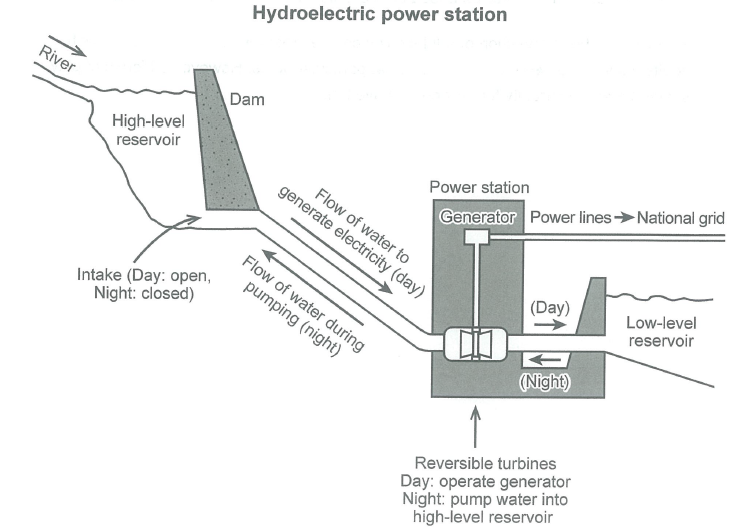
The diagram below shows how electricity is generated in a hydroelectric power station.
Summarise the information by selecting and reporting the main features, and make comparisons where relevant.
Student answer (Band 5.0)
The diagram illustrates how electricity works in a hydroelectric power station.
Overall, there are five process on how the electricity works in a hydroelectric power station. There are different process during day and night. First in river to the dam, power station, water reservoir, flowing through tubelines and finally, pumping flowing up.
To begin with, in the moring water comes from river, flows down to dam, and going down to reversible tublines to operate generator to the power station.
However, in the night the flow of the water is revered going up, first the water somes from low-level reservoir flowing going to reversible tubelines and pump the water into high-level reservoir, the intake for the day is open and for the night is closed. And that's how the electricity is generated in a hydroelectric power station.
AI examiner evaluation
| Criterion | Band |
|---|---|
| Task Achievement / Task Response | 5.0 |
| Coherence and Cohesion | 5.0 |
| Lexical Resource | 5.0 |
| Grammatical Range and Accuracy | 5.0 |
| Overall | 5.0 |
Task Achievement / Task Response: Band 5.0
You identify the two operating modes and include several relevant stages, such as water passing through the turbines by day and being pumped back at night. However, the account is only partial: the overview’s claim of “five process” is unclear, and the sequence “river to the dam, power station, water reservoir” does not accurately explain the system. The generator, power lines and national grid are not clearly described, and the daytime route to the low-level reservoir is omitted. The response also contains 128 words, below the required 150, which limits the detail available. To improve, give a clear overview of the cycle, then describe each route in order and include the electricity transmission stage.
Coherence and Cohesion: Band 5.0
The response has an introduction, an overview and separate paragraphs for daytime and nighttime operation, so the reader can recognise an intended structure. The contrast signalled by “However, in the night” is also relevant. Nevertheless, progression is not consistently clear: the overview lists stages in a confusing order, and phrases such as “First in river to the dam, power station, water reservoir” do not show how the parts connect. Some linking words are used mechanically, while the final sentence repeats the introduction rather than adding a clear concluding stage. Organise the description chronologically, using one paragraph for the daytime cycle and one for the reverse nighttime cycle, with precise references such as “from the low-level reservoir” and “back to the high-level reservoir.”
Lexical Resource: Band 5.0
You use some task-relevant terms, including “high-level reservoir,” “low-level reservoir,” “reversible” and “generator,” which help identify key components. However, the range is limited and several inaccurate or repeated expressions make the process difficult to follow. “Tubelines” is not the appropriate term for the conduit, and “the flow of the water is revered going up” does not clearly express that water is pumped back uphill. “Electricity works” is also imprecise for describing a generation process. Use accurate process vocabulary consistently, such as “flows,” “drives,” “generates” and “is pumped back,” and check spelling of technical terms. This would make the account clearer without requiring unnecessarily advanced vocabulary.
Grammatical Range and Accuracy: Band 5.0
You attempt both simple statements and longer clauses, for example, “in the night the flow of the water is revered going up,” but the longer constructions are often faulty and the range remains limited. Errors in verb forms and sentence structure occur throughout: “there are five process,” “water comes from river, flows down to dam, and going down,” and “the water somes … flowing going” are difficult to process. Articles and prepositions are also frequently missing, as in “from river” and “to dam.” These problems sometimes obscure the sequence of events. Practise building complete sentences with a clear subject and verb, and use consistent present simple forms for process descriptions, such as “Water flows through the turbines and drives the generator.”
See this exact question answered at other band scores. The same prompt compared across bands.
Browse more IELTS Writing model answers or get your own writing scored by the same AI examiner.