Band 5.0 IELTS Writing Task 1 Model Answer
Overall Band Score: 5.0 · Cambridge IELTS 14 · 2026-11-19
IELTS Writing Task 1 question
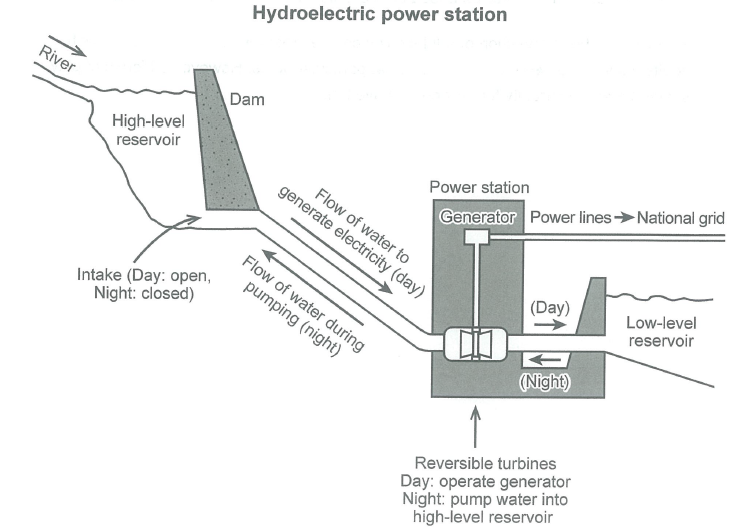
The diagram below shows how electricity is generated in a hydroelectric power station.
Summarise the information by selecting and reporting the main features, and make comparisons where relevant.
Student answer (Band 5.0)
The blueprint of hydroelectric power station illustrates that how it generated energy power in step by step recyclation in whole day.
Overall, it is clearly described that rapid motion of water can produce energy without human labor. with adequet arrangements.
To begin with high flowing river where have water storage construct dam. Which is control the folw of water. AT day time dam opens to generate electricity by flow of water. this flow regulate the turbine from its force which is connected with generator. this appliance conver energy into power to shared on national grid.
Furthermore, that high forced water reserved at low-level. afterthat in night that water was replace by pumping system via upside down flow back to river.
IN conclusion, that how power station work with utilising water.
AI examiner evaluation
| Criterion | Band |
|---|---|
| Task Achievement / Task Response | 5.5 |
| Coherence and Cohesion | 5.5 |
| Lexical Resource | 5.0 |
| Grammatical Range and Accuracy | 4.5 |
| Overall | 5.0 |
Task Achievement / Task Response: Band 5.5
You identify the process as hydroelectric generation and include several relevant stages: water passes from the high-level reservoir through a turbine, the generator supplies the national grid, and water is later pumped back. However, the account is only partial and some key details are unclear or inaccurate. In particular, the low-level reservoir is where water is stored after daytime generation; it is not simply “reserved” there, and the water is pumped back to the high-level reservoir at night, not “back to river.” The overview that water produces energy “without human labor” is not a main process feature. The response also falls 20 words short of the required minimum. Covering both the daytime and nighttime cycles more precisely would make the summary more complete.
Coherence and Cohesion: Band 5.5
The response has a basic overall structure, moving from an introduction and overview to daytime operation, nighttime pumping, and a conclusion. Sequencing phrases such as “To begin with” and “Furthermore” help signal stages. However, progression is not consistently clear: the nighttime explanation is compressed into one sentence, and “that water was replace by pumping system via upside down flow back to river” leaves the direction and destination difficult to follow. Some transitions feel mechanical, while the conclusion repeats the general topic rather than bringing the process together. Use clearer links between stages and refer explicitly to the high- and low-level reservoirs so readers can track the water’s movement.
Lexical Resource: Band 5.0
You use some relevant process vocabulary, including “dam,” “turbine,” “generator,” “pumping,” and “national grid,” which helps identify the main components. However, the range is limited and several word choices or collocations make the description difficult to understand, such as “step by step recyclation,” “high forced water,” and “shared on national grid.” Spelling errors, including “folw,” “adequet,” and “conver,” also reduce clarity. Aim for precise, standard terms for the stages and equipment, and check spelling carefully. Reusing accurate words such as “reservoir” and “water flow” is preferable to inventing unclear expressions.
Grammatical Range and Accuracy: Band 4.5
There are attempts to use more than simple statements, but sentence structures are often incomplete or faulty, and errors sometimes obscure the process. For example, “The blueprint … illustrates that how it generated” has an incorrect clause structure and tense, while “Which is control the folw of water” is a fragment with faulty verb form. The sentence beginning “To begin with high flowing river” also lacks a clear grammatical connection to the next clause. Capitalisation and punctuation are inconsistent, including “AT” and “IN,” and several sentences begin with dependent clauses that are not properly joined. Practise complete subject–verb sentences and use consistent present simple forms to describe each stage.
See this exact question answered at other band scores. The same prompt compared across bands.
Browse more IELTS Writing model answers or get your own writing scored by the same AI examiner.