Band 5.0 IELTS Writing Task 1 Model Answer
Overall Band Score: 5.0 · Cambridge IELTS 14 · 2026-11-20
IELTS Writing Task 1 question
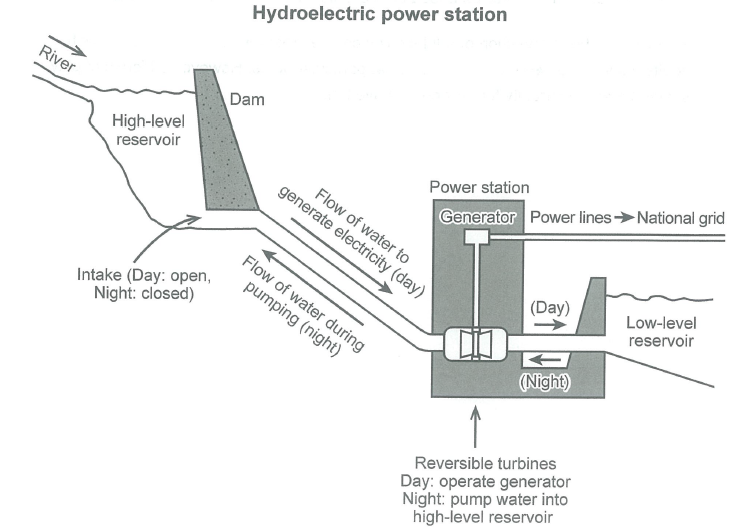
The diagram below shows how electricity is generated in a hydroelectric power station.
Summarise the information by selecting and reporting the main features, and make comparisons where relevant.
Student answer (Band 5.0)
the diagram bellow illustrate the way electricity is generated in a hydroelectric power station
first of all the water from the river is contained in a high level reservoir with massive dam that open during the day and closed at night then the water flow to generate the electricity throw the turbines that moves to outcome electricity throw power lines to national grid
finally after generating electricity we will do the reverse by pushing the water out from low level reservoir which is easy process not such as the first one, the turbines will push water in the same pipeline as we said before from low level reservoir to the high level reservoir to keep the same amount of water in our reservoir it's not complicated process and not expensive neither all counties could make it
generating electricity it's a massive development and it's necessary in all countries to provide energy
AI examiner evaluation
| Criterion | Band |
|---|---|
| Task Achievement / Task Response | 5.0 |
| Coherence and Cohesion | 5.5 |
| Lexical Resource | 5.0 |
| Grammatical Range and Accuracy | 5.0 |
| Overall | 5.0 |
Task Achievement / Task Response: Band 5.0
You identify the main day/night cycle: water flows from the upper reservoir through turbines to generate electricity, then is pumped back from the lower reservoir at night. However, the account is only partial and includes unsupported claims, such as saying the process is “not expensive” and that all countries could use it. The intake is described as opening by day and closing at night, but you incorrectly say the dam itself opens and closes. The overview of the system’s two operating modes could be clearer, and several stages—especially the generator and the route to the lower reservoir—are only briefly covered. The response is also 143 words, below the 150-word minimum; the eight words copied from the prompt are excluded.
Coherence and Cohesion: Band 5.5
The response has a basic sequence, signalled by “first of all” and “finally,” and the reader can follow the broad movement of water from the upper reservoir to the lower one and back. However, most information is packed into two long sentences, so the stages and the day/night contrast are not clearly separated. The final comments about cost and national development interrupt the process description rather than extending it. Some linking is also mechanical, particularly the repeated use of “then” and “finally.” Organise the account into a brief overview and clearly ordered stages, using separate sentences or paragraphs for daytime generation and nighttime pumping.
Lexical Resource: Band 5.0
You use some relevant process vocabulary, including “reservoir,” “turbines,” “power lines,” and “national grid,” which helps communicate the basic subject. However, the range is limited and several word choices or collocations are inaccurate: “outcome electricity” does not express generating electricity, and “push water out from” is unclear for describing pumping. Spelling errors such as “bellow” and “throw” also make the writing less precise. Informal or evaluative phrases such as “it’s not complicated” and “massive development” are not suitable for a neutral process summary. Aim for precise verbs and standard technical phrasing, and avoid adding opinions that are not shown in the diagram.
Grammatical Range and Accuracy: Band 5.0
You attempt to connect several stages in longer sentences, but these structures are often faulty and make relationships between steps difficult to follow. For example, “the water from the river is contained … with massive dam that open” has problems with articles, agreement, and clause structure; “the turbines that moves” also has subject–verb disagreement. Tense and sentence boundaries are inconsistent, as in the extended sentence beginning “finally after generating electricity.” Most of the response relies on simple clauses joined together, with limited accurate variety. Use present simple consistently for a process, check singular and plural agreement, and divide the explanation into shorter sentences with clear punctuation.
See this exact question answered at other band scores. The same prompt compared across bands.
Browse more IELTS Writing model answers or get your own writing scored by the same AI examiner.