Band 6.0 IELTS Writing Task 1 Model Answer
Overall Band Score: 6.0 · Cambridge IELTS 14 · 2026-11-21
IELTS Writing Task 1 question
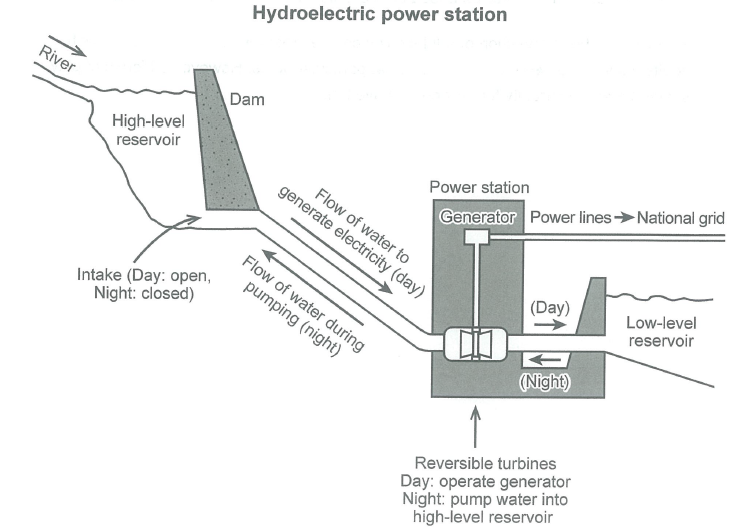
The diagram below shows how electricity is generated in a hydroelectric power station.
Summarise the information by selecting and reporting the main features, and make comparisons where relevant.
Student answer (Band 6.0)
The picture below illustrates how a hydroelectric power station generates electricity.
Overall, a complete procedure is shown in this diagram which starts from the river water entering to a high-level reservior till the generator gives electricity through the power lines to the national grid.
To begin with, the river water comes into a high-level reservior called dam, those water flow from the dam to the generator during the day time to create electricity as it is closed during the night while some of these water goes into the low-level reservior. Moreover, these water flows back from the low-level reservior to the high-level reservior (dam) during the night through the reversible turbines.
Following this, when these water reaches to the generator during the day, it generates electricity and spreads through the power lines to the national grid and then it is spreading to cities. This cycle is repeating everytime and creates electricty.
AI examiner evaluation
| Criterion | Band |
|---|---|
| Task Achievement / Task Response | 6.5 |
| Coherence and Cohesion | 6.0 |
| Lexical Resource | 6.0 |
| Grammatical Range and Accuracy | 5.5 |
| Overall | 6.0 |
Task Achievement / Task Response: Band 6.5
You identify the process as a cycle and include its main components: the river, two reservoirs, reversible turbines, generator, power lines and national grid. The overview also captures the broad movement from water storage to electricity generation and back-pumping. However, some details are inaccurate or unclear: the high-level reservoir is not “called dam”; the dam contains the reservoir, and water passes through an intake and conduit to the turbines, not directly to the generator. The intake is open by day and closed at night, but your wording makes it sound as though the water flow itself is closed. The claim that electricity is spread to cities is not shown. This covers the task well overall, but more precise stage descriptions and a clearer account of the day/night cycle would strengthen it further.
Coherence and Cohesion: Band 6.0
The response has a recognisable structure: an introduction, an overview, and two paragraphs describing the process. Sequencing phrases such as “To begin with” and “Following this” help guide the reader, and the general cycle is easy to follow. However, the progression is not always clear because the first process paragraph combines several stages in a long sentence, while the next paragraph returns to daytime generation already mentioned. References such as “these water” and “it” are also unclear, making it harder to track whether you mean the water, the generator, or the electricity. Organise the stages in a single chronological sequence—daytime flow and generation, then nighttime pumping—and use clearer references to improve cohesion.
Lexical Resource: Band 6.0
You use relevant process vocabulary, including “high-level reservoir,” “low-level reservoir,” “reversible turbines,” “power lines” and “national grid,” which gives the response an adequate range for describing the diagram. Some choices, however, are inaccurate or unnatural: a reservoir is not “called dam,” and electricity does not “spread” through power lines; it is transmitted or supplied. “Creates electricity” is understandable but less precise than “generates electricity.” There are also spelling errors in “reservior” and “electricty,” and “everytime” should be written as two words. Aim for accurate technical collocations and check spelling, while retaining the useful vocabulary you already use.
Grammatical Range and Accuracy: Band 5.5
You attempt both simple and complex sentences, including a relative clause in “which starts from the river water…” and a time clause beginning “when these water reaches…”. The overall meaning is generally recoverable, but some grammatical errors affect clarity. For example, “those water flow” has a demonstrative and verb-agreement problem, while “when these water reaches” has a mismatch between the plural demonstrative and singular verb. The construction “water comes into …, those water flow…” joins clauses incorrectly, and “water … till the generator gives electricity” is not a well-formed description of the stages. Practise accurate subject–verb agreement, articles and clause boundaries, and use shorter sentences to explain each stage clearly.
See this exact question answered at other band scores. The same prompt compared across bands.
Browse more IELTS Writing model answers or get your own writing scored by the same AI examiner.