Band 5.0 IELTS Writing Task 1 Model Answer
Overall Band Score: 5.0 · Cambridge IELTS 14 · 2026-11-22
IELTS Writing Task 1 question
The diagram below shows how electricity is generated in a hydroelectric power station.
Summarise the information by selecting and reporting the main features, and make comparisons where relevant.
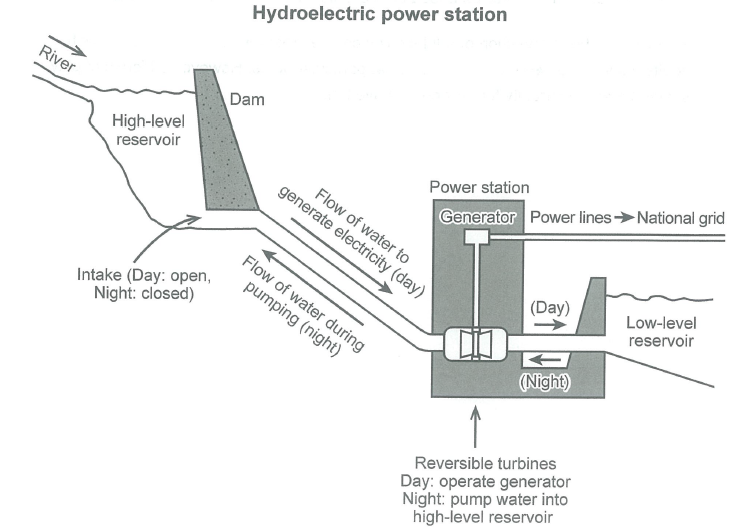
Student answer (Band 5.0)
This pictures demonstrates how electricity is produced in hydro-electric power station . The water which is used for generating electricity comes from natural water body like river . Then the station store it in water reserviors . The water is usually collected in high level container for further utilization .Furthermore ,it brings to dams for next procedure.
The power station form electricity by the aid of generator. Electricity is being generated during day time . on the other hand the water then bring backs to water body after being use at night. Moreover ,it is supplied to general populance for their daily use by national grid. In addition to this, the processes after water is released from dam and after power station are similar because water is going while day and it is pumped back at night . The water which is left behind throw to the lower water reserviors.
AI examiner evaluation
| Criterion | Band |
|---|---|
| Task Achievement / Task Response | 5.0 |
| Coherence and Cohesion | 5.0 |
| Lexical Resource | 5.0 |
| Grammatical Range and Accuracy | 5.0 |
| Overall | 5.0 |
Task Achievement / Task Response: Band 5.0
You identify the broad topic and mention several relevant components, including the river, reservoir, dam, generator, and national grid. However, the process is only partially described, and some key stages are unclear or inaccurate. For example, the account does not clearly explain that water flows from the high-level reservoir through the turbines during the day, then into the low-level reservoir; at night, the turbines pump it back uphill. The statement that water is returned “at night” blurs the two distinct operating stages, while “it brings to dams” does not accurately explain the dam’s role. A clearer overview of the day/night cycle, followed by the stages in order, would make the main features more complete and precise.
Coherence and Cohesion: Band 5.0
The response contains some relevant sequencing and uses linking expressions such as “Then,” “on the other hand,” and “In addition.” These help signal relationships between ideas, but the overall progression is difficult to follow because the stages are not consistently presented in process order. The shift from water storage to electricity generation and then to nighttime pumping is not clearly organised, and the final sentence repeats the lower-reservoir idea without resolving the sequence. Paragraphing is also limited, with the description presented as two blocks that do not clearly separate the overview from the process details. Organise the response into a brief overview and a step-by-step account, using time markers such as “During the day” and “At night” consistently.
Lexical Resource: Band 5.0
You use some task-related vocabulary, including “generator,” “national grid,” “high level,” and “lower water reservoirs,” so the reader can recognise the general subject. However, the range is limited and several word choices or collocations make the process harder to understand. For instance, “the station store it in water reservoirs” is imprecise, “brings to dams” does not express the relationship clearly, and “throw to the lower water reserviors” is unsuitable for describing water flow. Spelling and word-form errors such as “reserviors” and “populance” are also noticeable. Aim for precise process vocabulary and natural combinations, such as “water is stored,” “flows through the turbines,” and “is pumped back.”
Grammatical Range and Accuracy: Band 5.0
You attempt both simple and longer sentences, including a sentence beginning “because water is going while day,” but complex structures are often faulty and errors occur frequently. Examples include “The station store it,” where subject–verb agreement is incorrect, and “the water then bring backs,” which has an incorrect verb form. Articles and sentence boundaries are also inconsistent, as in “in hydro-electric power station” and the lower-case sentence beginning “on the other hand.” These errors sometimes make the sequence difficult to interpret. Practise accurate present-simple passive forms for processes, such as “water is stored” and “electricity is generated,” and check agreement, articles, and punctuation when editing.
See this exact question answered at other band scores. The same prompt compared across bands.
Browse more IELTS Writing model answers or get your own writing scored by the same AI examiner.