Band 5.5 IELTS Writing Task 1 Model Answer
Overall Band Score: 5.5 · Cambridge IELTS 14 · 2026-11-22
IELTS Writing Task 1 question
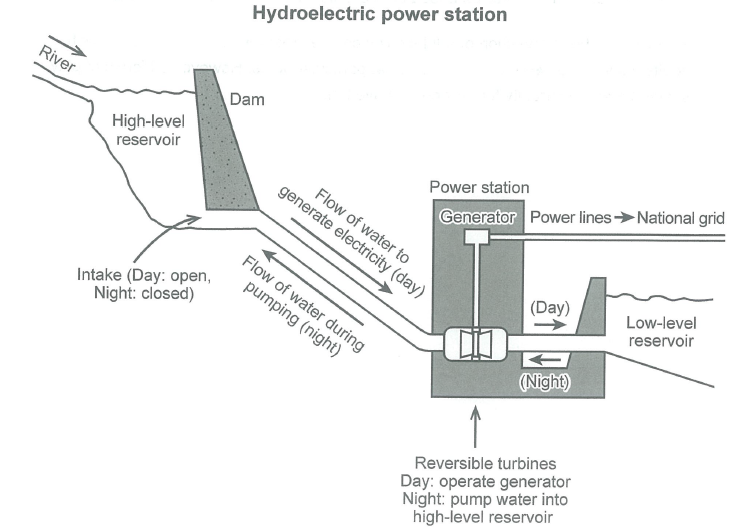
The diagram below shows how electricity is generated in a hydroelectric power station.
Summarise the information by selecting and reporting the main features, and make comparisons where relevant.
Student answer (Band 5.5)
This is the Hydroelectric power station and its the big project the direction of the river form left side and staring from the main point first we can see theser is the High-level reservir area to block the water and keep level up for generating electricity and in the day time the Power station open and at night it closes the dam gate after the flow of water goes down at day time and genarates electricity through power station with the help ofGenerator after that goes to power lines to National grid, But during night time the water that is near the Generator has been taken out with the help of water pumping. At day the Reversible turbines operate generator but at night pump water into the high-level reservoir and at last the water which passes through the generator and power line through national grid they collect into the low-level reservoir.
AI examiner evaluation
| Criterion | Band |
|---|---|
| Task Achievement / Task Response | 5.5 |
| Coherence and Cohesion | 5.0 |
| Lexical Resource | 5.5 |
| Grammatical Range and Accuracy | 5.0 |
| Overall | 5.5 |
Task Achievement / Task Response: Band 5.5
You identify the main components and describe the broad day–night cycle, including the turbines, generator, power lines and two reservoirs. The detail that the turbines generate electricity by day and pump water back at night is relevant and matches the diagram. However, some key stages are unclear or inaccurate: you say the power station opens by day and “closes the dam gate” at night, whereas it is the intake that is open by day and closed at night. The account also suggests water passes through the power lines before reaching the low-level reservoir; in fact, water flows from the turbines into that reservoir, while electricity travels separately to the grid. A clearer overview and more precise explanation of these two flows would make the process more complete.
Coherence and Cohesion: Band 5.0
The response follows a broadly chronological order and uses time markers such as “in the day time,” “after that,” and “during night time” to signal stages. This gives the reader some sense of the process. However, the whole account is presented as one long sentence, with ideas joined mainly by “and,” “after that,” and “but.” As a result, the day and night operations are not clearly separated, and the final sentence combines the water route with the electricity route. Organise the response into a short overview and separate paragraphs for daytime generation and nighttime pumping. Use clearer links such as “Meanwhile” or “By contrast,” and make references to each reservoir and flow explicit.
Lexical Resource: Band 5.5
You use several relevant process terms, including “high-level reservoir,” “reversible turbines,” “generator,” and “national grid,” which help convey the subject. However, spelling and word-choice problems are noticeable, for example “reservir,” “genarates,” and “taken out,” and some phrases are imprecise or unnatural, such as “the big project” and “the direction of the river form left side.” The repeated use of “water” and “goes” also limits precision when describing movement through the system. Aim for accurate process vocabulary and collocations, such as “flows into,” “is channelled through,” and “is pumped back.” Proofreading technical terms would make the description easier to follow.
Grammatical Range and Accuracy: Band 5.0
You attempt to connect several stages using clauses, and the response includes both present-tense descriptions and time contrasts. However, the sentence structures are limited and often become long, run-on constructions, particularly the opening sentence and the sequence beginning “after the flow of water goes down.” Punctuation does not reliably separate the stages, and some grammatical patterns are faulty, as in “the direction of the river form left side” and “the water … they collect.” Articles and agreement also need attention. Use shorter, controlled sentences, for example: “During the day, the intake is open. Water flows through the turbines, which drive the generator.” This would improve accuracy while still allowing you to use complex clauses.
See this exact question answered at other band scores. The same prompt compared across bands.
Browse more IELTS Writing model answers or get your own writing scored by the same AI examiner.