Band 5.5 IELTS Writing Task 1 Model Answer
Overall Band Score: 5.5 · Cambridge IELTS 14 · 2026-11-23
IELTS Writing Task 1 question
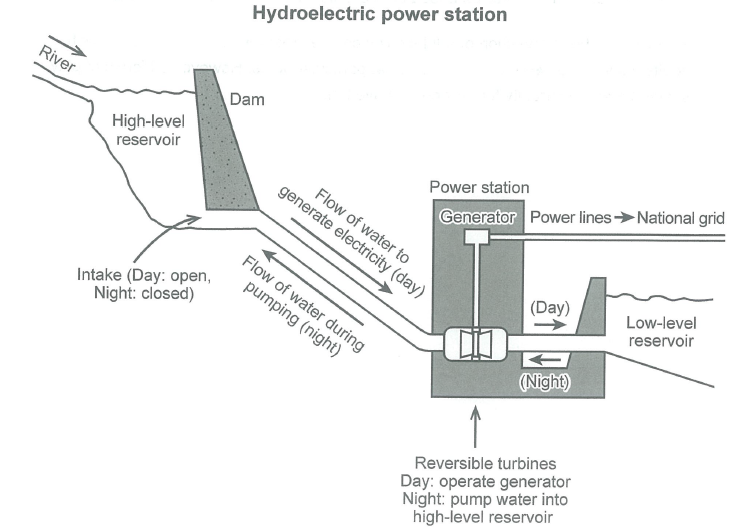
The diagram below shows how electricity is generated in a hydroelectric power station.
Summarise the information by selecting and reporting the main features, and make comparisons where relevant.
Student answer (Band 5.5)
The given diagram explain us how electricity is produced in hydro power station.
First of all waters comes from the river in the dam. There is a high level reservoir and a intake which is open in day and close in night. In day the water is used for generating electricity and in night the water pumps reverse in the dam for reuse that water to generate energy. In the next step there is a turbine it is set in the lower side of dam the water strickes to the turbine the turbine moves against the water pressure this turbine works as a turbine in the day on the other hand that turbine work as a pump to use pump the water in high level water reservoir after generate energy the water wents to low level reservoir which is situated in the lower side of dam. There is a generator which is directly connect with turbine that is a last step in the process of generation of eletricity generator converts the mechanical energy to electical energy that goes to the national grids through power lines.
In conclusion i learn how to produce electricity in hydro power stations.
AI examiner evaluation
| Criterion | Band |
|---|---|
| Task Achievement / Task Response | 5.0 |
| Coherence and Cohesion | 5.5 |
| Lexical Resource | 5.5 |
| Grammatical Range and Accuracy | 5.0 |
| Overall | 5.5 |
Task Achievement / Task Response: Band 5.0
You identify the process as hydroelectricity generation and include several relevant stages: water enters from the river, passes through an intake, drives turbines, and reaches the low-level reservoir, while electricity travels through power lines to the grid. You also mention the day/night difference. However, the account is only partly complete and some details are unclear or inaccurate. For example, water is not pumped “in the dam”; at night, it is pumped from the low-level reservoir back to the high-level reservoir. The generator and grid are described, but the two-way cycle is not clearly explained as the central feature. The conclusion about what you learned does not summarise the process. Give a concise overview of the cycle, then report the stages in their correct order and direction.
Coherence and Cohesion: Band 5.5
The response has a basic sequence, moving from the river and reservoir to the turbines, generator, and grid, and the opening signals the topic. However, most of the explanation is placed in one long paragraph, so the stages and the day/night cycle are difficult to follow. Connectors such as “First of all,” “In the next step,” and “on the other hand” provide some organisation, but they do not always clarify the relationship between steps. The sentence beginning “In day the water…” combines several stages and reverses the pumping direction, weakening progression. Use separate paragraphs for the overview and process details, and use clear sequencing and contrast markers to distinguish daytime generation from nighttime pumping.
Lexical Resource: Band 5.5
You use some relevant process vocabulary, including “reservoir,” “turbine,” “generator,” “mechanical energy,” and “power lines,” which helps communicate the subject. However, the range is limited and several word choices or collocations are inaccurate, such as “waters comes,” “water strickes to the turbine,” and “pump the water in high level water reservoir.” Spelling errors in “eletricity” and “electical” also reduce precision. Some repetition of “water,” “turbine,” and “generate” makes the description less controlled. Aim for accurate process verbs and standard technical phrases, such as “flows through,” “drives the turbines,” and “is pumped back to the upper reservoir.”
Grammatical Range and Accuracy: Band 5.0
You attempt to link ideas in longer sentences, but these structures are often faulty, and errors sometimes make the sequence hard to understand. Examples include “The given diagram explain us,” “waters comes,” and “the turbine works as a turbine in the day,” which show problems with agreement, articles, and sentence construction. The long sentence beginning “In the next step” joins several ideas without clear punctuation, while “after generate energy” lacks a correctly formed verb phrase. Most clauses follow simple patterns, with limited accurate control of more complex structures. Practise writing shorter, complete sentences first, checking subject–verb agreement and verb forms, then combine related stages using accurate clauses and punctuation.
See this exact question answered at other band scores. The same prompt compared across bands.
Browse more IELTS Writing model answers or get your own writing scored by the same AI examiner.