Band 5.5 IELTS Writing Task 1 Model Answer
Overall Band Score: 5.5 · Cambridge IELTS 14 · 2026-11-25
IELTS Writing Task 1 question
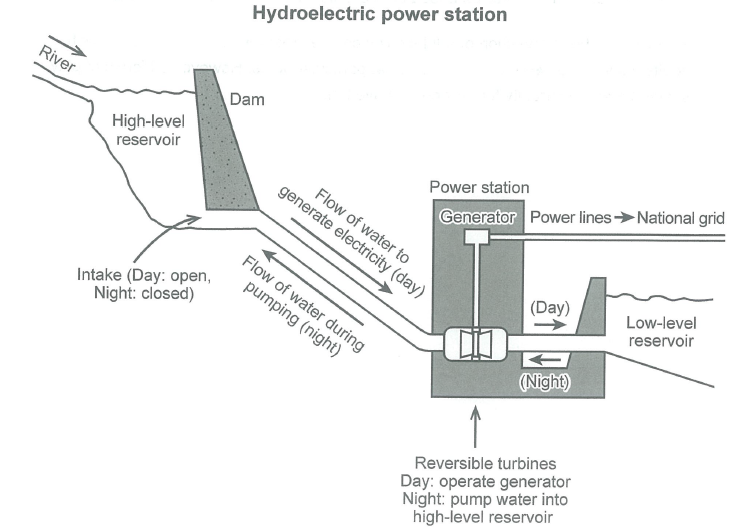
The diagram below shows how electricity is generated in a hydroelectric power station.
Summarise the information by selecting and reporting the main features, and make comparisons where relevant.
Student answer (Band 5.5)
This diagram demonstrates the stepsabout how electricity is generated in a hydroelectric power station.
There are few steps starting from river and ending at creating electricity.
At first river water meet with dam. Then in day time dam opens and flow of water meet with power station where it generates electricity. In power station there are two components first the generator and the other reversible turbines. When water comes to power station it meets with reversible turbines which operate generator at day time and then water goes to low level resorvior but at night dam closed and reversible turbines pump water in to high level resorvoir. After these all steps electricity is produced.
Over all, there are seven to eight steps that help to generate electricity by the help of hydroelectric power station
AI examiner evaluation
| Criterion | Band |
|---|---|
| Task Achievement / Task Response | 5.0 |
| Coherence and Cohesion | 5.5 |
| Lexical Resource | 5.5 |
| Grammatical Range and Accuracy | 5.0 |
| Overall | 5.5 |
Task Achievement / Task Response: Band 5.0
You identify the main day/night cycle: water passes through the turbines to generate electricity during the day, then is pumped back to the high-level reservoir at night. However, the account is incomplete and includes some unclear or inaccurate details. For example, the river feeds the high-level reservoir; it does not simply “meet with” the dam, and the intake—not the dam—is open by day and closed at night. The generator, power lines and national grid are also not clearly described, and the overview that there are “seven to eight steps” does not explain the process’s main stages. The response is 124 words, 26 words below the 150-word minimum. To develop the report, describe the full route of water and electricity and give a clearer overview.
Coherence and Cohesion: Band 5.5
The response follows a broadly chronological order, moving from the river to daytime generation and then to nighttime pumping. Linking phrases such as “At first,” “Then,” and “but at night” help signal this sequence. However, the ideas are presented in one block, and the progression becomes difficult to follow in the long sentence beginning “When water comes to power station.” The opening and closing also repeat the general idea that the diagram shows steps without adding useful information. Organise the report into a brief overview and a paragraph describing the day and night stages, and use clear references such as “the water” or “this flow” to connect steps. This would make the sequence easier to follow.
Lexical Resource: Band 5.5
You use some relevant process vocabulary, including “generator,” “reversible turbines,” “low level reservoir,” and “pump,” so the reader can recognise the topic. However, the range is limited, and several word choices or spellings make the description less precise: “meet with” is not a natural way to describe water entering or passing through a structure, while “resorvior” and “resorvoir” are misspelled. “There are few steps” is also an imprecise way to introduce a process. Use accurate terms from the diagram, such as “intake,” “conduit,” “flows into,” and “is transferred to the national grid,” and check spelling consistently. More precise process vocabulary would help you explain each stage without relying on repeated general words such as “steps” and “goes.”
Grammatical Range and Accuracy: Band 5.0
You attempt both simple and longer sentences, including a sequence joined with “which” and a contrast between daytime and nighttime operation. However, errors are frequent, and some sentences are difficult to interpret. Examples include “There are few steps starting from river,” “river water meet with dam,” and “at night dam closed”; these need articles and more accurate verb forms, such as “The river feeds the reservoir” and “the intake is closed at night.” The long sentence beginning “When water comes to power station” also has unclear clause connections and inconsistent tense. Practise accurate present-simple descriptions of processes, including subject–verb agreement, articles, and passive forms, and divide long sequences into shorter sentences.
See this exact question answered at other band scores. The same prompt compared across bands.
Browse more IELTS Writing model answers or get your own writing scored by the same AI examiner.