Band 5.5 IELTS Writing Task 1 Model Answer
Overall Band Score: 5.5 · Cambridge IELTS 14 · 2026-11-08
IELTS Writing Task 1 question
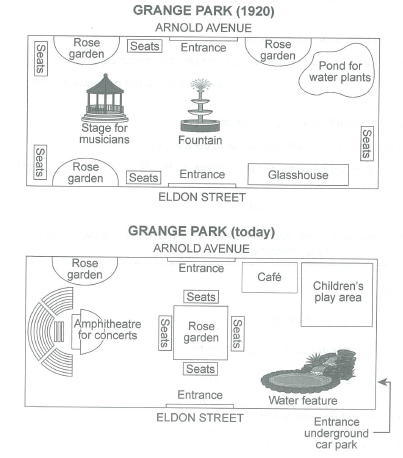
The plans below show a public park when it first opened in 1920 and the same park today.
Summarise the information by selecting and reporting the main features, and make comparisons where relevant.
Student answer (Band 5.5)
The map demonstrates how a public park changed in a hundred years (from 1920 to 2026)
Overall, the grange park changed and in today's time is considered to be commercial more than what it was back in 1920, with more places to spend money in, rather than just chilling and enjoying the fountian and the gardens.
The location of the two main entrances remained the same, one at the top when you come from arnold avenue and another one south when you come across eldon street, adding only one entrance today for the parking spot
Grange park in 1920 is known for having seats in every corner, many green spaces and a big fountain at the center, even a stage for musicians for the people interested in music, which changed nowadays and is renovated to have only one rose garden at the center with multiple seats around it, an amphitheatre for concerts west and a water feature east. Children even got their special spot to play in just beside a café where parents can mool out for them.
AI examiner evaluation
| Criterion | Band |
|---|---|
| Task Achievement / Task Response | 6.0 |
| Coherence and Cohesion | 5.5 |
| Lexical Resource | 5.5 |
| Grammatical Range and Accuracy | 5.0 |
| Overall | 5.5 |
Task Achievement / Task Response: Band 6.0
You identify the main period of change and make relevant comparisons, including the central fountain being replaced by a rose garden with surrounding seats, and the western music stage area becoming an amphitheatre. You also note that the two street entrances remain and mention the new car-park entrance. However, some important changes are omitted or unclear: the north-east pond became a children’s play area, the glasshouse site became a water feature, and the café replaced a northern rose garden. The overview that the park is now “commercial more than” before is also too broad; the plan shows a café and underground parking, but does not establish that commercial use is the park’s main character. Covering these changes more precisely would make the summary more complete.
Coherence and Cohesion: Band 5.5
The response has a recognisable overall structure: an opening, an overview, and details comparing the two plans. Ideas are generally relevant, and phrases such as “in 1920” and “today” help signal the time contrast. However, the progression is not consistently clear because several features are packed into long sentences, and the final sentence moves from the play area to the café without explaining their locations or the change from the former pond. The paragraphing is also limited, with the main comparisons grouped together rather than organised by area or by key changes. Use clearer topic sentences and link each former feature directly to its present replacement to improve the flow.
Lexical Resource: Band 5.5
You use some relevant vocabulary for describing a plan, including “entrances,” “at the center,” “amphitheatre,” and “rose garden,” so the reader can understand the main features. There is also an attempt to vary expression with “changed” and “renovated.” However, several choices are informal or imprecise for an academic map summary: “just chilling,” “spend money in,” and “special spot” sound conversational, while “commercial” overstates what the map shows. “Seats in every corner” is also not an accurate description of their distribution. Check spelling and word forms, including “fountain,” and choose neutral terms such as “recreational facilities” or “seating areas.” More precise location and change vocabulary would strengthen the description.
Grammatical Range and Accuracy: Band 5.0
You attempt a mixture of sentence forms, including a relative clause in “which changed nowadays” and a comparison between the two plans. Meaning is usually recoverable, but errors in sentence construction and punctuation make some passages difficult to follow. For example, “The location of the two main entrances remained the same, one at the top…” is a comma splice, and “Grange park in 1920 is known for having…” shifts awkwardly between past and present. The long final sentence also joins several ideas without clear grammatical boundaries. Use full stops or conjunctions to separate comparisons, keep past-tense descriptions consistent for 1920, and check articles and sentence openings. Greater control of these patterns would make the information easier to read.
See this exact question answered at other band scores. The same prompt compared across bands.
Browse more IELTS Writing model answers or get your own writing scored by the same AI examiner.