Band 5.5 IELTS Writing Task 1 Model Answer
Overall Band Score: 5.5 · Cambridge IELTS 14 · 2026-11-19
IELTS Writing Task 1 question
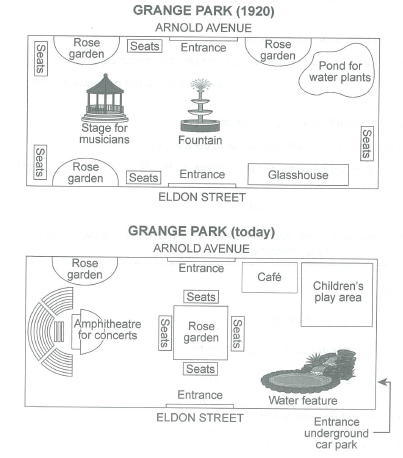
The plans below show a public park when it first opened in 1920 and the same park today.
Summarise the information by selecting and reporting the main features, and make comparisons where relevant.
Student answer (Band 5.5)
The GRANGE PARK is situated at the middle of ARNOLD AVENUE which is in the North and ELDON STREET which is in the South. Previously the park had a fountain at the centre which is now replaced by rose garden surrounded by seats. Back then there were three rose garden in three corners except the south side of the park. One of the rose garden which was beside the pond for the water plants is now replaced by a cafe and the pond is replaced by children's play area. Amphitheatre for concert has taken the place of stage for musicians now. But the rose garden near is still there as before while the seats are removed now. The glasshouse and nearby seats are replaced by water feature at present. And there is an entrance for underground car park just near that water feature which wasnot there in the 1920. Alllllso the rose garden and seats beside the south side entrance is now removed.
AI examiner evaluation
| Criterion | Band |
|---|---|
| Task Achievement / Task Response | 5.5 |
| Coherence and Cohesion | 5.0 |
| Lexical Resource | 6.0 |
| Grammatical Range and Accuracy | 5.5 |
| Overall | 5.5 |
Task Achievement / Task Response: Band 5.5
You identify several important changes, including the central fountain becoming a rose garden, the pond becoming a play area, and the glasshouse being replaced by a water feature. However, the response does not give a clear overall summary of how the park has changed, and some details are inaccurate or unclear. For example, the southern rose garden and nearby seats are described as removed, but the plan shows the south entrance area without that garden, while seats remain elsewhere around the central garden. The statement that the north-west rose garden is still there is also difficult to follow because it is followed by “the seats are removed now.” To strengthen the report, state the main pattern of change first, then compare the key locations precisely.
Coherence and Cohesion: Band 5.0
The response follows a broadly chronological comparison, moving from the earlier layout to present-day replacements, and words such as “Previously,” “now,” and “But” help signal change. However, it is presented as one continuous paragraph, so the main overview and supporting details are not clearly separated. Several transitions are abrupt, particularly “Amphitheatre for concert has taken the place…” and “Alllllso…” at the end. Some references are also unclear: “the rose garden near” does not specify which garden, and “which was not there” could refer to more than one feature. Organise the answer into an overview and a paragraph comparing the main changes, and use clear location-based references to guide the reader.
Lexical Resource: Band 6.0
You use a suitable range of map vocabulary, including “replaced,” “surrounded,” “entrance,” “fountain,” and “amphitheatre,” which allows the reader to understand most of the changes. There are also attempts at more specific expressions, such as “at the centre” and “taken the place of.” Some choices are imprecise or awkward, however: “situated at the middle of” is not a natural way to describe the park’s position, and “rose garden near” leaves the location incomplete. “Alllllso” is an inappropriate spelling and register choice for a formal report. Aim for concise, precise phrases such as “lies between,” “in the north-west corner,” and “was converted into,” while checking spelling and avoiding conversational additions.
Grammatical Range and Accuracy: Band 5.5
You attempt a mixture of simple statements and longer sentences with relative clauses, for example, “One of the rose garden which was beside the pond…,” and the sequence of past and present forms generally communicates the timeline. Some grammatical errors remain and occasionally make relationships harder to follow. These include singular-plural agreement in “three rose garden,” the incomplete construction “the rose garden near is still there,” and the missing space in “wasnot.” Articles and sentence boundaries also need attention, as in “the GRANGE PARK” and the long final sentence beginning “And there is…”. Use consistent past tense for the 1920 plan and present tense for today, and check agreement, articles, and punctuation when revising complex sentences.
See this exact question answered at other band scores. The same prompt compared across bands.
Browse more IELTS Writing model answers or get your own writing scored by the same AI examiner.