Band 5.5 IELTS Writing Task 1 Model Answer
Overall Band Score: 5.5 · Cambridge IELTS 14 · 2026-11-20
IELTS Writing Task 1 question
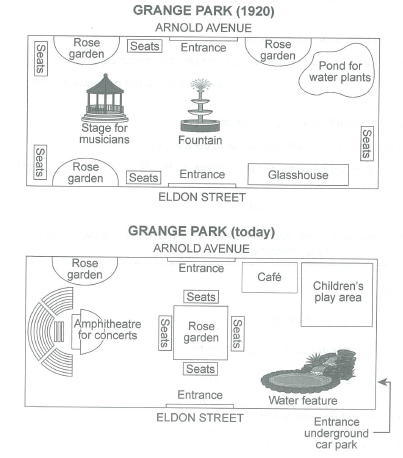
The plans below show a public park when it first opened in 1920 and the same park today.
Summarise the information by selecting and reporting the main features, and make comparisons where relevant.
Student answer (Band 5.5)
The following maps shows the old map pattern and the current map of Grange park in Arnold avenue.
Firstly, we will discuss the 1920's map and in the map we had different intresting areas for children, starting with a great huge enterance and in the mid of the map we had a beautiful fountain. Moreover, in the North side we also had an enterance which was beneficial then we had pond for water plant and three different rose gardens in the park and at last we had a stage for musicians which was the best area of that map.
Next, the current map of the Garange park is also enjoyable areas, begin with the enterance in underground car park then we have a lovely water feature and in the mid of this map we also have a rose garden with seating benchs and the major development in the current map is Ampthitheatre for concerts and in the North corner we have children's playing area with the cafe.
Overall, both maps are best but the current map have some new and amazing areas for the young genegration.
AI examiner evaluation
| Criterion | Band |
|---|---|
| Task Achievement / Task Response | 5.5 |
| Coherence and Cohesion | 6.5 |
| Lexical Resource | 5.0 |
| Grammatical Range and Accuracy | 5.0 |
| Overall | 5.5 |
Task Achievement / Task Response: Band 5.5
You identify the two time periods and report several relevant features, including the central fountain becoming a rose garden with seating, the new amphitheatre, and the play area and café. However, the account is only partly complete: it does not clearly explain that the north-west rose garden remains, or compare the former pond and glasshouse with the play area and water feature that replace them. Some details are inaccurate or unclear, such as describing a “great huge entrance” and placing the underground car-park entrance as the first feature without explaining that it is at the south-east corner. The final overview that both maps are “best” and the current park is “amazing” is subjective rather than a summary of the main changes. Prioritise accurate location-based comparisons and a concise factual overview.
Coherence and Cohesion: Band 6.5
The response has a recognisable sequence: it describes the 1920 plan, moves to the present-day plan, and ends with an overall comment. Paragraphing and signposts such as “Firstly,” “Next,” and “Overall” help the reader follow this basic progression. This gives the account a coherent overall arrangement. However, the linking is sometimes mechanical, and long strings joined by “and” make relationships between features less clear—for example, the sentence beginning “Next, the current map…” lists several locations without a clear spatial order. “Then” and “at last” also suggest a sequence that is not meaningful for a map. Group features by location or by what changed, and use comparisons such as “whereas” and “in contrast” to make the progression more precise.
Lexical Resource: Band 5.0
You use some relevant map vocabulary, including “fountain,” “pond,” “rose gardens,” “water feature,” and “amphitheatre,” so the reader can identify several park facilities. However, the range is limited and often informal or imprecise for an academic map summary. Expressions such as “beautiful,” “lovely,” “best area,” and “amazing areas” give opinions instead of describing changes, while “mid of the map” and “children's playing area” are not natural or precise collocations. Spelling errors, including “intresting,” “Garange,” “Ampthitheatre,” and “genegration,” also reduce accuracy. Build a more neutral vocabulary for location and change, and check spelling carefully; terms such as “central area,” “replaced,” and “located” would support clearer reporting.
Grammatical Range and Accuracy: Band 5.0
You attempt to connect ideas in longer sentences, but the response relies heavily on simple clauses joined with “and,” and complex sentences are often not controlled accurately. The opening, “The following maps shows,” has a subject–verb agreement error; “the current map have” repeats this problem. There are also issues with articles and sentence construction in “is also enjoyable areas” and “starting with a great huge enterance.” The tense shifts between “we had” for the historical plan and present-tense descriptions without a consistent pattern. These errors sometimes make relationships between features harder to follow. Use past tense for the 1920 layout and present tense for today, and practise accurate comparison structures, for example, “The pond was replaced by a children’s play area.”
See this exact question answered at other band scores. The same prompt compared across bands.
Browse more IELTS Writing model answers or get your own writing scored by the same AI examiner.