Band 5.5 IELTS Writing Task 1 Model Answer
Overall Band Score: 5.5 · Cambridge IELTS 14 · 2026-11-20
IELTS Writing Task 1 question
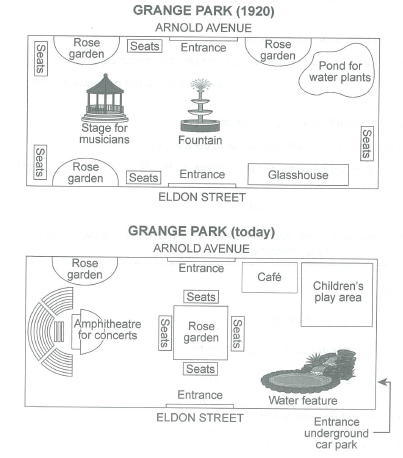
The plans below show a public park when it first opened in 1920 and the same park today.
Summarise the information by selecting and reporting the main features, and make comparisons where relevant.
Student answer (Band 5.5)
the given map illustrate the grange park which is opened in 1920 and the same park today. according to this map we can see numerous changes in this map which i explain in following paragraph. first map is 106years old map .first of all we can saw a fountain in the middle of map and main entrance had north and south both sides of the map and when we intered in south side we moved on left side there is rose garden .and north east corner had pond for water plants .and east side there was seats place .morover when we went west side of fountain we saw a stage of musicians and this apposite side north and south had rose garden .and two more seats in west side in corners. now today in 2026 we see a different changes in new map .main entrance are still same and remaind same place north and south .fountain is convert in rose garden and this four sides have seats .morover,cafe is add on this map at rose garden place which is north left side of new map.in addition, pond of water plants is convert to children play area and water feature is new addition on south east corner .furthermore,the ampitheater for concerts is new changes in today map. at the end ,as a coclusion the new today map is better than the old map many new things are add in this map therefore this map is absolutly good .
AI examiner evaluation
| Criterion | Band |
|---|---|
| Task Achievement / Task Response | 5.5 |
| Coherence and Cohesion | 5.0 |
| Lexical Resource | 5.5 |
| Grammatical Range and Accuracy | 5.0 |
| Overall | 5.5 |
Task Achievement / Task Response: Band 5.5
You identify several important changes, including the central fountain becoming a rose garden, the pond becoming a children’s play area, and the addition of a water feature and concert amphitheatre. You also note that the north and south entrances remain. However, the response only partly covers the plans: it omits the café’s location in relation to the former rose garden, the underground car-park entrance, and the glasshouse’s replacement. Some locations are unclear or inaccurate; for example, the 1920 rose garden was in the south-west, not simply to the left after entering from the south, and the café is east of the northern entrance. The final claim that the new park is “better” is unsupported. A concise overview of the main transformations, followed by accurate comparisons, would make the report more complete.
Coherence and Cohesion: Band 5.0
The response has a basic chronological structure: it describes the 1920 plan first and the present-day plan second. This helps readers follow the broad comparison, and linking expressions such as “in addition” and “furthermore” show an attempt to connect information. However, the opening promises a paragraph-by-paragraph explanation, while the body is largely one long, loosely punctuated sequence. Repeated transitions such as “moreover” and “and” do not always clarify how features relate spatially, and phrases like “this apposite side north and south” are difficult to follow. The conclusion repeats a personal judgement rather than summarising the key changes. Use separate paragraphs for the overview and details, and group features by location or by what was replaced.
Lexical Resource: Band 5.5
You use some relevant map vocabulary, including “fountain,” “rose garden,” “pond for water plants,” “children play area,” and “amphitheater for concerts,” so the reader can identify many features. There are also attempts to describe change with “convert” and “new addition.” However, the range is limited and several choices or spellings make the description less precise, such as “seats place,” “different changes,” “intered,” and “coclusion.” “Better” and “absolutely good” are evaluative rather than suitable for a neutral map report. Aim for precise verbs and collocations such as “was replaced by,” “was added,” and “is located in the north-east corner.” Check spelling of key labels and avoid repeating “map” and “new.”
Grammatical Range and Accuracy: Band 5.0
You attempt to combine ideas using clauses, for example, “when we went west side of fountain we saw a stage,” and you use present and past forms to distinguish the two plans. However, sentence structures are limited, and many sentences contain errors that make relationships or timing harder to understand. Examples include “the grange park which is opened in 1920,” “main entrance are still same,” and “fountain is convert in rose garden.” Articles, agreement, verb forms, and sentence boundaries need more consistent control. Several long sentences are joined with “and” or commas without clear punctuation, while capitalisation is also inconsistent. Practise accurate past-tense descriptions of the original plan and present-tense descriptions of today’s layout, using shorter, complete sentences before adding complex clauses.
See this exact question answered at other band scores. The same prompt compared across bands.
Browse more IELTS Writing model answers or get your own writing scored by the same AI examiner.