Band 5.5 IELTS Writing Task 1 Model Answer
Overall Band Score: 5.5 · Cambridge IELTS 14 · 2026-11-20
IELTS Writing Task 1 question
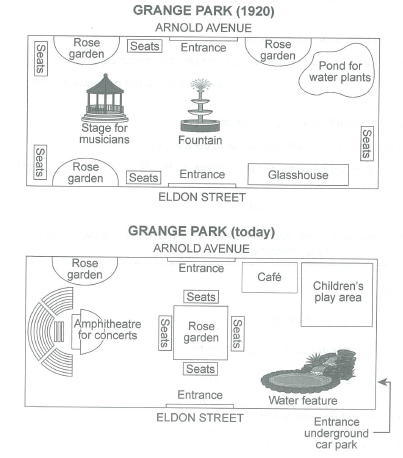
The plans below show a public park when it first opened in 1920 and the same park today.
Summarise the information by selecting and reporting the main features, and make comparisons where relevant.
Student answer (Band 5.5)
The maps illustrates the change from 1920 to today.Overall, park underwent significant redevelopment,with new areas constructed and some existing features replaced.In 1920 there is a fountain in park now it replaced with the Rose garden also around it some sitting place added.In today park extra entrance for underground parking available and other two entrance remain in same place as these are before .However in 1920 park where is pond for water plants now there is children,s play area and now the pond for water plants is in the glass house place although there is no glass house in today park.
In 1920 park seat are in the different places and now these are around the rose garden only.One new thing build in the today park is cafe .Although there are three Rose garden in 1920 but now only two .In today park the Amphitheatre for concerts constructed befor there is only a stage exist.
AI examiner evaluation
| Criterion | Band |
|---|---|
| Task Achievement / Task Response | 6.0 |
| Coherence and Cohesion | 5.0 |
| Lexical Resource | 5.5 |
| Grammatical Range and Accuracy | 5.0 |
| Overall | 5.5 |
Task Achievement / Task Response: Band 6.0
You identify the main transformation: the central fountain is replaced by a rose garden, and the former pond area becomes a children’s play area. You also note the café, the reduced number of rose gardens, and the change from a stage to an amphitheatre, so the response covers several relevant features. However, some details are inaccurate: the water feature is in the former glasshouse location, not the pond’s location, and the seats now surround the central rose garden rather than being only there. The overview is present but broad, and several changes are listed without clear locations or comparison. To strengthen the report, describe the western redevelopment and the north-west garden’s retention, and check each location against the plans.
Coherence and Cohesion: Band 5.0
The response has an identifiable overall structure: an opening and overview are followed by details about changes to the park. This gives the reader a basic route through the information. However, progression within the paragraphs is uneven, and several ideas are joined in long, crowded sentences, such as the sentence beginning “However in 1920 park where is pond…”. Linking words including “also,” “however,” and “although” are sometimes used mechanically or do not clearly show the relationship between ideas. References such as “these” and “there” can also be unclear. Group the changes by area—for example, the centre and west, then the north and south—and use shorter sentences with precise location references.
Lexical Resource: Band 5.5
You use relevant map vocabulary, including “fountain,” “rose garden,” “children’s play area,” “entrance,” and “Amphitheatre for concerts,” which allows the reader to recognise many of the features. There are also attempts at useful change language, such as “replaced” and “constructed.” However, word choice and collocation are often imprecise: “sitting place” is not natural for park seating, “extra entrance” is vague, and “the pond for water plants is in the glass house place” mislabels the feature and location. Spelling and word forms such as “cafe,” “befor,” and “build” also reduce accuracy. Use consistent terms such as “seating,” “additional entrance,” and “the water feature occupies the former glasshouse site.”
Grammatical Range and Accuracy: Band 5.0
You attempt both simple and more complex sentences, including clauses introduced by “although” and “where,” and the main ideas are generally understandable. However, errors in sentence structure, agreement, articles, and tense occur across the response. For example, “The maps illustrates” has subject–verb disagreement, while “In 1920 there is a fountain in park now it replaced” combines clauses without clear punctuation and uses an unsuitable tense. Missing articles and awkward constructions also appear in “in today park” and “there is only a stage exist.” Use past tense for the 1920 plan and present tense for today, and check each sentence for a clear subject and verb. Full stops between separate comparisons would improve control.
See this exact question answered at other band scores. The same prompt compared across bands.
Browse more IELTS Writing model answers or get your own writing scored by the same AI examiner.