Band 5.0 IELTS Writing Task 1 Model Answer
Overall Band Score: 5.0 · Cambridge IELTS 14 · 2026-11-25
IELTS Writing Task 1 question
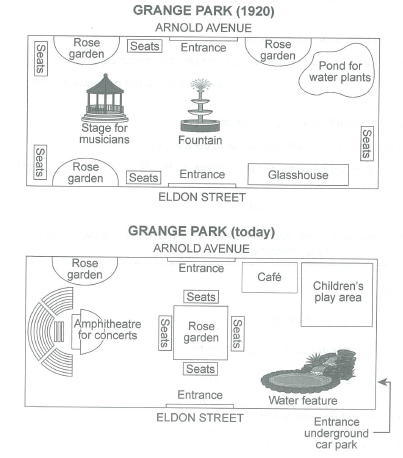
The plans below show a public park when it first opened in 1920 and the same park today.
Summarise the information by selecting and reporting the main features, and make comparisons where relevant.
Student answer (Band 5.0)
introduction.
this plans illustrate that the grange park in 1920 to today. see the huge comparesion in this time the parks things are change due to changing of time. and in 1920 the park have a small stage for the musicians but it change in today. and now there are a huge amphitheatre for concerts.
overall, in 1920 the grange park is huge at this time. the first thing is stagefor musicians to perform a music. but it change in today grange park now it replace the stage for musicians to big amphitheatre for concerts. and in 1920 the park have water foundation in his middle. but it change to small rose garden and also installed seats in his corners for people. and the last one is glass house. it change to water feature in today grange park.
BODY PARAGRAPH 1
in 1920 the grange park has to entrance, one is arnold avenue and second is eldon street. when you enter in this park. you can see the beautifull water foundation. and the left side of the foundation you see the stage for musicians.back of the stage. you can also see the rose garden. and the right side of the eldon street entrance there is glass house. and front of the glass house you see the pond for water plants .
BODY PARAGRAPH 2
today grange park have also two enterence. pne is eldon street and second is arnold avenue. and near enterence the underground parking is also avialable
AI examiner evaluation
| Criterion | Band |
|---|---|
| Task Achievement / Task Response | 5.5 |
| Coherence and Cohesion | 4.5 |
| Lexical Resource | 5.0 |
| Grammatical Range and Accuracy | 4.5 |
| Overall | 5.0 |
Task Achievement / Task Response: Band 5.5
You identify several important changes, including the replacement of the musicians’ stage by an amphitheatre, the central fountain by a rose garden, and the glasshouse by a water feature. You also mention the two street entrances and the underground car park. However, the account is only partial: the present-day café and children’s play area are omitted, as are the north-west rose garden that remains and the seating around the central garden. Some locations are misreported: the pond was in the north-east corner, not “front of the glass house,” and the rose garden was not simply replaced by seats in its corners. A clearer overview of the park’s main changes, followed by accurate comparisons of both plans, would make the response more complete.
Coherence and Cohesion: Band 4.5
The response has identifiable sections and attempts to describe the 1920 plan before the present-day plan, so the reader can recognise the intended comparison. However, progression is weak: the introduction and overview repeat the stage, amphitheatre, fountain and rose-garden changes, while the second body paragraph gives only a brief detail about the current layout. Linking phrases such as “but it change” are repeated and do not always clarify the relationship between features. Some references are also difficult to follow, for example “back of the stage” and “front of the glass house.” Organise the response into a concise overview and two plan-based paragraphs, and use clear location language to guide the reader through each map.
Lexical Resource: Band 5.0
You use some relevant map vocabulary, including “entrance,” “rose garden,” “pond,” “stage,” and “amphitheatre,” which helps communicate the main subject. However, the range is limited and several words or phrases are repeated, particularly “change,” “today,” and “you can see.” There are also noticeable spelling and word-choice problems, such as “comparesion,” “beautifull,” “enterence,” and “water foundation”; the last phrase is not the appropriate name for the feature shown. Phrases such as “the park have a small stage” also rely on basic wording rather than precise description. Build a wider set of accurate terms for map changes and locations, and check spelling and collocations before finishing.
Grammatical Range and Accuracy: Band 4.5
The response attempts both simple statements and longer sentences, but grammatical control is inconsistent, and errors often make relationships between features harder to understand. Examples include “this plans illustrate,” “the park have,” and “it change,” where demonstratives, agreement and verb forms are inaccurate. Articles and sentence construction are also problematic in “the left side of the foundation you see the stage,” while several sentences begin with lowercase letters or run together after full stops. The repeated use of “and” and “but” limits the range of structures. Practise accurate present- and past-tense descriptions, subject–verb agreement, and complete sentences; for example, “In 1920, a fountain stood in the centre, but it has since been replaced by a rose garden.”
See this exact question answered at other band scores. The same prompt compared across bands.
Browse more IELTS Writing model answers or get your own writing scored by the same AI examiner.