Band 6.5 IELTS Writing Task 1 Model Answer
Overall Band Score: 6.5 · Cambridge IELTS 11 · 2026-11-10
IELTS Writing Task 1 question
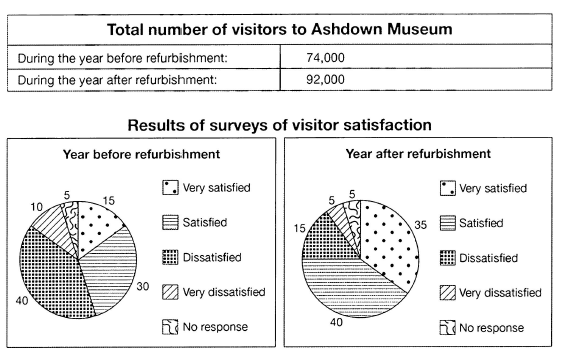
The table below shows the numbers of visitors to Ashdown Museum during the year before and the year after it was refurbished. The charts show the result of surveys asking visitors how satisfied they were with their visit, during the same two periods.
Summarise the information by selecting and reporting the main features, and make comparisons where relevant.
Student answer (Band 6.5)
The table illustrates the total number of visitors to Ashdown Museum and the two pie charts depict the results of surveys of visitor satisfaction with five aspects of feedback .
Overall , it is observed that the total number of visitors rose substanially after the renovation of Ashdown Museum. Whereas, very satisfied feedback grew significantly after the refurbishment.
Turning to the details, before the refurbishment of Ashdown Museum had the 74,000 travellers during the year . Additionally, dissatisfied feedback received by vistors had the largest proportion which accounted for 40% , followed by satisfied at 30%.Very satisfied feedback recorded 15% from respondents . No response and Very dissatisfied recorded very lowest share with 5% and 10% respectively.
Apart from that, travellers to Ashdown museum grew sharply to 92,000 after the reconstruction. very satisfied feeback went up steeply to 35%. Satisfied feedback increased marginally 30% to 40% after the renovation .No response remained unchanged and very dissatisfied fell slighlt to 10% to 5% . Dissatisfied feedback from visitors decreased significantly to 40% to 15%.
AI examiner evaluation
| Criterion | Band |
|---|---|
| Task Achievement / Task Response | 7.5 |
| Coherence and Cohesion | 6.5 |
| Lexical Resource | 6.0 |
| Grammatical Range and Accuracy | 5.5 |
| Overall | 6.5 |
Task Achievement / Task Response: Band 7.5
The response selects the main features and reports the figures accurately: visitors rose from 74,000 to 92,000, satisfaction increased overall, and dissatisfaction declined. It also gives useful detail on each survey category, including the unchanged 5% with no response. The overview identifies the rise in visitors and the growth in very satisfied responses, though it could more clearly summarise the broad shift from predominantly dissatisfied feedback before refurbishment to predominantly satisfied feedback afterwards. One comparison is expressed unclearly: “Dissatisfied feedback … decreased significantly to 40% to 15%” should state that it fell from 40% to 15%. Overall, the key information is covered and supported with relevant data; a sharper overview and clearer comparison wording would make the summary more complete and precise.
Coherence and Cohesion: Band 6.5
The response has a clear overall structure: an introduction, an overview, and separate paragraphs for the two periods. This makes the information easy to locate, and sequencing the figures by year is a sensible approach. Some linking is effective, such as “Additionally” and “Apart from that,” but transitions are occasionally mechanical or awkward, and punctuation spacing disrupts the flow. The final paragraph also groups several comparisons into a long sequence, making the relationship between figures less clear. For stronger progression, organise the details around the main contrast—positive versus negative satisfaction—and use concise links such as “By contrast” or “Meanwhile.” The paragraphing is appropriate, but cohesion is not consistently smooth.
Lexical Resource: Band 6.0
There is an adequate range of task-related vocabulary, including “proportion,” “accounted for,” “remained unchanged,” and “decreased significantly.” The writer also attempts varied trend language, such as “rose,” “grew,” and “fell.” However, some choices are imprecise or unnatural: visitors are called “travellers,” survey results are described as “feedback,” and “reconstruction” is not the most accurate term for refurbishment. Spelling errors such as “substanially,” “vistors,” “feeback,” and “slighlt” are noticeable, although the intended meaning is generally recoverable. Aim for precise chart language—“visitors,” “respondents,” and “satisfaction ratings”—and check spelling carefully. More accurate collocations would improve clarity and control.
Grammatical Range and Accuracy: Band 5.5
The response attempts a mix of simple and more complex forms, including the contrast introduced by “Whereas” and the participial phrase “followed by satisfied at 30%.” However, some sentence structures are incomplete or awkward. “Whereas, very satisfied feedback grew significantly” is a dependent clause presented as a sentence, while “before the refurbishment … had the 74,000 travellers” has an unclear subject and faulty construction. Comparisons also need clearer grammatical framing: “fell … to 10% to 5%” should be “fell from 10% to 5%.” Comma spacing and missing spaces after full stops further affect punctuation. Practise complete clauses and consistent “from … to …” patterns; this will make the range of structures more accurate and easier to follow.
See this exact question answered at other band scores. The same prompt compared across bands.
Browse more IELTS Writing model answers or get your own writing scored by the same AI examiner.