Band 6.0 IELTS Writing Task 1 Model Answer
Overall Band Score: 6.0 · Cambridge IELTS 11 · 2026-11-10
IELTS Writing Task 1 question
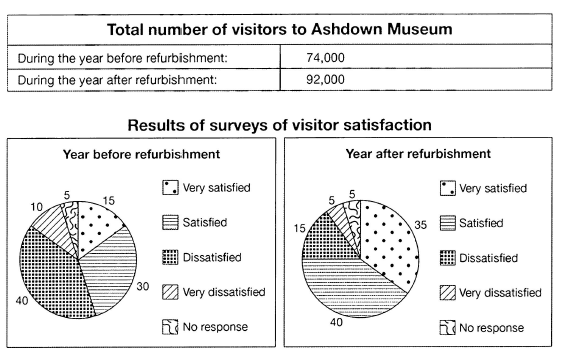
The table below shows the numbers of visitors to Ashdown Museum during the year before and the year after it was refurbished. The charts show the result of surveys asking visitors how satisfied they were with their visit, during the same two periods.
Summarise the information by selecting and reporting the main features, and make comparisons where relevant.
Student answer (Band 6.0)
The chart compares the proportion of visitors from of a Ashdown museum before and after its renovation. The chart illustrates the finding of survey about visitors satisfaction about their visit to museum during the same periods. The categories to collect survey was in 5 options.
Overall, the number of tourisits increase after its refurbishment, they were very satisified with the result. Before renovation, there were huge unsatisfactory visitors. Refurbishment improves museum overall outcome.
There is increase of 18000 visitors after renovation, in after year, almost 35% people were highly satisfied, which were only 15% before. The ratio of dissatisfied visitors were also reduced with 15% from 40%. The graph shows 40% were happy about renovation which increase by 10% from previous year.
On the other hand, the ratio of very dissatisfied tourists also decline with 5% from 15%. In before and after years there were 5% visitors who does not gave any response on survey.
AI examiner evaluation
| Criterion | Band |
|---|---|
| Task Achievement / Task Response | 7.0 |
| Coherence and Cohesion | 6.0 |
| Lexical Resource | 5.5 |
| Grammatical Range and Accuracy | 5.0 |
| Overall | 6.0 |
Task Achievement / Task Response: Band 7.0
You address the task by describing visitor numbers and the survey results, and your overview identifies the main direction of change: attendance rose and satisfaction improved after refurbishment. Several key figures are accurate, including the increase from 74,000 to 92,000, very satisfied visitors rising from 15% to 35%, and dissatisfied visitors falling from 40% to 15%. However, some comparisons are unclear or inaccurate: “40% were happy” should be identified as satisfied, and this rose by 10 percentage points, while very dissatisfied visitors fell from 10% to 5%, not from 15%. The overview also overgeneralises by saying visitors were “very satisfied” without distinguishing the satisfaction categories. More precise reporting of all categories would make the comparisons better supported.
Coherence and Cohesion: Band 6.0
The response has a recognisable structure, with an introduction, an overview and two detail paragraphs. The broad progression from attendance and overall satisfaction to individual survey categories is sensible. However, links between ideas are sometimes mechanical or unclear. For example, “On the other hand” introduces another decline, rather than a contrasting point, and “they were very satisfied with the result” has an unclear reference. Some information is also grouped in a way that makes comparisons harder to follow: the 40% satisfied figure appears after the discussion of dissatisfaction, without a clear contrast. Use more precise referencing and organise the survey figures consistently—for example, compare positive responses first, then negative responses and non-responses.
Lexical Resource: Band 5.5
You use relevant task vocabulary such as “proportion,” “survey,” “satisfied,” and “refurbishment,” so the reader can understand the topic and main trends. However, word choice and collocation are often imprecise, and spelling errors are noticeable: “tourisits,” “satisified,” and “unsatisfactory visitors” weaken clarity. Phrases such as “the finding of survey,” “the ratio of very dissatisfied tourists,” and “museum overall outcome” are not natural ways to describe these data. Prefer standard chart language, such as “survey results,” “the percentage of visitors,” and “overall satisfaction.” Take care to distinguish “satisfied” from “very satisfied,” since these labels represent separate categories.
Grammatical Range and Accuracy: Band 5.0
You attempt both simple and more complex sentences, including “Before renovation, there were…” and a sentence linking the increase in attendance with satisfaction. However, the range is limited and errors in sentence structure, agreement, articles and verb forms are frequent enough to make some statements awkward. For example, “The categories to collect survey was in 5 options” has faulty agreement and construction; “the number of tourisits increase” needs a past-tense verb; and “visitors who does not gave any response” has errors in both agreement and verb form. The opening also contains an unclear article and preposition sequence. Build accuracy with shorter, complete sentences first, then practise combining comparisons using correctly formed clauses.
See this exact question answered at other band scores. The same prompt compared across bands.
Browse more IELTS Writing model answers or get your own writing scored by the same AI examiner.