Band 6.5 IELTS Writing Task 1 Model Answer
Overall Band Score: 6.5 · Cambridge IELTS 11 · 2026-11-10
IELTS Writing Task 1 question
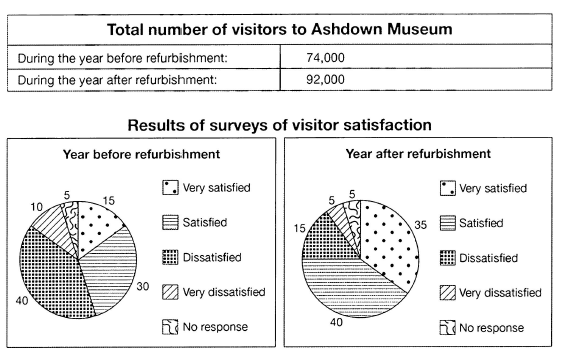
The table below shows the numbers of visitors to Ashdown Museum during the year before and the year after it was refurbished. The charts show the result of surveys asking visitors how satisfied they were with their visit, during the same two periods.
Summarise the information by selecting and reporting the main features, and make comparisons where relevant.
Student answer (Band 6.5)
THE GIVEN TABLE CHART ILLUSTRATES THE TOTAL NUMBER OF VISITORS IN THE MUSEUM WHILE THE PROVIDED PIE CHARTS INDICATES THE SATISFACTION LEVEL OF VISITORS.
OVERALL,DURING THE YEAR BEFORE REFURBISHMENT VISITORS WAS LOW BUT AFTER THE YEAR THEY WERE INCREASED.DISSATISFACTION WAS HIGH IN PEOPLE IN THE YEAR BEFORE REFURBISHMENT AND AFTER REFURBISHMENT THE LEVEL OF SATISFIED INCREASED.IN BOTH YEAR LEVEL OF NO RESPONSE REMAINED SAME AND LESS THAN OTHERS.
FIRSTLY,THE TOTAL NUMBER OF VISITORS TO ASHDOWN MUSEUM BEFORE THE REFURBISHMENT WAS 74000 WHILE THE NUMBER OF VISITORS WAS ROSE AFTER REFURBISHMENT AND ABOUT 92000.
SECONDLY,IN THE YEAR BEFORE REFURBISHMENT THE LEVEL OF DISSATISFIED PEOPLE WAS HIGHER AND ABOUT 40%,SOME WERE VERY SATISFIED ABOUT 15 PERCENT AND THE SATISFIED PEOPLE WERE ABOUT THIRTY PERCENT.LEVEL OF VERY DISSATISFIED PEOPLE WERE 10% WHILE THE NO RESONSED WERE ONLY FIVE PERCENT.
LASTLY,IN THE YEAR AFTER REFURBISHMENT THE LEVEL OF SATISFIED PEOPLE WERE ABOUT 40% WHILE THE PEOPLE WITH VERY SATISFIED WERE ABOUT THIRTY FIVE PERCENT.THE PEOPLE WITH DISSATISFIED WERE ABOUT 15 PERCENT AND THE LEVEL OF PEOPLE WITH VERY DISSATISFIED AND NO RESPONSE WERE ONLY 5%, RESPECTIVELY.
AI examiner evaluation
| Criterion | Band |
|---|---|
| Task Achievement / Task Response | 7.5 |
| Coherence and Cohesion | 7.0 |
| Lexical Resource | 5.5 |
| Grammatical Range and Accuracy | 5.0 |
| Overall | 6.5 |
Task Achievement / Task Response: Band 7.5
You cover the main features and report the figures accurately: visitors rose from 74,000 to 92,000, dissatisfaction fell from 40% to 15%, and satisfaction increased after refurbishment. The overview also identifies the unchanged 5% with no response, while the body includes the other survey categories for both years. This gives the reader a clear account of the key comparisons and supports a strong response to the task. To make the summary more precise, distinguish the two positive categories in the overview: both “satisfied” and “very satisfied” increased, rather than referring generally to “the level of satisfied.” You could also state more explicitly that dissatisfaction and very dissatisfaction both declined.
Coherence and Cohesion: Band 7.0
The response has a clear overall progression: an introduction, an overview, then separate descriptions of the two periods. Sequencers such as “Firstly,” “Secondly,” and “Lastly” help the reader follow the information, and the comparisons are generally easy to locate. However, these transitions are somewhat mechanical, and the repeated structure of listing each category makes the report feel less fluid. Some links between ideas could be more precise; for example, the overview moves from visitor numbers to satisfaction without a clear contrast or connection. Grouping the positive responses together and the negative responses together would create a more natural comparison across the two years and strengthen the progression.
Lexical Resource: Band 5.5
You use relevant task vocabulary, including “refurbishment,” “dissatisfied,” “satisfied,” and “total number of visitors,” so the subject is clear. However, the range is limited and several phrases are awkward or imprecise, such as “the level of satisfied,” “the people with dissatisfied,” and “the number of visitors was rose.” “No responsed” is also an inaccurate form. These choices sometimes make the report less natural, even though the intended meaning is usually recoverable. Aim for concise, conventional chart language, such as “the proportion of visitors who were satisfied” and “visitor numbers rose.” Check spelling and word forms carefully, and avoid repeating “people” when “visitors” or “respondents” is more appropriate.
Grammatical Range and Accuracy: Band 5.0
Your response communicates the main comparisons, but grammatical control is uneven. Errors include subject–verb agreement in “visitors was low” and “the level … were,” and faulty verb forms in “they were increased” and “the number of visitors was rose.” Several sentences also omit necessary grammatical elements, as in “the level of dissatisfied people was higher,” while punctuation and spacing are inconsistent. Most sentences follow a simple listing pattern, with limited variety in clause structures; attempts to combine ideas sometimes produce errors. Practise accurate comparative sentences, for example, “Visitor numbers rose from 74,000 to 92,000,” and use a consistent past-tense structure when describing both survey periods. Clear sentence boundaries and standard punctuation would also improve readability.
See this exact question answered at other band scores. The same prompt compared across bands.
Browse more IELTS Writing model answers or get your own writing scored by the same AI examiner.