Band 5.5 IELTS Writing Task 1 Model Answer
Overall Band Score: 5.5 · Cambridge IELTS 11 · 2026-11-11
IELTS Writing Task 1 question
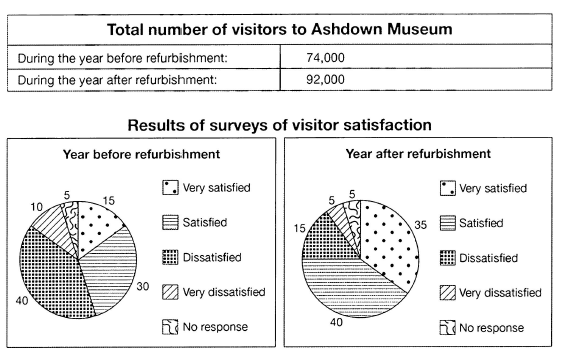
The table below shows the numbers of visitors to Ashdown Museum during the year before and the year after it was refurbished. The charts show the result of surveys asking visitors how satisfied they were with their visit, during the same two periods.
Summarise the information by selecting and reporting the main features, and make comparisons where relevant.
Student answer (Band 5.5)
The table illustrates the number of tourist visited Ashdown Museum compare between time period of refurbishment.The chart depics the outcome of how much people loved and liked the place after visiting in both time period.
Overall, In table figures of people visited after renovation more than the year before refurbishment . Similarly, mostly people are not satisfied before the renovation of museum but after the reovation there is a daramatical change and the figures of Dissatisfied changes into satisfied tourists.
Firstly, Number of visitors was before refurbishment had les figures around 74 thousand but after the renovation show a significant increase in figures and reached 92 thousnd in the time period .
Furthermore, Survey results showed that around 40% people were not satisfied and 30% had satisfied and remains 10 percent also very dissatisfied . Similarly, around 15% figures were very satisfied and 5% had no reponse but after renovation there is a daramatical change occur and 35% of visitors review was very satisfied and 40 % rated satisfied there was very less number of dissatisfied and very dissatisfied that was around 15 % and 5% respctively. but no response proportion remains same of 5% in the end.
AI examiner evaluation
| Criterion | Band |
|---|---|
| Task Achievement / Task Response | 6.5 |
| Coherence and Cohesion | 6.0 |
| Lexical Resource | 5.0 |
| Grammatical Range and Accuracy | 5.0 |
| Overall | 5.5 |
Task Achievement / Task Response: Band 6.5
You cover both the visitor totals and the satisfaction surveys, and your overview identifies the main contrasts: attendance rose from 74,000 to 92,000, while satisfaction improved after refurbishment. Most figures are reported accurately, including the unchanged 5% with no response. This meets the task well, and the overview shows some ability to select key features rather than list every figure. However, the statement that “mostly people are not satisfied” before refurbishment is imprecise: 40% were dissatisfied, but this was not a majority. The description of the survey changes is also compressed, so the shift from 40% dissatisfied to 15% and from 10% very dissatisfied to 5% could be made clearer. More precise comparisons and fuller development of the overview would strengthen the response further.
Coherence and Cohesion: Band 6.0
The response has a recognisable structure: an introduction, an overview, and two paragraphs presenting the visitor total and survey results. Sequencing words such as “Overall,” “Firstly,” and “Furthermore” help signal the stages of the description. However, some links are mechanical or unclear, particularly the repeated use of “Similarly,” which does not always express a clear comparison. The long final paragraph combines several before-and-after figures, making the progression harder to follow, and the opening sentences contain little spacing after full stops. Grouping the survey results into positive and negative responses, then comparing the two years, would create clearer progression. Use reference words and linking phrases more selectively so the relationships between figures are explicit.
Lexical Resource: Band 5.0
You use some relevant task vocabulary, including “refurbishment,” “significant increase,” “proportion,” and “rated satisfied,” and the reader can generally understand the intended comparisons. However, the range and control are limited by repeated or imprecise expressions such as “figures,” “people,” and “dramatically change.” Several word choices and collocations sound unnatural, for example “tourist visited,” “how much people loved and liked the place,” and “visitors review.” Spelling errors such as “depics,” “reovation,” “thousnd,” and “respctively” also reduce accuracy. Aim for concise, conventional chart language and check spelling carefully; precise terms such as “visitors,” “share,” and “satisfaction ratings” will make the report clearer and more formal.
Grammatical Range and Accuracy: Band 5.0
You attempt both simple and more extended sentence forms, including a contrast between the two periods and a clause beginning “but after renovation.” However, control is inconsistent, and errors sometimes make relationships between ideas difficult to follow. Examples include “The table illustrates the number of tourist visited,” “figures of people visited,” and “there is a daramatical change occur,” where sentence structure, verb forms, or agreement are faulty. Articles and sentence boundaries also need attention: “after renovation” and “in the time period” are used without consistently natural grammatical framing, while several sentences run together or begin with a lower-case “but.” Build shorter, complete sentences first, then add accurate comparison clauses. Check subject–verb agreement, verb tense, and punctuation during revision.
See this exact question answered at other band scores. The same prompt compared across bands.
Browse more IELTS Writing model answers or get your own writing scored by the same AI examiner.