Band 4.5 IELTS Writing Task 1 Model Answer
Overall Band Score: 4.5 · Cambridge IELTS 11 · 2026-11-11
IELTS Writing Task 1 question
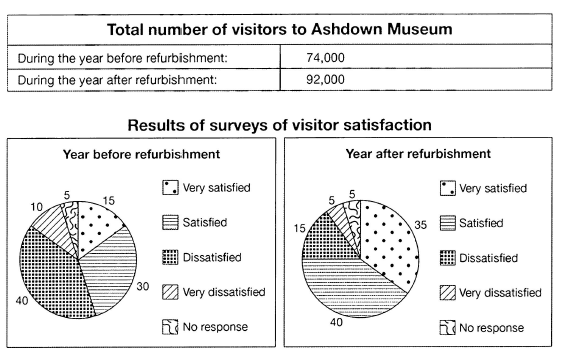
The table below shows the numbers of visitors to Ashdown Museum during the year before and the year after it was refurbished. The charts show the result of surveys asking visitors how satisfied they were with their visit, during the same two periods.
Summarise the information by selecting and reporting the main features, and make comparisons where relevant.
Student answer (Band 4.5)
The two type of pie chart illustretesthe results of the survay about visiutors satificationin the byear of before and after refurbishment
Before the refuribishment 40% of visitors were disstified, making it the largest group.Meanwhile30% visitors were satified and 15% of visitors were very satisfied and 10% visitors were very dissatisfied and 5% give no response.
After the refurbisment the visitors increased very satified visitors considebarely from 15% to 35%.
next the visitors percentage increased from 30% to 40%
then who person unsatisfied 40% and after visiting he satisfied 35% dissatisfied 5% and 5% perctange people do not change his mind and 5% not gave any response
in conculsion the reburfisment had a postive impact on visitor satisfication
this is the difference of before visiting and after visiting refurbishment
AI examiner evaluation
| Criterion | Band |
|---|---|
| Task Achievement / Task Response | 4.5 |
| Coherence and Cohesion | 4.5 |
| Lexical Resource | 4.5 |
| Grammatical Range and Accuracy | 4.5 |
| Overall | 4.5 |
Task Achievement / Task Response: Band 4.5
You report several relevant survey figures, including the largest dissatisfied group before refurbishment and the rise in very satisfied visitors from 15% to 35%. You also give a general conclusion that satisfaction improved. However, the overview is limited, and the visitor totals—74,000 before and 92,000 after—are omitted. Some comparisons are unclear or inaccurate: after refurbishment, 15% were dissatisfied and 5% were very dissatisfied, but the response says “dissatisfied 5%.” The statement that 5% “do not change his mind” is not supported by the chart; the unchanged 5% represents no response. The response is also 22 words below the required minimum. Include the total figures, accurately summarise the main shifts, and develop the report with clear comparisons.
Coherence and Cohesion: Band 4.5
The response follows a basic before-and-after order, and phrases such as “Before the refurbishment,” “After the refurbishment,” and “in conclusion” help signal the stages of the report. However, the ideas are not arranged into clear paragraphs, and the sequence becomes difficult to follow in the second half. For example, “next the visitors percentage increased” does not identify which satisfaction category is being discussed, while “then who person unsatisfied” makes the comparison hard to interpret. The final sentence repeats the conclusion without adding information. Organise the response into an introduction, an overview, and clearly grouped details, using linking phrases that explicitly connect each figure to its category.
Lexical Resource: Band 4.5
You use some task-relevant vocabulary, including “visitors,” “survey,” “percentage,” and “refurbishment,” and attempt to describe changes with “increased.” However, the range is basic and repeated, and frequent spelling errors make several phrases difficult to understand, such as “satification,” “disstified,” and “refurbisment.” Some word choices are also inaccurate or unclear: “do not change his mind” does not describe the chart’s “no response” category, and “the visitors increased very satisfied visitors” is not a natural way to report a percentage change. Learn the spelling of key chart vocabulary and use precise expressions such as “the proportion of visitors who were satisfied rose.”
Grammatical Range and Accuracy: Band 4.5
The response attempts simple comparisons and a few longer sentences, but grammatical control is weak and errors frequently make the meaning difficult to follow. Examples include “The two type of pie chart,” which has incorrect number agreement, and “40% of visitors were disstified, making it the largest group,” where the sentence structure is attempted but the wording around the category is unclear. The sequence “then who person unsatisfied 40% and after visiting he satisfied 35%” lacks a clear subject and has faulty clause construction. Punctuation and spacing are also inconsistent, as in “group.Meanwhile30%.” Practise complete sentences with a clear subject and verb, and use consistent past-tense reporting patterns such as “The proportion who were dissatisfied fell to 15%.”
See this exact question answered at other band scores. The same prompt compared across bands.
Browse more IELTS Writing model answers or get your own writing scored by the same AI examiner.