Band 5.5 IELTS Writing Task 1 Model Answer
Overall Band Score: 5.5 · Cambridge IELTS 11 · 2026-11-11
IELTS Writing Task 1 question
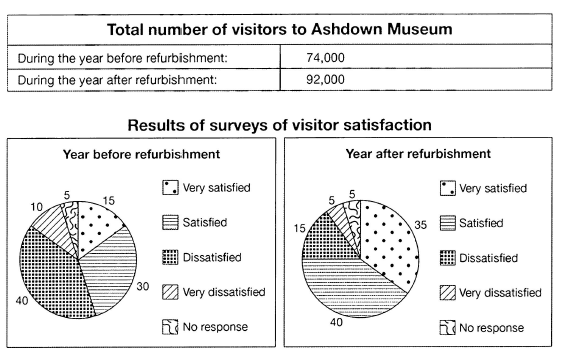
The table below shows the numbers of visitors to Ashdown Museum during the year before and the year after it was refurbished. The charts show the result of surveys asking visitors how satisfied they were with their visit, during the same two periods.
Summarise the information by selecting and reporting the main features, and make comparisons where relevant.
Student answer (Band 5.5)
The table illustrates the figures of visitors comes to Ashdown Museum in the time period of before and after the year when the museum was refurbished. The below chart shows the result of reviews asking visitors about there visit, during the similar both periods.
To begin with, The large numbers of people comes after the refurbished of Ashdown museum rather than the people who comes before the refurbished of museum. so that the numbers of individuals who come before refurbihed is 74,000 and 92,000 entre to visit the museum after the refurbished.
Whereas, the charts describe the surveys of visitors before and after refurbishment of museum. In the before refurbisment the people are more dissatisfied with the number of 40 and the numbers of no response is 5. Meanwhile, after the refurbishment of museum the satisfied number of visitors are 40 and the lowest number of surveys is 5 which is similar in both categories those are no response and very dissatisfied.
Overall, The number of visitors is higher after the refurbishment of museum. Meanwhile, the surveys of visitor satisfaction before is lower than the higher.
AI examiner evaluation
| Criterion | Band |
|---|---|
| Task Achievement / Task Response | 5.5 |
| Coherence and Cohesion | 6.0 |
| Lexical Resource | 5.0 |
| Grammatical Range and Accuracy | 5.0 |
| Overall | 5.5 |
Task Achievement / Task Response: Band 5.5
You identify the main increase in attendance, from 74,000 before refurbishment to 92,000 afterwards, and report some relevant survey figures, including the pre-refurbishment dissatisfaction peak of 40 and the post-refurbishment satisfaction peak of 40. However, the account of the survey is incomplete: it omits the important rise in “very satisfied” responses from 15 to 35 and the fall in “dissatisfied” responses from 40 to 15. The overview, “the surveys of visitor satisfaction before is lower than the higher,” is unclear and does not accurately summarise the overall shift from dissatisfaction towards satisfaction. To strengthen the response, compare the main positive and negative categories across both periods and give a clear overview of those changes.
Coherence and Cohesion: Band 6.0
The response has a recognisable structure: an introduction, separate discussion of visitor numbers and survey results, and a concluding overview. This gives the reader a basic route through the information. Some linking is effective, such as “Whereas” to introduce the survey discussion and “Meanwhile” to signal a contrast. However, progression within the paragraphs is sometimes unclear, and the final sentence repeats the visitor-number point without clearly summarising the survey trend. Phrases such as “the lowest number of surveys is 5 which is similar in both categories” make the comparison difficult to follow. Organise the survey figures around clear contrasts—satisfaction rising and dissatisfaction falling—and use linking words only where the relationship between ideas is precise.
Lexical Resource: Band 5.0
You use some task-relevant vocabulary, including “refurbished,” “surveys,” “dissatisfied,” and “satisfied,” so the topic is generally understandable. However, the range is limited and several word choices or collocations are inaccurate or repetitive. For example, “figures of visitors comes” and “numbers of individuals who come” are awkward ways to describe attendance; “visitors” or “visitor numbers” would be more natural. “The lowest number of surveys” also mislabels the data, which shows percentages of responses rather than survey counts. Spelling errors such as “refurbihed” and “refurbisment” further reduce control. Aim for precise chart language, such as “the proportion of visitors who were dissatisfied,” and check spelling and repeated phrasing.
Grammatical Range and Accuracy: Band 5.0
You attempt both simple and more extended sentence forms, including “Whereas, the charts describe…” and a sentence comparing the two periods. However, grammatical errors are frequent and sometimes make relationships between ideas hard to interpret. Examples include “visitors comes,” “people who comes,” and “the satisfied number of visitors are 40,” where subject–verb agreement and sentence construction are faulty. Articles and prepositions are also inconsistent in phrases such as “after the refurbished of museum.” Capitalisation after full stops is uneven, and the final sentence, “the surveys of visitor satisfaction before is lower than the higher,” is not grammatically complete in meaning. Practise accurate basic clauses first, then combine them using controlled comparisons such as “The figure rose from… to…”
See this exact question answered at other band scores. The same prompt compared across bands.
Browse more IELTS Writing model answers or get your own writing scored by the same AI examiner.