Band 5.0 IELTS Writing Task 1 Model Answer
Overall Band Score: 5.0 · Cambridge IELTS 11 · 2026-11-16
IELTS Writing Task 1 question
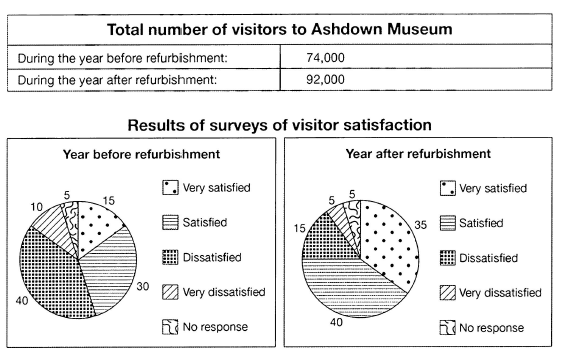
The table below shows the numbers of visitors to Ashdown Museum during the year before and the year after it was refurbished. The charts show the result of surveys asking visitors how satisfied they were with their visit, during the same two periods.
Summarise the information by selecting and reporting the main features, and make comparisons where relevant.
Student answer (Band 5.0)
The given table illustrates the numbers of visitors to Ashdown Museum during the year before and the year after it was refurbished. The charts gives information about the results of surveys of visitor satisfaction, during the same period.
Overall, In the table the number of visitore was higher in the year after refurbishment. In the charts, the percentage of visitors dissatisfied was the highest durnig the year before refurbishment, while the visitors were satisfied in the year after refurbishment. In contrast, the lowest percentage was no response in the year before and after refurbishment.
In the table, the number of visitors during the year before refurbishment was 74.000 visitors, while the total number of visitors durning the year after refurbidhment was 92.000 visitors.
In the charts, the percentage of dissatisfing was 40% in the year before refurbishment, and it was 15% in the year after refurbishment. In year before refurbishment, the visitors were satisfied with syrveys, accounting for 30% of the total. the percentage of visitors who are satisfing was 40% in the year after re
AI examiner evaluation
| Criterion | Band |
|---|---|
| Task Achievement / Task Response | 5.0 |
| Coherence and Cohesion | 5.0 |
| Lexical Resource | 5.0 |
| Grammatical Range and Accuracy | 5.0 |
| Overall | 5.0 |
Task Achievement / Task Response: Band 5.0
You identify the main increase in museum attendance, from 74,000 to 92,000, and correctly report the fall in dissatisfaction from 40% to 15%. You also note that no response was the smallest category in both years. However, the account is only partial: it ends mid-sentence (“in the year after re”), and the satisfaction figures and other important changes are not fully compared. The overview is also unclear when it says visitors “were satisfied” after refurbishment, without distinguishing the 40% satisfied from the 35% very satisfied. Develop a complete summary of the main shifts across both charts, including the rise in very satisfied responses and the fall in very dissatisfied responses.
Coherence and Cohesion: Band 5.0
The response has a recognisable structure, moving from an introduction and overview to details about the table and survey results. Basic linking words such as “while” and “In contrast” help show comparisons. However, progression is limited: the overview repeats information that is then restated in the detail paragraphs, and the final sentence is unfinished, leaving the report without a clear conclusion. Some references are also difficult to follow, as in “the visitors were satisfied with syrveys,” where the intended survey category is unclear. Organise the details more systematically—for example, compare the before-and-after figures for satisfaction categories together—and ensure each paragraph develops a complete point.
Lexical Resource: Band 5.0
You use relevant task vocabulary, including “refurbishment,” “percentage,” “dissatisfied,” and “total number,” so the topic is generally understandable. However, the range is limited and several noticeable spelling or word-form errors reduce clarity: “visitore,” “durning,” “refurbidhment,” “dissatisfing,” and “satisfing.” Some phrases are also imprecise, such as “the visitors were satisfied,” which does not clearly name the chart category, and “satisfied with syrveys,” which suggests satisfaction with the survey rather than the visit. Use the chart’s category labels consistently and choose accurate reporting phrases to distinguish “satisfied” from “very satisfied.”
Grammatical Range and Accuracy: Band 5.0
You attempt a few complex comparisons, including “while” and “In contrast,” and most of the basic message can be understood. However, the range of sentence structures is limited, and recurring errors affect accuracy. For example, “The charts gives” has subject–verb disagreement, while “In year before refurbishment” is missing an article. Capitalisation is inconsistent in “Overall, In the table,” and the final sentence is incomplete, ending with “in the year after re.” These issues make parts of the report difficult to read. Practise accurate sentence patterns for comparing figures, check agreement and articles, and proofread punctuation and sentence endings.
See this exact question answered at other band scores. The same prompt compared across bands.
Browse more IELTS Writing model answers or get your own writing scored by the same AI examiner.