Band 5.0 IELTS Writing Task 1 Model Answer
Overall Band Score: 5.0 · Cambridge IELTS 11 · 2026-11-17
IELTS Writing Task 1 question
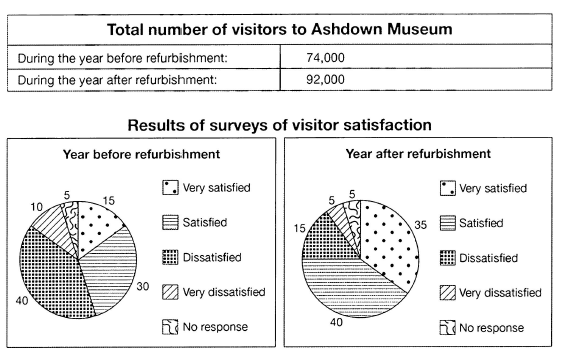
The table below shows the numbers of visitors to Ashdown Museum during the year before and the year after it was refurbished. The charts show the result of surveys asking visitors how satisfied they were with their visit, during the same two periods.
Summarise the information by selecting and reporting the main features, and make comparisons where relevant.
Student answer (Band 5.0)
The surveys shows big differwnce betweeen two time period before and after.In the first chart more visitors are disatisfied around 40percent and the second graph shows 40percent are satisfied after improvement.The number of visitors increase after first survey improvnment as given in the information which mean huge change did by the Organization.The difference between first graph disatisfied visitors decrease after improvnment which mean the organization put keen interest on the reviews and take account them imediately.The visitors whose are not bother to review remain same in both graphs some people are likely to not share reviews they are not taken it account and it remain same in both.Overall both graphs shows big difference before imporvement and after improvnment things get change.First shows more disatisfied visitors and second shows more satisfied customer.The surveys also shows the effort and accountibility of organization which they take in account imediately to improve customer support.
AI examiner evaluation
| Criterion | Band |
|---|---|
| Task Achievement / Task Response | 5.5 |
| Coherence and Cohesion | 4.5 |
| Lexical Resource | 5.0 |
| Grammatical Range and Accuracy | 5.0 |
| Overall | 5.0 |
Task Achievement / Task Response: Band 5.5
You identify the main contrast accurately: dissatisfaction was highest before refurbishment, while satisfaction was more prominent afterwards. You also report the unchanged share giving no response and note that visitor numbers rose. However, the response gives few precise figures beyond the 40% comparisons, and it does not clearly report the total visitor counts of 74,000 and 92,000 or the full shifts in the satisfaction categories. Some claims, such as the organisation acting “immediately” on reviews, are not shown by the charts. To strengthen the summary, select the key figures and describe the overall changes objectively, without inferring the organisation’s motives or actions.
Coherence and Cohesion: Band 4.5
The response has a recognisable overall direction: it contrasts the two periods and ends with a general summary. Basic linking phrases such as “after improvement,” “in both graphs” and “Overall” help connect some points. However, ideas are repeated rather than developed in a clear sequence, and the response is presented as one continuous paragraph. References such as “the first chart” and “the second graph” are not always precise, while several long sentences join multiple ideas without clear punctuation. Organise the report into a brief overview followed by comparisons of visitor numbers and satisfaction results, and use clear sentence boundaries and more exact references.
Lexical Resource: Band 5.0
You use some relevant vocabulary for describing the charts, including “visitors,” “satisfied,” “dissatisfied,” “surveys” and “difference.” This gives the reader a basic understanding of the topic. However, the range is limited and several words or phrases are repeated, particularly “improvement,” “graphs” and “shows.” Spelling errors such as “disatisfied,” “improvnment” and “imediately” are noticeable, and expressions such as “not bother to review” and “take account them” are not natural in this context. Use more precise chart language, for example “the proportion of dissatisfied visitors fell,” and check spelling and collocations carefully.
Grammatical Range and Accuracy: Band 5.0
You attempt to connect ideas using longer sentences, including “The number of visitors increase after first survey…” and “The difference between first graph…,” but control is inconsistent. Subject–verb agreement errors occur in “The surveys shows” and “the number of visitors increase”; articles and prepositions are also often missing, as in “between two time period” and “after first survey.” Some sentence boundaries are unclear, especially where several clauses are joined without full stops. These errors sometimes make relationships between ideas difficult to follow. Practise accurate simple comparisons first, then combine them with clauses using “while” or “whereas,” checking agreement, articles and punctuation.
See this exact question answered at other band scores. The same prompt compared across bands.
Browse more IELTS Writing model answers or get your own writing scored by the same AI examiner.