Band 6.0 IELTS Writing Task 1 Model Answer
Overall Band Score: 6.0 · Cambridge IELTS 11 · 2026-11-19
IELTS Writing Task 1 question
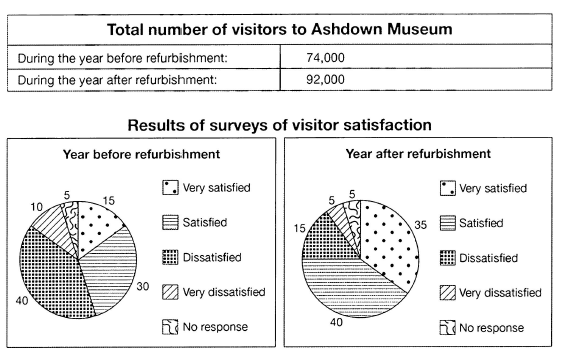
The table below shows the numbers of visitors to Ashdown Museum during the year before and the year after it was refurbished. The charts show the result of surveys asking visitors how satisfied they were with their visit, during the same two periods.
Summarise the information by selecting and reporting the main features, and make comparisons where relevant.
Student answer (Band 6.0)
The given table illustrates propotion of visitors to Ashdown Museum before and after it was refurbished and the chart shows results of satisfaction survey conducted during same two periods. It is evident that number of visitors and ratio of satisfaction to dissatisfaction increased after refurbishment.
Firstly, before renovation, 40% of the total visitors were dissatisfied while 10% were very dissatified. It can also observed that, around 30% of people reported to be satisfied while 15% of guests were very satisfied. Moreover, there were 5% of the total visitors who did not repsond to the survey.
In contrast, after the renovation the number of visitors who were dissatisfied jumped down to 15% and those who were very dissatisfied decreased by 5%. Furthermore, the satisfaction of individuals soared upto 40% and those who revealed to be very satisfied rose to 35%. People who did not participated in the survey still remained at 5% after renovation.
AI examiner evaluation
| Criterion | Band |
|---|---|
| Task Achievement / Task Response | 5.5 |
| Coherence and Cohesion | 6.5 |
| Lexical Resource | 6.0 |
| Grammatical Range and Accuracy | 5.5 |
| Overall | 6.0 |
Task Achievement / Task Response: Band 5.5
You identify the broad contrast correctly: visitor numbers rose after refurbishment, while satisfaction improved and dissatisfaction fell. Most survey percentages are reported accurately, including the unchanged 5% with no response. However, the table’s actual visitor totals—74,000 before and 92,000 after—are not stated, and the opening incorrectly describes the table as showing a “propotion” rather than the number of visitors. The overview also says the “ratio of satisfaction to dissatisfaction increased,” which is imprecise; the key pattern is that satisfied responses became the majority while dissatisfaction declined. To make the report more complete, include both totals and distinguish the two satisfaction categories from the two dissatisfaction categories in a clear overview.
Coherence and Cohesion: Band 6.5
The response has a clear overall arrangement: an introduction and overview are followed by a paragraph about the earlier survey and one about the later survey. “Firstly” and “In contrast” help signal the comparison, and the information is generally easy to follow. This meets the lower-band expectation of coherent organisation and shows some effective progression. However, the overview is broad and imprecise, and the body paragraphs list categories rather than drawing the main comparisons together. For example, the rise in satisfied responses from 30% to 40% and very satisfied responses from 15% to 35% could be explicitly contrasted with the falls in the two dissatisfied categories. Use linking and comparison more flexibly, rather than relying mainly on sequencing markers.
Lexical Resource: Band 6.0
You use a reasonable range of task-related vocabulary, including “dissatisfied,” “very satisfied,” “conducted,” and “remained,” and the meaning is generally clear. There are also attempts at more expressive wording, such as “soared,” though this is less suitable for a neutral data report. Some inaccurate word choices and spelling slips limit precision: “propotion” is misspelled, “ratio” does not accurately describe the visitor total, and “jumped down” is an awkward collocation for a decrease. “Renovation” is understandable as a substitute for refurbishment, but repeating the task’s term would keep the description precise. Aim for neutral reporting verbs and accurate terms for totals, percentages, increases, and decreases.
Grammatical Range and Accuracy: Band 5.5
You attempt a mix of sentence forms, including clauses introduced by “while” and “who,” and most of the message remains understandable. However, some grammatical errors affect accuracy. In “It can also observed,” the passive construction needs “be”; “People who did not participated” should use the base form after “did not”; and “those who were very dissatisfied decreased by 5%” has an unclear subject, since the percentage or share decreased, not the people themselves. The opening sentence also combines the table and chart in a way that makes their functions less clear. Practise accurate passive forms, verb patterns after auxiliaries, and clear subjects when describing changes. These corrections would make your comparisons more controlled.
See this exact question answered at other band scores. The same prompt compared across bands.
Browse more IELTS Writing model answers or get your own writing scored by the same AI examiner.