Band 6.0 IELTS Writing Task 1 Model Answer
Overall Band Score: 6.0 · Cambridge IELTS 11 · 2026-11-20
IELTS Writing Task 1 question
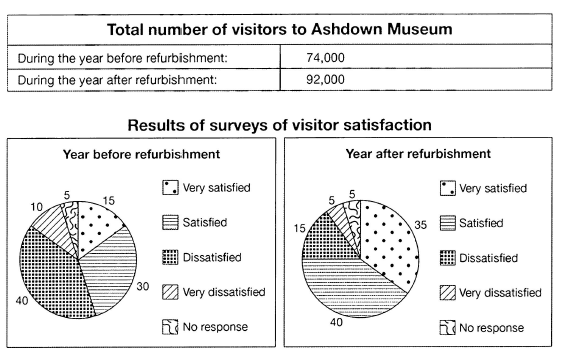
The table below shows the numbers of visitors to Ashdown Museum during the year before and the year after it was refurbished. The charts show the result of surveys asking visitors how satisfied they were with their visit, during the same two periods.
Summarise the information by selecting and reporting the main features, and make comparisons where relevant.
Student answer (Band 6.0)
The table illustrates the number of visitors to Ashdown museum during the year before and after the year of refurbished. Further the chart discribes the results of surveys asking visitors how they were satisfied with their visit to the museum during the same two periods.
Overall, it is visible that after the refurbishment was completed the number of visitors were higher in compare to before the refurbishment. Then after if we has close look at the chart then the refurbish had completed the level of satisfaction was incresed in compare to previouslly whereas before the refurbishment there were lots of touriest who were dissatisfied but that declined after the refurbishment.
A glance at the table it is noticeable that during the year befor refurbishment the total number of visitors visited the museum was 74000 that increased to 92000 after the work of refurbishment was over.
Further analysis of the chart reveals that the review before redevelopment was as followes. Visitors who had very satisfied was before the development 15% but after updating the museum that number hiked to 35%. whereas the number of satisfed visitors were 30 before the development that rose by 10% after the redevelopment.
AI examiner evaluation
| Criterion | Band |
|---|---|
| Task Achievement / Task Response | 6.5 |
| Coherence and Cohesion | 6.5 |
| Lexical Resource | 5.5 |
| Grammatical Range and Accuracy | 5.0 |
| Overall | 6.0 |
Task Achievement / Task Response: Band 6.5
You identify the main overall changes accurately: visitor numbers rose from 74,000 to 92,000, and satisfaction improved after refurbishment. You also report the very satisfied figures correctly (15% to 35%) and note that satisfied visitors increased from 30% to 40%. This gives the response a relevant overview and several useful comparisons. However, the survey description is incomplete: the largest shift, dissatisfaction falling from 40% to 15%, is mentioned generally but not quantified, and the changes in very dissatisfied and no-response figures are omitted. The final paragraph also ends without a concluding comparison. To strengthen coverage, report the key negative-response figures alongside the positive ones and ensure each main feature is developed clearly.
Coherence and Cohesion: Band 6.5
The response has a recognisable structure, moving from an introduction and overview to details about visitor totals and survey results. This helps the reader follow the main direction of the comparison. Some linking is effective, such as “Overall” and “Further analysis,” but several transitions are awkward or repetitive, including “Further” at the start of consecutive paragraphs and “Then after if we has close look.” The survey details are also presented only for positive responses, so the progression through the chart feels incomplete. Paragraphing is appropriate, but clearer sequencing—first visitor numbers, then positive and negative satisfaction categories—would make the account more coherent. Use concise links such as “By contrast” to connect the opposing trends.
Lexical Resource: Band 5.5
You use some task-relevant vocabulary, including “refurbishment,” “satisfaction,” “dissatisfied,” and “increased,” so the main subject is generally clear. There are also attempts at less common alternatives such as “redevelopment” and “hiked,” but some choices are inaccurate or unnatural: “the year of refurbished,” “how they were satisfied,” and “the number … hiked” do not fit the intended meaning or collocation. Spelling errors such as “discribes,” “incresed,” “previouslly,” and “satisfed” are noticeable and reduce precision. Aim for a smaller set of accurate, natural expressions for describing data, and check spelling carefully. This would make the vocabulary more flexible and reliable.
Grammatical Range and Accuracy: Band 5.0
You attempt both simple and more complex sentences, including clauses introduced by “whereas” and “that,” but control is inconsistent. Errors include subject–verb agreement in “the number of visitors were higher,” the malformed conditional “if we has close look,” and the verb pattern in “Visitors who had very satisfied.” Articles and sentence boundaries also need attention, as in “A glance at the table it is noticeable” and the lower-case “whereas” after a full stop. These problems sometimes make the reader pause, although the intended comparisons can usually be understood. Practise forming accurate comparison sentences and checking agreement, verb forms, and punctuation before adding more complex clauses.
See this exact question answered at other band scores. The same prompt compared across bands.
Browse more IELTS Writing model answers or get your own writing scored by the same AI examiner.