Band 7.0 IELTS Writing Task 1 Model Answer
Overall Band Score: 7.0 · Cambridge IELTS 11 · 2026-11-24
IELTS Writing Task 1 question
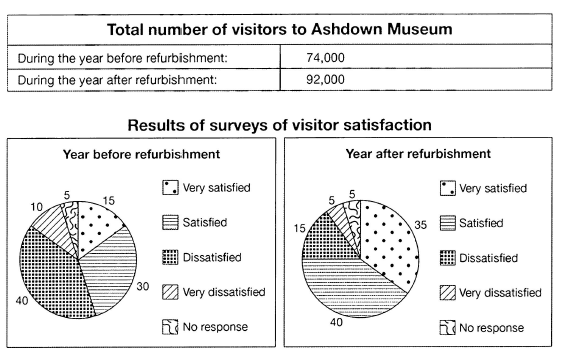
The table below shows the numbers of visitors to Ashdown Museum during the year before and the year after it was refurbished. The charts show the result of surveys asking visitors how satisfied they were with their visit, during the same two periods.
Summarise the information by selecting and reporting the main features, and make comparisons where relevant.
Student answer (Band 7.0)
The table depicts the total number of visitors while the pie charts present a thorough comparison of visitor satisfaction of Ashdown Museum year before and after refurbishment .
Looking at the overall trends , it can be easily concluded that the number of visitors have increased significantly .Subsequently ,the overall satisfaction level of visitors has sky rocketed from 45% to 75% .
The total number of visitors before the refurbishment were 74 thousands but it surged to 92 thousands during the year after renovation .This refurbishment has a clear impact on the satisfaction level of visitors .during the year before refurbishment ,only 15% were very satisfied , 30% were satisfied , 40% were dissatisfied , 10% were very dissatisfied and 5% had no response .
Year after refurbishment , the trends completely reversed . 35% were very satisfied ,40% were satisfied , 15% were dissatisfied , 5 % were very dissatisfied and 5% had no response .So, overall ,refurbishment played an important role in reversing the trend.
AI examiner evaluation
| Criterion | Band |
|---|---|
| Task Achievement / Task Response | 8.0 |
| Coherence and Cohesion | 7.0 |
| Lexical Resource | 6.5 |
| Grammatical Range and Accuracy | 6.0 |
| Overall | 7.0 |
Task Achievement / Task Response: Band 8.0
The response selects and reports the key information accurately: visitor numbers rise from 74,000 to 92,000, while the combined satisfied categories increase from 45% to 75%. It also gives the figures for every satisfaction category in both years, so the main comparisons are well supported. The overview identifies the two most important changes, and the conclusion that satisfaction shifted towards positive responses is grounded in the data. The phrase “trends completely reversed” is a little broad, since the no-response share stayed at 5%, but this is a minor qualification rather than a significant omission. To make the account even more precise, describe the shift as a marked improvement in satisfaction rather than implying every category changed direction.
Coherence and Cohesion: Band 7.0
The information is arranged in a clear sequence: an introduction, an overview, then detailed figures for the two periods. This makes the comparison easy to follow, and linking expressions such as “Looking at the overall trends,” “Subsequently,” and “So” help signal progression. The final sentence also returns to the central comparison. Some links are slightly mechanical or repetitive, however, and the detailed paragraph moves from visitor totals to satisfaction figures without a particularly smooth transition. Punctuation spacing and the lower-case start in “during the year before refurbishment” also interrupt the presentation. More controlled transitions and consistent paragraph-level punctuation would make the organisation feel more polished.
Lexical Resource: Band 6.5
The response uses an adequate range for describing the visuals, including “depicts,” “surged,” “overall satisfaction level,” and “reversing the trend.” These choices communicate the main changes, and the meaning remains clear. There are also some imprecise or unnatural collocations: “a thorough comparison” is not quite appropriate for what the charts show, and “satisfaction level … has sky rocketed” is overly informal and exaggerated for an academic report. “The trends completely reversed” similarly overstates the change because the no-response figure remained unchanged. Greater precision and a consistently formal register would strengthen the vocabulary; the response already shows some willingness to use less common wording, but control of collocation and tone is not yet consistent.
Grammatical Range and Accuracy: Band 6.0
There is a mix of simple and more developed sentence forms, and the response communicates the comparisons without serious difficulty. However, some grammatical errors remain. In “the number of visitors have increased,” the singular subject requires “has increased”; “the total number … were” has the same agreement issue. The opening also needs articles and a clearer time phrase, such as “in the year before and after the refurbishment.” Several sentences begin with lower-case letters after full stops, and spacing around punctuation is inconsistent. These errors do not generally obscure the message, but they show that control is not yet reliable. Check subject–verb agreement and sentence boundaries carefully, while retaining the range of sentence structures attempted.
See this exact question answered at other band scores. The same prompt compared across bands.
Browse more IELTS Writing model answers or get your own writing scored by the same AI examiner.