Band 6.0 IELTS Writing Task 1 Model Answer
Overall Band Score: 6.0 · Cambridge IELTS 11 · 2026-11-25
IELTS Writing Task 1 question
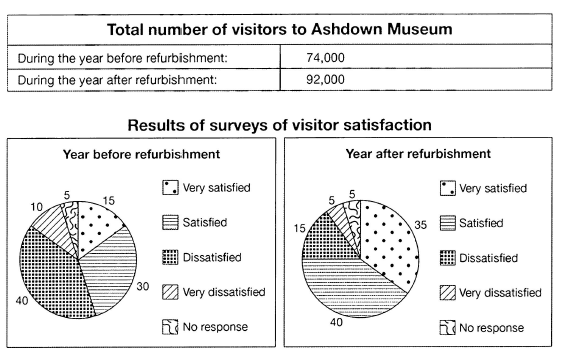
The table below shows the numbers of visitors to Ashdown Museum during the year before and the year after it was refurbished. The charts show the result of surveys asking visitors how satisfied they were with their visit, during the same two periods.
Summarise the information by selecting and reporting the main features, and make comparisons where relevant.
Student answer (Band 6.0)
The piecharts illustrate the number of visitors before and after the renovation of Ashdown Museum.
Overall, before refurbishment of museum the visitors were 74,000 that steadily rose to 92,000 after the refurbishment of the museum.
Before refurbishment, the perecentage of dissatisfied visitors was 40 and satisfied visitors was 30%, these two factors cover over 70% of the chart.While after the refurbishment the satisfied visitors rose dramatically to 40% and dissatisfied visitors declined almost half, summing up to only 15%.
Visitors that gave no response remained same of only 5%.Very dissatisfied visitors were 10% before the refurbishment but after the refurbishment it halfed to only 5%.At last, the visitors that were very satisfied with the service of museum were only 15% before the refurbishment of the museum.The amount later surged to a total of 35%, taking up the second highest place in the chart of visitors after the refurbishment of museum.
AI examiner evaluation
| Criterion | Band |
|---|---|
| Task Achievement / Task Response | 7.0 |
| Coherence and Cohesion | 6.0 |
| Lexical Resource | 6.0 |
| Grammatical Range and Accuracy | 5.5 |
| Overall | 6.0 |
Task Achievement / Task Response: Band 7.0
You cover the main features and make relevant comparisons: visitor numbers rose from 74,000 to 92,000, satisfaction increased, and dissatisfaction fell. The figures for the survey categories are accurately reported, including the unchanged 5% with no response and the rise in very satisfied visitors from 15% to 35%. Your opening overview identifies the increase in attendance, while the later comparisons convey the broad shift in opinion. To make the overview more complete and the report more sharply focused, summarise the contrasting satisfaction pattern explicitly at the start—for example, that dissatisfaction was the largest group before refurbishment, whereas satisfaction became more prominent afterwards. Avoid describing the charts as showing visitor numbers; they show satisfaction percentages.
Coherence and Cohesion: Band 6.0
The response follows a generally understandable order: it introduces the visuals, gives the attendance figures, and then compares survey results. Linking expressions such as “Overall,” “While,” and “At last” help signal relationships between points. However, the report is presented as one continuous block, so the overview and detailed comparisons are not clearly separated. Some transitions feel mechanical or imprecise, particularly “At last,” which does not naturally introduce the final category. Several comparisons are also packed into long sentences, and missing spaces after full stops make the progression harder to follow. Use distinct paragraphs for the overview and details, and connect categories with clearer contrasts such as “By comparison” or “Meanwhile.”
Lexical Resource: Band 6.0
You use a reasonable range of task-related vocabulary, including “dissatisfied,” “declined,” “remained,” and “surged,” and the meaning is generally clear. Some choices are imprecise or repetitive: “piecharts” misidentifies the visuals, which are charts showing satisfaction results, and “factors” is not a natural label for visitor categories. “Cover over 70% of the chart” is also an awkward way to describe the combined share. Spelling errors such as “perecentage” and “halved” (written as “halfed”) reduce accuracy. Aim for precise reporting language and check spelling; alternatives such as “proportion,” “category,” and “accounted for” would make the comparisons more natural and exact.
Grammatical Range and Accuracy: Band 5.5
You attempt both simple and more developed sentence forms, and the main comparisons can usually be understood. However, some grammatical errors recur in articles, agreement, and sentence construction. For example, “before refurbishment of museum” needs an article, while “the visitors were 74,000” incorrectly makes visitors the subject of the figure; write that the number of visitors was 74,000. In “the satisfied visitors rose dramatically to 40%,” the percentage, rather than the visitors, should be the subject. There are also punctuation problems where sentences run together, as in “chart.While” and “5%.Very.” Practise accurate subject–verb relationships and article use, and separate each sentence with correct punctuation.
See this exact question answered at other band scores. The same prompt compared across bands.
Browse more IELTS Writing model answers or get your own writing scored by the same AI examiner.