Band 6.0 IELTS Writing Task 1 Model Answer
Overall Band Score: 6.0 · Cambridge IELTS 11 · 2026-11-27
IELTS Writing Task 1 question
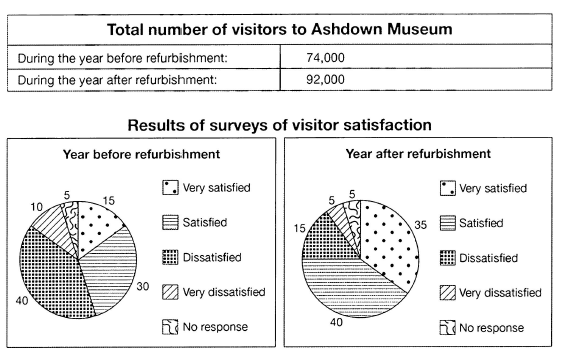
The table below shows the numbers of visitors to Ashdown Museum during the year before and the year after it was refurbished. The charts show the result of surveys asking visitors how satisfied they were with their visit, during the same two periods.
Summarise the information by selecting and reporting the main features, and make comparisons where relevant.
Student answer (Band 6.0)
The table compares the number of people who visited ashdown museum before and after its repairment and the pie charts show the result of surveys about people satisfaction over the same period.
It is clear that people visited most after completing the reconstitution of museum. It is also clear that the highest number of people was dissatisfied before this museum refurbishment. By contrast, the number of people visited this museum after refurbishment was mostly satisfied.
In terms of people's number, most people visited this museum after repairment, at 92,000. On the other hand 74,000 people went there before reconstruction.
Looking at the charts in more detail, we will notice that, before refurbishment the most number of visitors were either satisfied or dissatisfied, at 30 and 40, respectively. In contrast, the minimum number of people didn’t response, at 5. While the highest number of people were very satisfied and satisfied, at 35 and 40, respectively, the figure for very dissatisfied and no response were the lowest, at 5 after completing the repairment.
AI examiner evaluation
| Criterion | Band |
|---|---|
| Task Achievement / Task Response | 6.0 |
| Coherence and Cohesion | 6.0 |
| Lexical Resource | 5.5 |
| Grammatical Range and Accuracy | 5.5 |
| Overall | 6.0 |
Task Achievement / Task Response: Band 6.0
You cover both the visitor total and the satisfaction surveys, and your overview identifies the main contrast: attendance rose from 74,000 to 92,000, while dissatisfaction was most common before refurbishment and satisfaction became more prominent afterwards. The figures you give for the survey categories are generally accurate. However, some comparisons are unclear or incomplete. For example, “people visited this museum after refurbishment was mostly satisfied” does not specify that satisfied and very satisfied responses together made up 75%, while dissatisfaction and very dissatisfaction together fell to 20%. The before-refurbishment description also says the largest groups were “either satisfied or dissatisfied,” although dissatisfaction alone was the largest category. A clearer overview and more precise comparisons would develop the information more fully.
Coherence and Cohesion: Band 6.0
The response has a coherent overall arrangement: an introduction, a brief overview, a paragraph on attendance, and a paragraph on survey results. Linking expressions such as “By contrast,” “On the other hand,” and “Looking at the charts in more detail” help signal comparisons. However, progression is sometimes repetitive: the overview and the attendance paragraph both state that visitor numbers were higher after refurbishment. Some connections are also awkward or unclear, particularly the final sentence beginning “While,” which combines the after-refurbishment results without making the comparison easy to follow. Organise the survey details by period or by positive and negative responses, and use references such as “these proportions” clearly to make the progression smoother.
Lexical Resource: Band 5.5
You use relevant vocabulary for describing the visuals, including “refurbishment,” “dissatisfied,” “figure,” and “in contrast,” so the topic is generally clear. However, several word choices and collocations are inaccurate or unnatural, which limits precision. “Repairment” and “reconstitution” are not suitable substitutes for “refurbishment,” and “people satisfaction” would be more naturally expressed as “visitor satisfaction.” Phrases such as “the most number of visitors” and “didn’t response” also show difficulty selecting the correct form. Some repetition of “people” and “museum” could be reduced by using “visitors,” “respondents,” and “the venue.” More accurate collocations and a wider range of natural reporting verbs would strengthen this criterion.
Grammatical Range and Accuracy: Band 5.5
You attempt a mix of simple and more complex sentences, including a contrast structure with “While” and clauses introduced by “that.” Most of the intended meaning remains understandable, but some grammatical errors recur. For example, “the number of people visited” needs a relative clause (“the number of people who visited”), and “the highest number of people were” has a subject–verb agreement problem because “number” is singular. In “before refurbishment the most number,” the article and sentence structure are also faulty. Punctuation is occasionally missing after introductory phrases, as in “before refurbishment.” Aim to check agreement, articles, and clause construction, while keeping the useful variety of sentence forms you already attempt.
See this exact question answered at other band scores. The same prompt compared across bands.
Browse more IELTS Writing model answers or get your own writing scored by the same AI examiner.