Band 5.5 IELTS Writing Task 1 Model Answer
Overall Band Score: 5.5 · Cambridge IELTS 11 · 2026-11-28
IELTS Writing Task 1 question
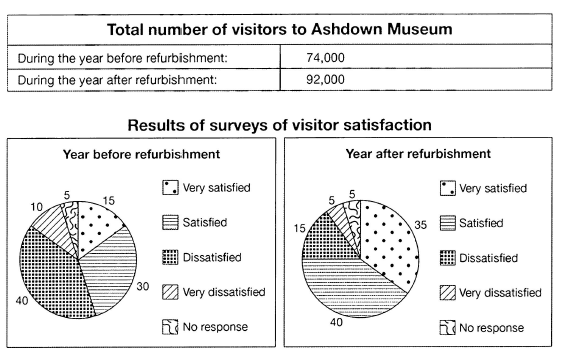
The table below shows the numbers of visitors to Ashdown Museum during the year before and the year after it was refurbished. The charts show the result of surveys asking visitors how satisfied they were with their visit, during the same two periods.
Summarise the information by selecting and reporting the main features, and make comparisons where relevant.
Student answer (Band 5.5)
The table illustrates the number of visitors to Ashdown Museum before and after refurbishment and the chart display the result of surveys by asking visitors that how much they satisfied with their visit during same two period.
Overall, total number of visitors before refurbishment was 74000 which is lower then visitors after refurbishment by almost 18000. the chart show that 40% individuals were not happy before the renovation and after renovation they all give positive review.
To initiate with, the year before refurbishment demonstrates mostly the dissatisfaction in their visit almost 40% were not satisfied and 15% was very satisfied and 10% of all from them are happy by there visit.
On the other hand, the year after refurbishment shows highly satisfied reviews by the renovation almost all of visitors who were not satisfied give positive review after the construction but 15% were still not satisfied by the reconstruction and 5% of visitors are remain same by not giving their response.
AI examiner evaluation
| Criterion | Band |
|---|---|
| Task Achievement / Task Response | 6.0 |
| Coherence and Cohesion | 6.0 |
| Lexical Resource | 5.5 |
| Grammatical Range and Accuracy | 5.0 |
| Overall | 5.5 |
Task Achievement / Task Response: Band 6.0
You cover both the visitor total and the satisfaction surveys, and your overview identifies the main contrast: attendance rose from 74,000 to 92,000, while satisfaction improved after refurbishment. Several figures are accurate, including 40% dissatisfied before and 15% dissatisfied afterwards. However, some details are unclear or inaccurate: “they all give positive review” overstates the change, since 15% remained dissatisfied and 5% were very dissatisfied; also, the 10% who were very dissatisfied before are incorrectly described as happy. The overview would be stronger if it clearly reported the broad shift from mostly dissatisfied responses to mostly satisfied ones, while noting that non-response stayed at 5%. Some survey details are less fully and precisely reported than the attendance figures.
Coherence and Cohesion: Band 6.0
The response has a recognisable four-paragraph structure: an introduction, an overview, and separate descriptions of the two periods. This gives the information an overall arrangement, and transitions such as “On the other hand” help signal comparison. However, progression is sometimes weakened by unclear references and mechanical linking. For example, “they all give positive review” does not clearly identify which visitors “they” refers to, and “To initiate with” is an awkward way to introduce the first set of figures. The final paragraph also combines the improvement with the remaining dissatisfied and non-response groups without clearly separating those points. Use direct comparisons between the two years and clearer references to each survey category to make the progression easier to follow.
Lexical Resource: Band 5.5
You use relevant task vocabulary, including “refurbishment,” “dissatisfaction,” “positive review,” and “response,” so the topic is generally clear. There is also some attempt to vary wording with “renovation” and “construction.” However, several choices are inaccurate or unnatural, such as “how much they satisfied,” “give positive review,” and “remain same by not giving their response.” “Happy” is also too informal and imprecise for reporting survey categories, while “construction” does not accurately describe refurbishment. These word-choice and collocation problems sometimes make the intended meaning less clear. Aim for precise terms such as “satisfied,” “dissatisfied,” and “no response,” and use natural reporting phrases consistently.
Grammatical Range and Accuracy: Band 5.0
You attempt both simple and more complex sentence forms, including a relative clause in “the year before refurbishment demonstrates…” and a contrastive clause beginning “but.” However, grammatical control is uneven, and errors sometimes make relationships between ideas difficult to follow. Examples include “the chart display” instead of “the charts display,” “how much they satisfied” instead of “how satisfied they were,” and “15% was very satisfied,” where the subject and verb do not agree. There are also tense and sentence-boundary problems, such as the lowercase “the chart show” after a full stop and “visitors are remain.” Work on consistent past-tense reporting, subject–verb agreement, and complete, correctly punctuated sentences while retaining your attempts at complex structures.
See this exact question answered at other band scores. The same prompt compared across bands.
Browse more IELTS Writing model answers or get your own writing scored by the same AI examiner.