Band 6.0 IELTS Writing Task 1 Model Answer
Overall Band Score: 6.0 · Cambridge IELTS 11 · 2026-11-08
IELTS Writing Task 1 question
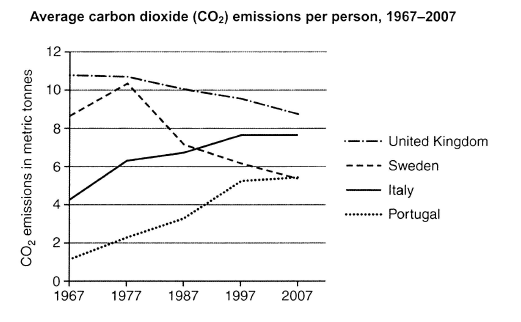
The graph below shows average carbon dioxide (CO2) emissions per person in the United Kingdom, Sweden, Italy and Portugal between 1967 and 2007.
Summarise the information by selecting and reporting the main features, and make comparisons where relevant.
Student answer (Band 6.0)
The line graph compares people releasing carbon dioxide from year 1967 to 2007 in different countries; uk, sweden, itlay and portugal
Overall, portugal and itlay indicates an icrease in figure as compare to sweden and united kingdom, which shows a fall by the year 2007.
Firstly, in portugal, 1.5 tonnes of CO2 was emitted in 1967 and showd a constant increase of trend. In 2007, it reached up to 5.5 tonnes of carbon dioxide. whereas in 1967, people released 4.5 tonnes of CO2 in itlay. It increased to 6.6 tonnes in 1977 and 7.5 in 1997 and then the figure showd a stability till 2007.
Secondly, uk and sweden showed a down fall, starting from 11 and 9 tonnes in 1967 and decreased to 9 and 5.5 in 2007, respectively. however, sweden showed a spike in 1977 reaching up to 10.5 tonnes and after that it dramatically falls to 7 tonnes of corbon dioxide emission.
AI examiner evaluation
| Criterion | Band |
|---|---|
| Task Achievement / Task Response | 6.5 |
| Coherence and Cohesion | 6.5 |
| Lexical Resource | 5.5 |
| Grammatical Range and Accuracy | 5.5 |
| Overall | 6.0 |
Task Achievement / Task Response: Band 6.5
You identify the main overall contrast: emissions rose in Italy and Portugal, while the UK and Sweden ended lower, and you report several relevant figures that broadly match the graph. The account of Sweden’s rise to a peak in 1977 followed by decline is also useful. However, the overview is brief and does not highlight the key final comparison: the UK remained highest in 2007, while Italy and Portugal finished level at about 7.6 and 5.4 tonnes respectively. Some details are imprecise, such as Portugal’s starting value (about 1.2, not 1.5) and the UK’s final value (about 8.7, rather than 9). More precise comparisons and a fuller overview would strengthen the report.
Coherence and Cohesion: Band 6.5
The response has a clear basic structure, moving from an introduction and overview to two paragraphs grouping the rising and falling countries. Sequencing words such as “Firstly” and “Secondly” help readers follow this organisation, and the Sweden paragraph presents its peak before its later decline. However, some linking is mechanical, and the overview does not fully prepare the reader for the comparisons that follow. The sentence beginning “whereas in 1967” is attached awkwardly to the Portugal discussion, while “however” begins a new sentence without a capital letter. Grouping the countries is effective, but clearer transitions and more explicit comparisons between their end values would make progression smoother.
Lexical Resource: Band 5.5
You use relevant topic vocabulary, including “emitted,” “tonnes,” “increase,” “decreased,” and “stability,” so the main trends are generally understandable. However, the range and control are uneven, with several inaccurate or unnatural choices: “people releasing carbon dioxide” is less precise than describing emissions per person, and “a down fall” and “a spike” are not well suited to these trends. Spelling errors such as “itlay,” “icrease,” “showd,” and “corbon” are noticeable and reduce accuracy. Aim for consistent, precise collocations and check spelling carefully; this would make the description more fluent and appropriately formal.
Grammatical Range and Accuracy: Band 5.5
You attempt both simple and more developed sentence forms, including clauses linked with “whereas” and “and then,” and the main meaning is usually clear. However, errors in agreement, tense, articles, and sentence boundaries recur. For example, “portugal and itlay indicates” should use a plural verb, while “showd a constant increase of trend” has an unclear verb pattern. The opening is a sentence fragment, and “whereas” is awkwardly punctuated after a full stop. There is also inconsistent use of past tense in descriptions of the historical data. Review subject–verb agreement and build complete, accurately punctuated sentences; greater control of these patterns would improve clarity.
See this exact question answered at other band scores. The same prompt compared across bands.
Browse more IELTS Writing model answers or get your own writing scored by the same AI examiner.