Band 6.0 IELTS Writing Task 1 Model Answer
Overall Band Score: 6.0 · Cambridge IELTS 11 · 2026-11-08
IELTS Writing Task 1 question
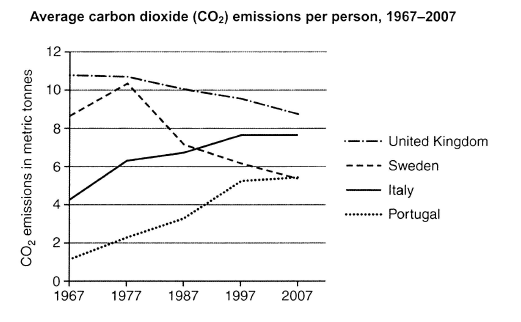
The graph below shows average carbon dioxide (CO2) emissions per person in the United Kingdom, Sweden, Italy and Portugal between 1967 and 2007.
Summarise the information by selecting and reporting the main features, and make comparisons where relevant.
Student answer (Band 6.0)
The line graph illustrates the average consumption of carbon dioxide emissions per head in four different countries, Namely UK, sweden, Italy and portugal from 1967 to 2007.
It is clear that the number fluctuated slightly. Portugal and Italy has rose steadily over the five year period while United kingdom and Sweden declined over the years
United kingdom has seen a gradual decline after the year 1977 throughout the period and reach just over 8 metric tonnes. Similarly, sweden have seen an incline in the first 10 years but dropped sharply after reaching just above 10 metric tonnes and finally stood at approximately 5 metric tonnes in 2007
Furthermore, Italy rose sharply in terms of carbon emissions with as high as almost 8 metric tonnes in 1997 and stayed the same until 2007. Portugal has increased in the usage of carbon emission starting from 1 metric tonnes and rose dramatically before reaching above 5 metric tonnes and remained almost same throughout next ten years.
AI examiner evaluation
| Criterion | Band |
|---|---|
| Task Achievement / Task Response | 6.0 |
| Coherence and Cohesion | 6.0 |
| Lexical Resource | 6.0 |
| Grammatical Range and Accuracy | 5.5 |
| Overall | 6.0 |
Task Achievement / Task Response: Band 6.0
You identify the main overall contrast: emissions rose in Italy and Portugal while falling in the UK and Sweden, and you report several relevant figures and endpoints. The account of the UK’s decline and Italy’s rise and subsequent plateau is broadly accurate. However, the overview is imprecise: “fluctuated slightly” does not capture the substantial changes, especially Sweden’s rise and sharp fall or Portugal’s strong increase. The statement that Portugal “remained almost same throughout next ten years” is inaccurate; its level continued rising from about 3.3 tonnes in 1987 to 5.2 in 1997, then levelled off. Make the overview more selective and ensure each trend description matches the relevant years.
Coherence and Cohesion: Band 6.0
The response has a clear overall arrangement, moving from an introduction and overview to country-specific details, and paragraph breaks help separate the main stages. Linking expressions such as “Similarly” and “Furthermore” make relationships between points visible. However, some connections are mechanical or unclear: “It is clear that the number fluctuated slightly” does not specify which figures, and “Similarly” introduces Sweden even though its pattern differs from the UK’s. The final paragraph also shifts between Italy and Portugal without a clear comparison. Organise the body around contrasting trends, and use precise references such as “emissions per person” or country names to make each sentence’s subject unmistakable.
Lexical Resource: Band 6.0
You use an adequate range of task-related vocabulary, including “gradual decline,” “dropped sharply,” “rose steadily,” and “metric tonnes,” which helps communicate the main movements. There are also attempts at varied phrasing, such as “stood at approximately” and “reaching above.” Some word choices and collocations are inaccurate or imprecise, however. “Consumption of carbon dioxide emissions” and “usage of carbon emission” are not natural ways to describe the data; use “CO₂ emissions per person” or “emissions levels.” “The number” is vague, and “rose dramatically” overstates Portugal’s steady increase. Check capitalisation of country names and avoid treating emissions as something consumed or used.
Grammatical Range and Accuracy: Band 5.5
You attempt both simple and more extended sentence forms, and the main trends are generally understandable. Some grammatical errors remain, particularly with subject–verb agreement and verb forms: “Portugal and Italy has rose” should be “Portugal and Italy rose,” while “Sweden have seen” should be “Sweden saw” or “has seen.” The UK sentence shifts from “has seen” to “reach,” and “Italy rose … with as high as” is not a well-formed construction. Articles and number expressions also need attention, as in “starting from 1 metric tonnes.” Improve control by keeping tense consistent when describing the past and checking agreement, articles, and singular/plural forms in each sentence.
See this exact question answered at other band scores. The same prompt compared across bands.
Browse more IELTS Writing model answers or get your own writing scored by the same AI examiner.