Band 5.5 IELTS Writing Task 1 Model Answer
Overall Band Score: 5.5 · Cambridge IELTS 11 · 2026-11-09
IELTS Writing Task 1 question
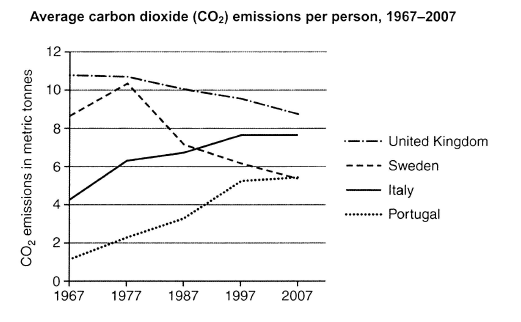
The graph below shows average carbon dioxide (CO2) emissions per person in the United Kingdom, Sweden, Italy and Portugal between 1967 and 2007.
Summarise the information by selecting and reporting the main features, and make comparisons where relevant.
Student answer (Band 5.5)
The line graph illustrates the average carbon dioxide emissions per person in metric tonnes in four countries from 1967 to 2007.
Overall, it is clear that the average gas emissions increased considerably in Italy and Portugal. Whereas, the Sweden experienced a significant declined in natural gas emissions.
Carbon dioxide emissions was significant in the United Kingdom, over the four decades, above 10 metric tonnes in 1967, dropped slightly almost 9 metric tonnes in 2007. In Sweden, emissions increased in first decade, above 8 metric tonnes in 1967 and reached almost 10 metric tonnes in 1977, experienced a gradually fell, around 5 metric tonnes in 2007.
In 1967, almost 4 metric tonnes emissions in Italy, gas emissions increased until 1997, almost 8 metric tones than levelled-off in last decade. In Portugal, only 1 metric tonnes carbon dioxide emission in 1967, carbon dioxide emisiions rose, almost 5 metric tonnes in 2007.
AI examiner evaluation
| Criterion | Band |
|---|---|
| Task Achievement / Task Response | 5.5 |
| Coherence and Cohesion | 5.5 |
| Lexical Resource | 5.5 |
| Grammatical Range and Accuracy | 5.0 |
| Overall | 5.5 |
Task Achievement / Task Response: Band 5.5
You identify the overall contrast between rising emissions in Italy and Portugal and falling emissions in Sweden, and you include relevant figures for all four countries. However, the overview is incomplete: it omits the UK’s gradual decline and does not highlight that the UK remained the highest emitter throughout, while Portugal began at the lowest level. Some details are imprecise: Italy reached about 7.6 tonnes by 1997 and then remained stable, rather than simply “almost 8,” and Portugal ended at about 5.4 tonnes, not “almost 5.” The response is also one word below the required minimum. Add a fuller overview and report the key end-point comparisons accurately.
Coherence and Cohesion: Band 5.5
The response has a recognisable structure: an introduction, an overview, and two paragraphs describing the countries’ figures. Grouping the UK and Sweden together, followed by Italy and Portugal, is a sensible way to organise the data. However, progression within sentences is sometimes unclear because several clauses are joined without complete grammatical links, as in “In Sweden, emissions increased in first decade …, experienced a gradually fell.” The overview’s “Whereas” also begins a fragment rather than connecting two complete ideas. Use clear sentence boundaries and linking expressions to show changes over time, and make each paragraph’s comparisons explicit. This would make the organisation easier to follow and cohesion less dependent on basic sequencing.
Lexical Resource: Band 5.5
You use relevant task vocabulary, including “average,” “metric tonnes,” “increased,” “dropped,” and “levelled-off,” so the main trends are generally understandable. However, the range is limited and some choices are inaccurate or awkward: “natural gas emissions” is not what the graph measures, and “gas emissions” is less precise than “CO₂ emissions.” There are also spelling and form errors, including “emisiions” and “tones,” while “a gradually fell” is an incorrect word combination. Aim for accurate, varied trend language such as “declined steadily,” “rose sharply,” and “remained stable,” and use the same precise term for the measured emissions throughout. These improvements would make the description clearer and more natural.
Grammatical Range and Accuracy: Band 5.0
The response attempts some complex structures, such as “Whereas…” and clauses describing changes over time, but these are often faulty, and many sentences lack a complete grammatical structure. For example, “Whereas, the Sweden experienced a significant declined” has an unnecessary article and an incorrect noun form; “Carbon dioxide emissions was significant” has subject–verb disagreement; and “In Portugal, only 1 metric tonnes carbon dioxide emission in 1967” is a sentence fragment. Articles, plurals, verb forms, and sentence boundaries also need attention. Prefer complete, controlled sentences—for example, “Emissions in Portugal stood at about 1.2 tonnes in 1967 and rose to around 5.4 tonnes by 2007”—before attempting more elaborate structures.
See this exact question answered at other band scores. The same prompt compared across bands.
Browse more IELTS Writing model answers or get your own writing scored by the same AI examiner.