Band 4.5 IELTS Writing Task 1 Model Answer
Overall Band Score: 4.5 · Cambridge IELTS 11 · 2026-11-11
IELTS Writing Task 1 question
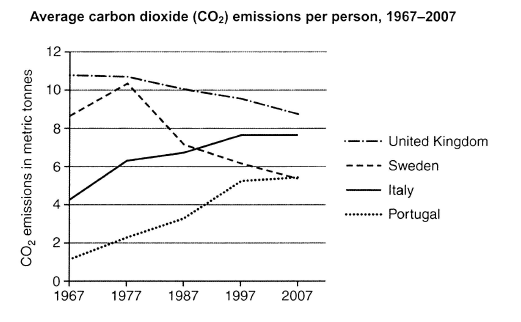
The graph below shows average carbon dioxide (CO2) emissions per person in the United Kingdom, Sweden, Italy and Portugal between 1967 and 2007.
Summarise the information by selecting and reporting the main features, and make comparisons where relevant.
Student answer (Band 4.5)
The graph illustrate about about average carbon dioxide (CO2) emissions per person in the united kingdom , Sweden , Italy and Portugal between 1967 and 2007 .
Overall , it is noticed by the average carbon dioxide emissions per person , 1967 to 2007 . First , The carbon dioxide emissions In Metric tonnes united kingdom is decrease by 11 to 9 . And second , The average carbon dioxide emissions per person, 1967 to 2007 . The carbon dioxide emissions in Metric tonnes in Sweden first is increase 9 to 11 and next decrease 11 to 5 . And third is , The average carbon dioxide emissions per person, 1967 to 2007 . The carbon dioxide emissions in Metric tonnes is Increase in Italy 4 to 8 . And Fourth is , The carbon dioxide CO2 emissions per person , 1967 to 2007 . The carbon dioxide emissions in Metric tonnes is Increase in Portugal 1 to 6 .
In conclusion , The average carbon dioxide CO2 emissions per person in , 1967 to 2007 in Metric tonnes.
AI examiner evaluation
| Criterion | Band |
|---|---|
| Task Achievement / Task Response | 5.0 |
| Coherence and Cohesion | 4.5 |
| Lexical Resource | 4.5 |
| Grammatical Range and Accuracy | 4.5 |
| Overall | 4.5 |
Task Achievement / Task Response: Band 5.0
You identify all four countries and report the broad direction of change for each: UK emissions fall, Sweden rises and then falls, and Italy and Portugal rise. These are relevant main features, and most of the approximate figures are broadly consistent with the graph. However, the response only partially summarises the data: the overview is unclear, and the repeated statements such as “the average carbon dioxide emissions per person, 1967 to 2007” do not explain the main comparisons. Important features are also missed, including the UK remaining the highest throughout and Italy and Portugal ending at similar levels. Give a concise overview, then select and compare the most significant trends rather than repeating the same framing.
Coherence and Cohesion: Band 4.5
The response has a basic sequence, moving through the UK, Sweden, Italy and Portugal, so the reader can identify which country each section concerns. However, there is little overall progression: the opening overview is unclear, and “First,” “And second,” “And third” and “And Fourth” create a mechanical list rather than grouping related trends. Repeated phrases about the period and emissions interrupt the flow, while the conclusion simply restates the topic without summarising a finding. Organise the report into a clear introduction, an overview of the main patterns, and body paragraphs that group countries with similar trends. Use linking and referencing only where they clarify comparisons.
Lexical Resource: Band 4.5
You use relevant topic vocabulary, including “emissions,” “per person,” “increase” and “decrease,” and the country names make the subject clear. However, the vocabulary is limited and highly repetitive, especially the repeated phrase “average carbon dioxide emissions per person.” Several choices and combinations are unnatural, such as “is decrease by 11 to 9” and “first is increase 9 to 11,” which make the trends harder to read smoothly. Capitalisation and spacing are also inconsistent, for example “united kingdom” and “In Metric tonnes.” Use a wider set of accurate trend expressions and collocations, such as “fell from,” “rose to,” “peaked at” and “remained stable,” while avoiding repeated full descriptions of the graph.
Grammatical Range and Accuracy: Band 4.5
The response mainly uses short, simple statements and attempts to describe changes over time, but control of sentence structure and verb forms is weak. Examples include “The graph illustrate” and “is decrease,” where subject–verb agreement and verb form are incorrect, as well as “Sweden first is increase,” which has an awkward and inaccurate structure. Several fragments begin with “And second” or “And third,” and the final sentence, “In conclusion, The average…,” does not form a complete concluding statement. Punctuation and capitalisation also disrupt sentence boundaries. Practise complete sentences using a consistent past-tense pattern, for example, “Emissions in Sweden rose from about 9 tonnes in 1967 to a peak of 10 tonnes in 1977, before falling.”
See this exact question answered at other band scores. The same prompt compared across bands.
Browse more IELTS Writing model answers or get your own writing scored by the same AI examiner.