Band 5.5 IELTS Writing Task 1 Model Answer
Overall Band Score: 5.5 · Cambridge IELTS 11 · 2026-11-11
IELTS Writing Task 1 question
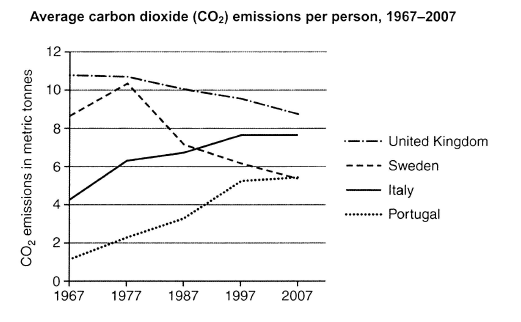
The graph below shows average carbon dioxide (CO2) emissions per person in the United Kingdom, Sweden, Italy and Portugal between 1967 and 2007.
Summarise the information by selecting and reporting the main features, and make comparisons where relevant.
Student answer (Band 5.5)
The graph compares the average carbon dioxide (CO2) emissions in metric tonnes per person in four countries (United Kingdom, Sweden, Italy and Portugal), between 1967 and 2007.
Overall, it is evident that United Kingdom has the highest quantity of carbone emissions over all the period, when Portugal represent the lowest average carbone emissions compares to the other countries.
Firstly, Portugal and Italy have a significant rose in the same trend over all the period from 1 and 4.5 metric tonnes of CO2 emissions in 1967 to 5.5 and 7.5 metric tonnes in 2007.
On the other hand, United Kingdom represent the highest country in carbon emissions with 11 metric tonnes in 1967 and it decrease slowly over the period until 9 metric tonnes in 2007.For Sweden it begin with 8.7 metric tonnes in 1967 and rose to a peak of 10 metric tonnes in 1977, then decreasing until 5 metric tonnes in 2007.
AI examiner evaluation
| Criterion | Band |
|---|---|
| Task Achievement / Task Response | 5.5 |
| Coherence and Cohesion | 5.5 |
| Lexical Resource | 5.0 |
| Grammatical Range and Accuracy | 5.0 |
| Overall | 5.5 |
Task Achievement / Task Response: Band 5.5
You identify the four countries and give a relevant overview: the UK remains highest, while Portugal starts lowest, and you report the broad rise in Italy and Portugal and the fall in the UK and Sweden after its peak. Most figures are close to the chart, though Italy begins at about 4.3 rather than 4.5, a small difference. The account is only partly complete: it does not mention that Italy levels off at around 7.6 from 1997 to 2007, and the overview could better capture Sweden’s sharp rise and subsequent decline. The response is also 144 words, below the required 150; develop the comparisons with a little more precise detail to meet the minimum and make the summary fuller.
Coherence and Cohesion: Band 5.5
The response has a recognisable structure, with an introduction, an overview and two body paragraphs. The contrast signalled by “On the other hand” helps distinguish the UK and Sweden from the rising countries, and the information is generally understandable. However, progression within the body is not always smooth: the first paragraph groups Portugal and Italy, while the next shifts to the UK and Sweden without a clear organising principle or consistent comparison. Some linking is mechanical, and the final paragraph combines two separate country trends in a long sequence. Organise the details into clearer comparisons—for example, rising Italy and Portugal together, then declining UK and Sweden—and use references such as “the former” only when their meaning is unmistakable.
Lexical Resource: Band 5.0
You use relevant task vocabulary, including “average,” “metric tonnes,” “peak,” and “emissions,” so the main subject and trends are clear. However, the range is limited and several word-choice, collocation, word-form and spelling problems make the writing less natural. Examples include “a significant rose,” “represent the lowest average,” “carbone emissions,” and “it decrease slowly.” “Rose” is not the appropriate noun after “a,” and “represent” does not naturally describe a country’s position in the data. Use precise trend language and check spelling and collocations; this will make the comparisons clearer and more fluent without needing overly advanced vocabulary.
Grammatical Range and Accuracy: Band 5.0
You attempt both simple statements and longer sentences, including a time clause in “when Portugal represent the lowest…” and a sequence describing Sweden’s rise and fall. However, the range is limited, and errors recur in basic sentence patterns, sometimes making the reader pause. For example, “United Kingdom has” needs an article, “Portugal represent” has a subject–verb agreement error, and “it decrease slowly” uses the wrong verb form. The sentence beginning “For Sweden it begin…” also needs a comma after the introductory phrase and correct agreement. Practise accurate present-tense reporting, articles with country names where required, and agreement before adding more complex structures. Clearer sentence boundaries would also improve control.
See this exact question answered at other band scores. The same prompt compared across bands.
Browse more IELTS Writing model answers or get your own writing scored by the same AI examiner.