Band 4.0 IELTS Writing Task 1 Model Answer
Overall Band Score: 4.0 · Cambridge IELTS 11 · 2026-11-17
IELTS Writing Task 1 question
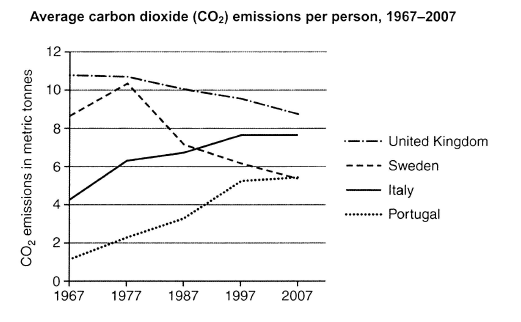
The graph below shows average carbon dioxide (CO2) emissions per person in the United Kingdom, Sweden, Italy and Portugal between 1967 and 2007.
Summarise the information by selecting and reporting the main features, and make comparisons where relevant.
Student answer (Band 4.0)
The graph below shows average carbon dioxide shows per person in the countries .
overview ,moreover it has 4 countries united kingdom,sweden,italy,portugal .
first of all we have to united kingdom which is actually 12 percent is increased in 1967 in the times which is slightly lower to 10 percen in the other country is sweden which 8 percent increased in 10 percent are above slowly interected to united kingdom increased by 12 percent in decreased to touch with portugal in 1967 to 2007 .
in the other hand italy in 1967 which is 2 percent of carbon dioxide passage of time taken increased to 2007 which is 6 percent carbon dioxide in averge emission .
conclusion of per person in 1967 to united kindom has 12 percent low down avergae .sweden has 8 percent increased low down and same with italy.
AI examiner evaluation
| Criterion | Band |
|---|---|
| Task Achievement / Task Response | 3.5 |
| Coherence and Cohesion | 3.5 |
| Lexical Resource | 4.5 |
| Grammatical Range and Accuracy | 4.5 |
| Overall | 4.0 |
Task Achievement / Task Response: Band 3.5
You identify the four countries and attempt to describe changes over time, but the main features are not reported accurately or clearly enough. For example, the UK starts at about 10.8 tonnes and declines to 8.7, rather than being “12 percent” and then falling to 10; Italy rises from about 4.3 to 7.6, not from 2 to 6. The overview is also unclear, and Portugal’s substantial rise and Italy’s eventual position above Sweden are not explained. The response is 142 words, below the required 150. To improve, give a concise overview of the contrasting trends, use tonnes rather than percentages, and select a few accurate comparisons to support it.
Coherence and Cohesion: Band 3.5
There is an attempt to move through the countries and time periods, using phrases such as “first of all,” “in the other hand,” and “conclusion.” However, these signposts do not create a clear progression: the opening repeats the task, the overview is not distinct, and the country descriptions are difficult to follow. The sentence about Sweden, for instance, combines its rise, decline, and comparison with the UK and Portugal without clear relationships. Paragraphing and punctuation are also insufficient to separate the main points. Organise the response into an introduction, a clear overview, and two short detail paragraphs, grouping countries by trend and using linking words only where they clarify the comparison.
Lexical Resource: Band 4.5
You use some relevant topic vocabulary, including “average,” “increased,” “decreased,” and “emission,” so the reader can recognise that the response concerns trends in CO₂. However, word choice and collocation are often inaccurate or repetitive, which makes several descriptions hard to interpret. “Carbon dioxide shows” appears to confuse emissions with the gas itself, while “slowly interected” and “carbon dioxide passage of time” do not express a clear trend. “Percent” is also unsuitable for the chart’s measurements, which are in metric tonnes. Build a small set of accurate trend phrases and use them consistently, such as “emissions per person,” “rose steadily,” and “fell gradually.”
Grammatical Range and Accuracy: Band 4.5
The response attempts both simple statements and longer sentences, but control of sentence structure is inconsistent. Several clauses lack a clear subject or verb relationship, as in “which 8 percent increased in 10 percent,” and the long sentence about the UK and Sweden is difficult to parse. Articles, agreement, and sentence boundaries are also unreliable; for example, “the countries” and “in the other hand” occur in structures that do not form clear, complete sentences. Capitalisation and punctuation further obscure the meaning. Practise writing short, complete sentences first, then combine related ideas with accurate clauses—for example, “UK emissions fell from about 10.8 tonnes in 1967 to 8.7 in 2007.”
See this exact question answered at other band scores. The same prompt compared across bands.
Browse more IELTS Writing model answers or get your own writing scored by the same AI examiner.