Band 5.0 IELTS Writing Task 1 Model Answer
Overall Band Score: 5.0 · Cambridge IELTS 11 · 2026-11-17
IELTS Writing Task 1 question
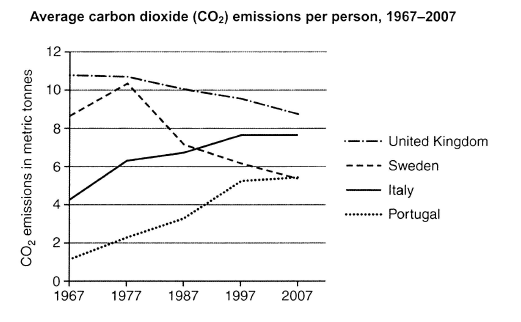
The graph below shows average carbon dioxide (CO2) emissions per person in the United Kingdom, Sweden, Italy and Portugal between 1967 and 2007.
Summarise the information by selecting and reporting the main features, and make comparisons where relevant.
Student answer (Band 5.0)
The graph illustarte average carbon dioxide (CO2) emissions per person in the United Kingdom, Sweden, Italy and Portugal between 1967 and 2007.
Firstly,we can see that, United Kingdom had CO2 emissions metric tonnes between in 10 to 12,which was the highest in 1967. Till 2007 it fell down to near 8 metric tonnes.For Sweden,In 1967 it stands between 8 to 10 metric tonnes of CO2 emissions.Then it was gradually grow till 1977 and fell down to near 6 metric tonnes in 2007,which was the highest CO2 emissions metric tonnes for Portugal.Lastly Italy had arround 4 CO2 emissions metric tonnes and then it was quickly grow near to 6 metric tonnes,after that it was slowly gorw and reached near 8 metric tonnes in 1997 and become stable till 2007.
Overall,we can conclude United Kingdom had highest CO2 emissions in each year.And Portugal had drastic grow in CO2 emissions in between [redacted phone].For Italy, it had drastic change in these years.
AI examiner evaluation
| Criterion | Band |
|---|---|
| Task Achievement / Task Response | 4.5 |
| Coherence and Cohesion | 5.0 |
| Lexical Resource | 5.5 |
| Grammatical Range and Accuracy | 5.0 |
| Overall | 5.0 |
Task Achievement / Task Response: Band 4.5
You identify the four countries and report several broad trends, including the UK’s decline, Sweden’s rise and subsequent fall, and increases in Italy and Portugal. The overview that the UK remained highest is accurate, and you note Portugal’s substantial overall growth. However, the account is incomplete and some comparisons are unclear: for example, Sweden’s 1977 peak is not given, and Italy’s rise to about 6.7 by 1987 is blurred by “quickly grow near to 6.” The claim that Italy had a “drastic change” is too general to explain its pattern. The response also contains 143 words, below the required 150; develop the key comparisons with a few precise figures to meet the task fully.
Coherence and Cohesion: Band 5.0
The response has a basic structure: an introduction, a sequence of country descriptions, and a concluding overview. This gives the reader some organisation, and words such as “Then,” “after that,” and “Overall” signal time or summary. However, progression is not consistently clear because several countries’ trends are combined in long sentences, and the opening “Firstly” does not lead to a clearly organised set of comparisons. Punctuation and spacing also make connections harder to follow, as in “For Sweden,In 1967” and “2007,which.” Group the information into clearer paragraphs—for example, declining trends and rising trends—and use linking phrases accurately rather than relying mainly on basic sequencing words.
Lexical Resource: Band 5.5
You use relevant topic vocabulary, including “emissions,” “metric tonnes,” “gradually,” “stable,” and “highest,” so the main subject is generally understandable. There is some attempt to describe change, but the range is limited and several word choices or forms are inaccurate: “fell down,” “drastic grow,” “quickly grow,” and “slowly gorw” do not express the trends naturally. Spelling errors such as “illustarte,” “arround,” and “gorw” also reduce accuracy. Aim for precise chart language and check spelling and word forms. For example, use “declined” for a fall, “rose sharply” for a rapid increase, and “levelled off” when a figure remained stable.
Grammatical Range and Accuracy: Band 5.0
You attempt both simple statements and longer sentences that connect changes over time, and the reader can usually identify the countries and broad trends. However, control is inconsistent, particularly in verb forms and sentence construction. Examples include “it was gradually grow,” “it was quickly grow,” and “it had drastic change”; these need forms such as “grew gradually,” “rose quickly,” and “changed considerably.” Some clauses are joined without clear punctuation, as in the long description beginning “For Sweden,” which makes the relationships between ideas difficult to follow. Articles and prepositions are also sometimes missing or awkward, as in “between in 10 to 12.” Practise accurate past-tense reporting and divide complex descriptions into complete, clearly punctuated sentences.
See this exact question answered at other band scores. The same prompt compared across bands.
Browse more IELTS Writing model answers or get your own writing scored by the same AI examiner.