Band 5.5 IELTS Writing Task 1 Model Answer
Overall Band Score: 5.5 · Cambridge IELTS 11 · 2026-11-17
IELTS Writing Task 1 question
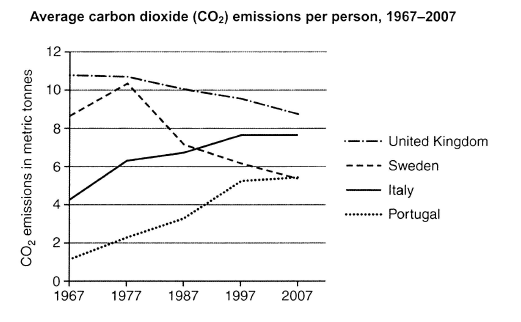
The graph below shows average carbon dioxide (CO2) emissions per person in the United Kingdom, Sweden, Italy and Portugal between 1967 and 2007.
Summarise the information by selecting and reporting the main features, and make comparisons where relevant.
Student answer (Band 5.5)
The line graph illustrates the average Co2 emissions per person in four countries between [redacted phone].
Overall, In United Kingdom and Sweden emission is reducing with the passage of time. While, in other countries is increasing with in period.
In 1967, Unied Kingdom was the largest country which emits carbon dioxide which was 11 tonnes While, sweden had the moderate emission which was 9 tonnes and Italy and Portugal had a lowest emission which is 4 and 1 tonne respectively. In next decade Uk start faceing the downward trend where as, Sweden was at its peak at 10 tonnes. where as, in Italy and Portuges had an increase in emission and reached at 6 and 2 tonnes respectively.
In 1997, UK and Sweden start reducing the carbon emission simultaniously, Italy and Portugal increased its emission 7 and 5 tonnes respectively. Finaly in last year, UK and Sweden emission declined up to 9 and 5 tonnes where as, Italy and Portugal regain stable at last year d.
AI examiner evaluation
| Criterion | Band |
|---|---|
| Task Achievement / Task Response | 6.0 |
| Coherence and Cohesion | 6.0 |
| Lexical Resource | 5.0 |
| Grammatical Range and Accuracy | 5.0 |
| Overall | 5.5 |
Task Achievement / Task Response: Band 6.0
You identify the graph’s subject and cover all four countries across the period, with relevant figures such as the UK’s fall from about 11 to 9 tonnes and Portugal’s rise from about 1 to 5 tonnes. The overview also recognises the broad contrast between declining emissions in the UK and Sweden and increases in Italy and Portugal. However, some key features are incomplete or unclear: Italy’s emissions levelled off at about 7.6 tonnes by 1997–2007, and Portugal continued rising to around 5.4 tonnes rather than simply remaining stable. The claim that the UK and Sweden began declining in 1997 also misses that both had already fallen after their 1977 levels. More precise reporting of these patterns would make the summary fuller and clearer.
Coherence and Cohesion: Band 6.0
The response has a recognisable structure: an introduction, an overview, and paragraphs describing the figures and later changes. This gives the reader a generally coherent route through the information, and time markers such as “In 1967” and “in next decade” help establish chronology. However, the organisation is sometimes mechanical, and comparisons are not consistently grouped by trend or country. Repeated “where as” constructions make relationships harder to follow, while the final sentence ends with the unclear phrase “stable at last year d.” Use clearer paragraphing to separate the overview from detailed comparisons, and connect related trends with more precise referencing. This would make the progression smoother and reduce ambiguity.
Lexical Resource: Band 5.0
You use relevant task vocabulary, including “emissions,” “downward trend,” “peak,” “declined,” and “increased,” so the main trends can generally be understood. However, the range and control are limited by repeated wording and several inaccurate or awkward expressions. For example, “the largest country which emits carbon dioxide” describes the country rather than its per-person emissions, and “regain stable” does not express the intended idea naturally. There are also spelling errors such as “Unied,” “faceing,” “simultaniously,” and “Finaly.” Aim for precise collocations such as “recorded the highest per-capita emissions” and “remained stable,” and check spelling carefully to make the comparisons easier to interpret.
Grammatical Range and Accuracy: Band 5.0
You attempt both simple and more complex sentence forms, including contrasts introduced by “While” and “whereas,” and the overall meaning is usually recoverable. Some grammatical errors remain, particularly in sentence structure, agreement, articles, and punctuation. For instance, “in other countries is increasing” lacks a clear subject, while “Italy and Portugal increased its emission” has a subject–verb agreement problem and an incorrect pronoun. Capitalisation and sentence boundaries are also inconsistent, as in “Overall, In United Kingdom” and the lower-case “where as” after a full stop. Practise forming complete clauses with clear subjects, and check articles and singular/plural agreement. More accurate control of these patterns would make your comparisons clearer.
See this exact question answered at other band scores. The same prompt compared across bands.
Browse more IELTS Writing model answers or get your own writing scored by the same AI examiner.